Thank you for visiting SNEWPapers!
Sign up free
The Port Gibson Correspondent
Port Gibson, Claiborne County, Mississippi
What is this article about?
New Spanish customs regulations for U.S. vessels, requiring detailed cargo manifests via consuls, with strict fines for non-compliance, effective October 16, 1843. Communicated by U.S. Consul at Malaga.
Clipping
OCR Quality
Full Text
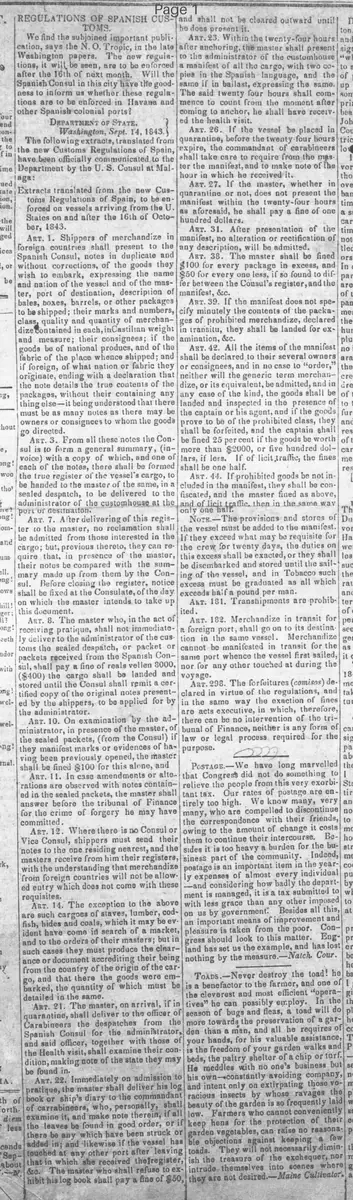
We find the subjoined important publication, says the N. O. Tropic, in the late Washington papers. The new regulations, it will be seen, are to be enforced after the 16th of next month. Will the Spanish Consul in this city have the goodness to inform us whether these regulations are to be enforced in Havana and other Spanish colonial ports?
DEPARTMENT OF STATE,
Washington, Sept. 14, 1843.
The following extracts, translated from the new Customs Regulations of Spain, have been officially communicated to the Department by the U. S. Consul at Malaga:
Extracts translated from the new Customs Regulations of Spain, to be enforced on vessels arriving from the U. States on and after the 16th of October, 1843.
Art. I. Shippers of merchandize in foreign countries shall present to the Spanish Consul, notes in duplicate and without corrections, of the goods they wish to embark, expressing the name and nation of the vessel and of the master, port of destination, description of bales, boxes, barrels, or other packages to be shipped; their marks and numbers, class, quality and quantity of merchandize contained in each, in Castilian weight and measure; their consignees; if the goods be of national produce, and of the fabric of the place whence shipped; and if foreign, of what nation or fabric they originate, ending with a declaration that the note details the true contents of the packages, without their containing any thing else—it being understood that there must be as many notes as there may be owners or consignees to whom the goods go directed.
Art. 3. From all these notes the Consul is to form a general summary, (invoice) with a copy of which, and one of each of the notes, there shall be formed the true register of the vessel's cargo, to be handed to the master of the same, in a sealed despatch, to be delivered to the administrator of the customhouse at the port of destination.
Art. 7. After delivering of this register to the master, no reclamation shall be admitted from those interested in the cargo; but, previous thereto, they can require that, in presence of the master, their notes be compared with the summary made up from them by the Consul. Before closing the register, notice shall be fixed at the Consulate, of the day on which the master intends to take up this document.
Art. 8. The master who, in the act of receiving pratique, shall not immediately deliver to the administrator of the customs the sealed despatch, or packet or packets received from the Spanish Consul, shall pay a fine of 8000 reals vellon ($400) the cargo shall be landed and stored until the Consul shall remit a certified copy of the original notes presented by the shippers, to be applied for by the administrator.
Art. 10. On examination by the administrator, in presence of the master, of the sealed packets (from the Consul) if they manifest marks or evidences of having been previously opened, the master shall be fined 100 for this alone, and
Art. 11. In case amendments or alterations are observed with notes contained in the sealed packets, the master shall answer before the tribunal of Finance for the crime of forgery he may have committed.
Art. 12. Where there is no Consul or Vice Consul, shippers must send their notes to the one residing nearest, and the masters receive from him their registers, with the understanding that merchandize from foreign countries will not be allowed entry which does not come with these requisites.
Art. 14. The exception to the above are such cargoes of staves, lumber, cod-fish, hides and coals, which it may be evident have come in search of a market, and to the orders of their masters: but in such cases they must produce the clearance or document accrediting their being from the country of the origin of the cargo, and that there the goods were embarked, the quantity of which must be detailed in the same.
Art. 21. The master, on arrival, if in quarantine, shall deliver to the officer of Carabineers the despatches from the Spanish Consul or the administrator, and said officer, together with those of the Health visit, shall examine their condition, making note of the state they may be found in.
Art. 22. Immediately on admission to pratique, the master shall deliver his log book or ship's diary to the commandant of carabineers, who, personally, shall examine it, and make note therein, if all the leaves be found in good order, or if there be any which have been struck or added in; and likewise if the vessel has touched at any other port after leaving that in which she received the register, &c. The master who shall refuse to exhibit his log book shall pay a fine of $50.
and shall not be cleared outward until he does present it.
Art. 23. Within the twenty-four hours after anchoring, the master shall present to the administrator of the customhouse a manifest of all the cargo, with two copies in the Spanish language, and the same if in ballast, expressing the same.
The said twenty-four hours shall commence to count from the moment after coming to anchor, he shall have received the health visit.
Art. 26. If the vessel be placed in quarantine, before the twenty four hours expire, the commandant of carabineers shall take care to require from the master the manifest, and to make note of the hour in which he received it.
Art. 27. If the master, whether in quarantine or not, does not present the manifest within the twenty-four hours as aforesaid, he shall pay a fine of one hundred dollars.
Art. 31. After presentation of the manifest, no alteration or rectification of any description, will be admitted.
Art. 38. The master shall be fined $100 for every package in excess, and $50 for every one less, if so found to differ between the Consul's register, and the manifest, &c.
Art. 39. If the manifest does not specify minutely the contents of the packages of prohibited merchandize, declared in transitu, they shall be landed for examination, &c.
Art. 42. All the items of the manifest shall be declared to their several owners or consignees, and in no case to "order," neither will the generic term merchandize, or its equivalent, be admitted, and in any case of the kind, the goods shall be landed and inspected in the presence of the captain or his agent, and if the goods prove to be of the prohibited class, they shall be forfeited, and the captain shall be fined 25 per cent if the goods be worth more than $2000, or five hundred dollars, if less. If of licit traffic, the fines shall be one half.
Art. 44. If prohibited goods be not included in the manifest, they shall be confiscated, and the master fined as above, and of licit traffic, then in the same way only one half.
Note.—The provisions and stores of the vessel must be added to the manifest. If they exceed what may be requisite for the crew for twenty days, the duties on this excess shall be exacted, or they shall be disembarked and stored until the sailing of the vessel, and in Tobacco such excess must be graduated as all which exceeds half a pound per man.
Art. 181. Transhipments are prohibited.
Art. 182. Merchandize in transit for a foreign port, shall go on to its destination in the same vessel. Merchandize cannot be manifested in transit for the same port whence the vessel first sailed, nor for any other touched at during the voyage.
Art. 298. The forfeitures (comisos) declared in virtue of the regulations, and in the same way the exaction of fines are acts executive, in which, therefore, there can be no intervention of the tribunal of Finance, neither is any form of law or legal process required for the purpose.
What sub-type of article is it?
What keywords are associated?
Where did it happen?
Foreign News Details
Primary Location
Spain
Event Date
On And After The 16th Of October, 1843
Outcome
new regulations impose detailed documentation requirements, fines up to $400 for non-delivery of registers, $100 for tampering, confiscation of prohibited goods, and other penalties for discrepancies in manifests and cargo.
Event Details
Extracts from new Spanish Customs Regulations detail procedures for shippers to provide duplicate notes to consuls describing cargo, formation of cargo registers, delivery to masters in sealed dispatches, requirements for manifests in Spanish upon arrival, prohibitions on transhipments and alterations, exceptions for certain bulk cargoes, and executive enforcement of fines and forfeitures without judicial process.