Thank you for visiting SNEWPapers!
Sign up free
Literary
April 23, 1892
The Grenada Sentinel
Grenada, Grenada County, Mississippi
What is this article about?
An Easter sermon portraying death as a divine mercy that clears space for new generations and improved existence, incorporating an allegory of a poor woman named Misery who traps Death in her pear tree, preventing global death until released on condition. It celebrates Christ's resurrection and anticipates personal glorification.
Clipping
OCR Quality
75%
Good
Full Text
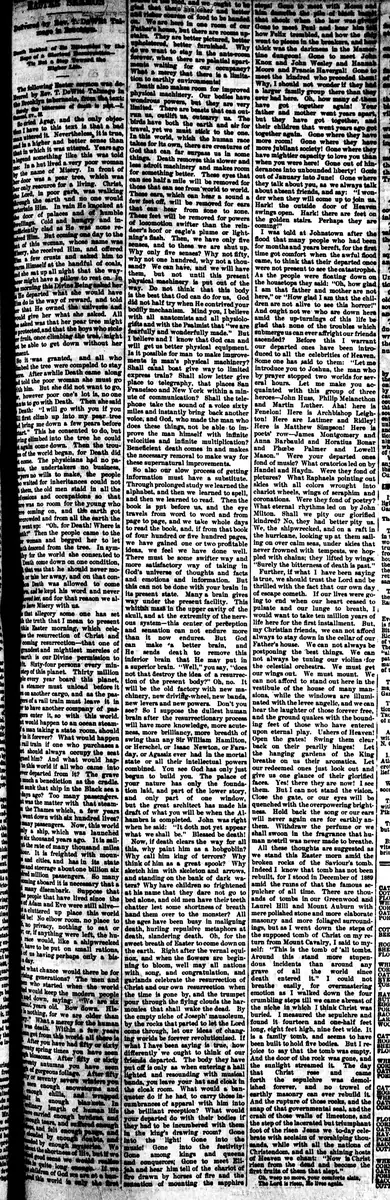
So cried Agag, and the only objection I have to this text is that a bedpan uttered it. Nevertheless it is true, and in a higher and better sense than Agag, something like this was told in which it was uttered. Years ago, in a hut lived a very poor woman by the name of Misery. In front of her door was a pear tree, which was her only resource for a living. Christ, the Lord, in poor garb, was walking through the earth and no one would entertain Him. In vain He knocked at the door of palaces and of humble dwellings. Cold and hungry and insufficiently clad as He was, none received Him. But coming one day to the hut of this woman, whose name was Misery, she received Him, and offered Him a few crusts and asked him to warm Himself at the handful of coals, and she sat up all night that the wayfarer might have a pillow to rest on. In the morning this Divine Being asked her in doing the way of reward, and told her that He owned the universe and could give her what she asked. All she asked was that her pear tree might be protected, and that the boys who stole her fruit, once climbing the tree, might not be able to get down without her consent. So it was granted, and all who climbed the tree were compelled to stay there. After awhile Death came along and told the poor woman she must go with him. But she did not want to go, for however poor one's lot is, no one wants to go with Death. Then she said to Death: "I will go with you if you will first climb up into my pear tree and bring me down a few pears before we start." This he consented to do, but having climbed into the tree he could not again come down. Then the troubles of the world began, for Death did not come. The physicians had no patients, the undertakers no business. Lawyers no wills to make, the people who waited for inheritances could not get them, the old men stayed in all the positions and occupations so that there was no room for the young who were coming on, and the earth got overcrowded and from all the earth the cry went up: "Oh, for Death! Where is he?" Then the people came to the woman and begged her to let him descend from the tree. In sympathy for the world she consented to let Death come down on one condition, and that was that he should never molest or take her away, and on that condition Death was allowed to come down and he kept his word and never molested her, and for that reason we all share Misery with us.
That allegory someone has set forth the truth that I mean to present this Easter morning, which celebrates the resurrection of Christ and our coming resurrection-that one of grandest and mightiest mercies of God is our Divine permission to quit. Sixty-four persons every minute step off this planet. Thirty million people every year board this planet, and as a steamer must unload before it takes on another cargo, and as the passengers of a rail train must leave it in order to have another company of passengers enter it, so with this world. What would happen to an ocean steamer if a man taking a state room should stay in it forever? What would happen to a mail train if one who purchases a ticket should always occupy the seat assigned him? And what would happen to this world if all who came into it never departed from it? The grave is as much a benediction as the cradle.
What sunk that ship in the Black Sea a few days ago? Too many passengers. What was the matter with that steamer in the Thames which, a few years ago, went down with six hundred lives? Too many passengers. Now, this world is only a ship, which was launched six thousand years ago. It is mailed at the rate of many thousand miles an hour. It is freighted with mountains and cities, and has in its state rooms and steerage about one billion six hundred million passengers. So many coming aboard it is necessary that as many disembark. Suppose that the people that have lived since the days of Adam and Eve were still alive-how cluttered up place this world would be! No elbow room, no place to live, or, if anything were left, the human race would, like a shipwrecked crew, have to be put on small rations; most of us having perhaps only a biscuit a day. What chance would there be for rising generations? The men and women who started when the world started would keep the modern people down, saying: "We are six thousand years old. Bow down. This is nothing, for we are older than you." What a mercy for the human race was death. Within few years get from this world all those in it. After you have had fifty or sixty spring times you have had enough blossoms. After fifty or sixty autumns you have had enough of gorgeous foliage. After fifty seventy summers you have had enough snowstorms and enough chilblains and enough wintry winds and enough mufflers. In length of human life enough by daylight; and enough torch, and suffered enough pangs, and dozed by enough somnambulisms and aided by enough anodyne. We mourn the shortness of life, but if we could most crowded world in quite long. It. Paul did not want our world crowded food to be his whereabouts in one room of our but there are rooms up there they are better pictured, better furnished. Why want to stay in the ante-room, when there are palatial apartments waiting for our occupancy? What a mercy that there is a limitation to earthly environments!
Death also makes room for improved physical machinery. Our bodies have wondrous powers, but they are very limited. There are beasts that can outrun us, outlift us, outcarry us. The birds have both the earth and air for travel, yet we must stick to the one. In this world, which the human race takes for its own, there are creatures of God that can far surpass us in some things. Death removes this slower and less adroit machinery and makes room for something better. These eyes that can see half a mile will be removed for those that can see from world to world. These ears, which can hear a sound a few feet off, will be removed for ears that can hear from zone to zone. These feet will be removed for powers of locomotion swifter than the reindeer's hoof or eagle's plume or lightning's flash. Then, we have only five senses, and to these we are shut up. Why only five senses? Why not fifty, why not one hundred, why not a thousand? We can have, and we will have them, but not until this present physical machinery is put out of the way. Do not think that this body is the best that God can do for us, God did not half try when He contrived your bodily mechanism. Mind you, I believe with all anatomists and all physiologists and with the Psalmist that "we are fearfully and wonderfully made." But I believe and I know that God can and will get us better physical equipment. Is it possible for man to make improvements in man's physical machinery? Shall canal boat give way to limited express train? Shall slow letter give place to telegraphy, that places San Francisco and New York within a minute of communication? Shall the telephone take the sound of a voice sixty miles and instantly bring back another voice, and God, who made the man who does these things, not be able to improve the man himself with infinite velocities and infinite multiplication? Beneficent death comes in and makes the necessary removal to make way for these supernatural improvements.
So also our slow process of getting information must have a substitute. Through prolonged study we learned the alphabet, and then we learned to spell, and then we learned to read. Then the book is put before us, and the eye travels from word to word and from page to page, and we take whole days to read the book, and, if from that book of four hundred or five hundred pages, we have gained one or two profitable ideas, we feel we have done well. There must be some swifter way and more satisfactory way of taking in God's universe of thoughts and facts and emotions and information. But this can not be done with your brain in its present state. Many a brain gives way under the present facility. This whitish mass in the upper cavity of the skull, and at the extremity of the nervous system-this center of perception and sensation can not endure more than it now endures. But God can make a better brain, and He sends death to remove this inferior brain that He may put in a superior brain. "Well," you say, "does not that destroy the idea of a resurrection of the present body?" Oh, no. It will be the old factory with new machinery, new driving-wheel, new bands, new levers and new powers. Don't you see? So I suppose the dullest human brain after the resurrectionary process will have more knowledge, more acuteness, more brilliancy, more breadth of swing than any Sir William Hamilton, or Herschel, or Isaac Newton, or Faraday, or Agassiz ever had in the mortal state or all their intellectual powers combined. You see God has only just begun to build you. The palace of your nature has only the foundation laid, and part of the lower story, and only part of one window, but the great architect has made his draft of what you will be when the Alhambra is completed. John was right when he said: "It doth not yet appear what we shall be."
Blessed be death! Now, if death clears the way for all this, why paint him as a hobgoblin? Why call him king of terrors? Why think of him as a great spook? Why sketch him with skeleton and arrows, and standing on the bank of dark waters? Why have children so frightened at his name that they dare not go to bed alone, and old men have their teeth chatter lest some shortness of breath hand them over to the monster? All the ages have been busy in maligning death, hurling repulsive metaphors at death, slandering death. Oh, for the sweet breath of Easter to come down on the earth. Right after the vernal equinox, and when the flowers are beginning to bloom, well may all nations with song, and congratulation, and garlands celebrate the resurrection of Christ and our own resurrection when the time is gone by, and the trumpet pour through the flying clouds the harmonies that shall wake the dead. By the empty niche of Joseph's mausoleum, by the rocks that parted to let the Lord come through, let our ideas of changing worlds be forever revolutionized.
If what I have been saying is true, how differently we ought to think of our friends departed. The body they have put off is only as when entering a hall lighted and resounding with musical bands, you leave your hat and cloak in the cloak room. What would a banqueter do if he had to carry those incumbrances of apparel with him into the brilliant reception? What would your departed do with their bodies if they had to be incumbered with them in the king's drawing room? Gone into the light! Gone into the music! Gone into the festivity! Gone among kings and queens and conquerors! Gone to meet Elijah and hear him tell of the chariot of fire drawn by horses of fire and the sensation of mounting the sapphire sky. Gone to meet Paul and hear him tell how Felix trembled, and how the mention thick was the darkness in the Roman dungeon. Gone to meet John Knox and John Wesley and Fanny Crosby and Francis Havergal! Gone to meet the kindred who preceded them! Why, I should not wonder if they have a larger family group there than they ever had here. Oh, how many of them have got together again! Father and mother went years ago but they have got together, their children that went years ago got together again. Gone where they have more room! Gone where they have more jubilant society! Gone where they have mightier capacity to love you than when you were here! Gone out of hindrances into unbounded liberty! Gone out of January into June! Gone where they talk about you, as we always talk about absent friends, and say: "I wonder when they will come up to join us. Hark! the outside door of Heaven swings open. Hark! there are feet on the golden stairs. Perhaps they are coming!"
I was told at Johnstown after the flood that many people who had been for months and years bereft, for the first time got comfort when the awful flood came, to think that their departed ones were not present to see the catastrophe. As the people were floating down on the housetops they said: "Oh, how glad I am that father and mother are not here," or "How glad I am that the children are not alive to see this horror!" And ought not we who are down here amid the up-turnings of this life be glad that none of the troubles which submerge us can ever affright our friends ascended? Before this I warrant our departed ones have been introduced to all the celebrities of Heaven. Some one has said to them: "Let me introduce you to Joshua, the man who by prayer stopped two worlds for several hours. Let me make you acquainted with this group of three heroes-John Huss, Philip Melancthon and Martin Luther. Aha! here is Fenelon! Here is Archbishop Leighton! Here are Latimer and Ridley! Here is Matthew Simpson! Here is poets' row-James Montgomery and Anna Barbauld and Horatius Bonar and Phoebe Palmer and Lowell Mason." Were your departed ones fond of music? What oratorios led on by Handel and Haydn. Were they fond of pictures? What Raphaels pointing out skies with all colors wrought into chariot wheels, wings of seraphim and coronations. Were they fond of poetry? What eternal rhythms led on by John Milton. Shall we pity our glorified kindred? No, they had better pity us. We, the shipwrecked, and on a raft in the hurricane, looking up at them sailing on over calm seas, under skies that never frowned with tempests, we hobbled with chains; they lifted by wings: "Surely the bitterness of death is past."
Further, if what I have been saying is true, we should trust the Lord and be thrilled with the fact that our own day of escape cometh. If our lives were going to end when our heart ceased to pulsate and our lungs to breathe, I would want to take ten million years of life here for the first installment. But, my Christian friends, we can not afford always to stay down in the cellar of our Father's house. We can not always be postponing the best things. We can not always be tuning our violins for the celestial orchestra. We must get our wings out. We must mount. We can not afford to stand out here in the vestibule of the house of many mansions, while the windows are illuminated with the levee angelic, and we can hear the laughter of those forever free, and the ground quakes with the bounding feet of those who have entered upon eternal play. Ushers of Heaven! Open the gates! Swing them clear back on their pearly hinges! Let the hanging gardens of the King breathe on us their aromatics. Let our redeemed ones just look out and give us one glance of their glorified faces. Yes! there they are now! I see them. But I can not stand the vision. Close the gate, or our eyes will be quenched with the overpowering brightness. Hold back the song or our ears will never again care for earthly anthem. Withdraw the perfume or we shall swoon in the fragrance that human nostril was never made to breathe.
All these thoughts are suggested as we stand this Easter morn amid the broken rocks of the Saviour's tomb. Indeed I know that tomb has not been rebuilt, for I stood in December of 1889 amid the ruins of that the famous sepulcher of all time. There are thousands of tombs in our Greenwood and Laurel Hill and Mount Auburn with more polished stone and more elaborate masonry and more foliaged surroundings, but as I went down the steps of the supposed tomb of Christ on my return from Mount Calvary, I said to myself: "This is the tomb of all tombs. Around this stand more stupendous incidents than around any grave of all the world since death entered it." I could not breathe easily, for overmastering emotion as I walked down the four crumbling steps till we came abreast of the niche in which I think Christ was buried. I measured the sepulchre and found it fourteen and one-half feet long, eight feet high, nine feet wide. It is a family tomb, and seems to have been built to hold five bodies. But I rejoice to say that the tomb was empty. And the door of the rock was gone, and the sunlight streamed in. The day that Christ rose and came forth the sepulchre was demolished forever, and no trowel of earthly masonry can ever rebuild it. And the rupture of those rocks, and the snap of that governmental seal, and the crash of those walls of limestone, and the step of the lacerated but triumphant foot of the risen Jesus we to-day celebrate with acclaim of worshiping thousands, while with all the nations of Christendom, and all the shining hosts of Heaven we chant: "Now Christ is risen from the dead and become the first fruits of them that slept."
Oh, weep no more, your comforts slain, The Lord is risen, He lives again.
That allegory someone has set forth the truth that I mean to present this Easter morning, which celebrates the resurrection of Christ and our coming resurrection-that one of grandest and mightiest mercies of God is our Divine permission to quit. Sixty-four persons every minute step off this planet. Thirty million people every year board this planet, and as a steamer must unload before it takes on another cargo, and as the passengers of a rail train must leave it in order to have another company of passengers enter it, so with this world. What would happen to an ocean steamer if a man taking a state room should stay in it forever? What would happen to a mail train if one who purchases a ticket should always occupy the seat assigned him? And what would happen to this world if all who came into it never departed from it? The grave is as much a benediction as the cradle.
What sunk that ship in the Black Sea a few days ago? Too many passengers. What was the matter with that steamer in the Thames which, a few years ago, went down with six hundred lives? Too many passengers. Now, this world is only a ship, which was launched six thousand years ago. It is mailed at the rate of many thousand miles an hour. It is freighted with mountains and cities, and has in its state rooms and steerage about one billion six hundred million passengers. So many coming aboard it is necessary that as many disembark. Suppose that the people that have lived since the days of Adam and Eve were still alive-how cluttered up place this world would be! No elbow room, no place to live, or, if anything were left, the human race would, like a shipwrecked crew, have to be put on small rations; most of us having perhaps only a biscuit a day. What chance would there be for rising generations? The men and women who started when the world started would keep the modern people down, saying: "We are six thousand years old. Bow down. This is nothing, for we are older than you." What a mercy for the human race was death. Within few years get from this world all those in it. After you have had fifty or sixty spring times you have had enough blossoms. After fifty or sixty autumns you have had enough of gorgeous foliage. After fifty seventy summers you have had enough snowstorms and enough chilblains and enough wintry winds and enough mufflers. In length of human life enough by daylight; and enough torch, and suffered enough pangs, and dozed by enough somnambulisms and aided by enough anodyne. We mourn the shortness of life, but if we could most crowded world in quite long. It. Paul did not want our world crowded food to be his whereabouts in one room of our but there are rooms up there they are better pictured, better furnished. Why want to stay in the ante-room, when there are palatial apartments waiting for our occupancy? What a mercy that there is a limitation to earthly environments!
Death also makes room for improved physical machinery. Our bodies have wondrous powers, but they are very limited. There are beasts that can outrun us, outlift us, outcarry us. The birds have both the earth and air for travel, yet we must stick to the one. In this world, which the human race takes for its own, there are creatures of God that can far surpass us in some things. Death removes this slower and less adroit machinery and makes room for something better. These eyes that can see half a mile will be removed for those that can see from world to world. These ears, which can hear a sound a few feet off, will be removed for ears that can hear from zone to zone. These feet will be removed for powers of locomotion swifter than the reindeer's hoof or eagle's plume or lightning's flash. Then, we have only five senses, and to these we are shut up. Why only five senses? Why not fifty, why not one hundred, why not a thousand? We can have, and we will have them, but not until this present physical machinery is put out of the way. Do not think that this body is the best that God can do for us, God did not half try when He contrived your bodily mechanism. Mind you, I believe with all anatomists and all physiologists and with the Psalmist that "we are fearfully and wonderfully made." But I believe and I know that God can and will get us better physical equipment. Is it possible for man to make improvements in man's physical machinery? Shall canal boat give way to limited express train? Shall slow letter give place to telegraphy, that places San Francisco and New York within a minute of communication? Shall the telephone take the sound of a voice sixty miles and instantly bring back another voice, and God, who made the man who does these things, not be able to improve the man himself with infinite velocities and infinite multiplication? Beneficent death comes in and makes the necessary removal to make way for these supernatural improvements.
So also our slow process of getting information must have a substitute. Through prolonged study we learned the alphabet, and then we learned to spell, and then we learned to read. Then the book is put before us, and the eye travels from word to word and from page to page, and we take whole days to read the book, and, if from that book of four hundred or five hundred pages, we have gained one or two profitable ideas, we feel we have done well. There must be some swifter way and more satisfactory way of taking in God's universe of thoughts and facts and emotions and information. But this can not be done with your brain in its present state. Many a brain gives way under the present facility. This whitish mass in the upper cavity of the skull, and at the extremity of the nervous system-this center of perception and sensation can not endure more than it now endures. But God can make a better brain, and He sends death to remove this inferior brain that He may put in a superior brain. "Well," you say, "does not that destroy the idea of a resurrection of the present body?" Oh, no. It will be the old factory with new machinery, new driving-wheel, new bands, new levers and new powers. Don't you see? So I suppose the dullest human brain after the resurrectionary process will have more knowledge, more acuteness, more brilliancy, more breadth of swing than any Sir William Hamilton, or Herschel, or Isaac Newton, or Faraday, or Agassiz ever had in the mortal state or all their intellectual powers combined. You see God has only just begun to build you. The palace of your nature has only the foundation laid, and part of the lower story, and only part of one window, but the great architect has made his draft of what you will be when the Alhambra is completed. John was right when he said: "It doth not yet appear what we shall be."
Blessed be death! Now, if death clears the way for all this, why paint him as a hobgoblin? Why call him king of terrors? Why think of him as a great spook? Why sketch him with skeleton and arrows, and standing on the bank of dark waters? Why have children so frightened at his name that they dare not go to bed alone, and old men have their teeth chatter lest some shortness of breath hand them over to the monster? All the ages have been busy in maligning death, hurling repulsive metaphors at death, slandering death. Oh, for the sweet breath of Easter to come down on the earth. Right after the vernal equinox, and when the flowers are beginning to bloom, well may all nations with song, and congratulation, and garlands celebrate the resurrection of Christ and our own resurrection when the time is gone by, and the trumpet pour through the flying clouds the harmonies that shall wake the dead. By the empty niche of Joseph's mausoleum, by the rocks that parted to let the Lord come through, let our ideas of changing worlds be forever revolutionized.
If what I have been saying is true, how differently we ought to think of our friends departed. The body they have put off is only as when entering a hall lighted and resounding with musical bands, you leave your hat and cloak in the cloak room. What would a banqueter do if he had to carry those incumbrances of apparel with him into the brilliant reception? What would your departed do with their bodies if they had to be incumbered with them in the king's drawing room? Gone into the light! Gone into the music! Gone into the festivity! Gone among kings and queens and conquerors! Gone to meet Elijah and hear him tell of the chariot of fire drawn by horses of fire and the sensation of mounting the sapphire sky. Gone to meet Paul and hear him tell how Felix trembled, and how the mention thick was the darkness in the Roman dungeon. Gone to meet John Knox and John Wesley and Fanny Crosby and Francis Havergal! Gone to meet the kindred who preceded them! Why, I should not wonder if they have a larger family group there than they ever had here. Oh, how many of them have got together again! Father and mother went years ago but they have got together, their children that went years ago got together again. Gone where they have more room! Gone where they have more jubilant society! Gone where they have mightier capacity to love you than when you were here! Gone out of hindrances into unbounded liberty! Gone out of January into June! Gone where they talk about you, as we always talk about absent friends, and say: "I wonder when they will come up to join us. Hark! the outside door of Heaven swings open. Hark! there are feet on the golden stairs. Perhaps they are coming!"
I was told at Johnstown after the flood that many people who had been for months and years bereft, for the first time got comfort when the awful flood came, to think that their departed ones were not present to see the catastrophe. As the people were floating down on the housetops they said: "Oh, how glad I am that father and mother are not here," or "How glad I am that the children are not alive to see this horror!" And ought not we who are down here amid the up-turnings of this life be glad that none of the troubles which submerge us can ever affright our friends ascended? Before this I warrant our departed ones have been introduced to all the celebrities of Heaven. Some one has said to them: "Let me introduce you to Joshua, the man who by prayer stopped two worlds for several hours. Let me make you acquainted with this group of three heroes-John Huss, Philip Melancthon and Martin Luther. Aha! here is Fenelon! Here is Archbishop Leighton! Here are Latimer and Ridley! Here is Matthew Simpson! Here is poets' row-James Montgomery and Anna Barbauld and Horatius Bonar and Phoebe Palmer and Lowell Mason." Were your departed ones fond of music? What oratorios led on by Handel and Haydn. Were they fond of pictures? What Raphaels pointing out skies with all colors wrought into chariot wheels, wings of seraphim and coronations. Were they fond of poetry? What eternal rhythms led on by John Milton. Shall we pity our glorified kindred? No, they had better pity us. We, the shipwrecked, and on a raft in the hurricane, looking up at them sailing on over calm seas, under skies that never frowned with tempests, we hobbled with chains; they lifted by wings: "Surely the bitterness of death is past."
Further, if what I have been saying is true, we should trust the Lord and be thrilled with the fact that our own day of escape cometh. If our lives were going to end when our heart ceased to pulsate and our lungs to breathe, I would want to take ten million years of life here for the first installment. But, my Christian friends, we can not afford always to stay down in the cellar of our Father's house. We can not always be postponing the best things. We can not always be tuning our violins for the celestial orchestra. We must get our wings out. We must mount. We can not afford to stand out here in the vestibule of the house of many mansions, while the windows are illuminated with the levee angelic, and we can hear the laughter of those forever free, and the ground quakes with the bounding feet of those who have entered upon eternal play. Ushers of Heaven! Open the gates! Swing them clear back on their pearly hinges! Let the hanging gardens of the King breathe on us their aromatics. Let our redeemed ones just look out and give us one glance of their glorified faces. Yes! there they are now! I see them. But I can not stand the vision. Close the gate, or our eyes will be quenched with the overpowering brightness. Hold back the song or our ears will never again care for earthly anthem. Withdraw the perfume or we shall swoon in the fragrance that human nostril was never made to breathe.
All these thoughts are suggested as we stand this Easter morn amid the broken rocks of the Saviour's tomb. Indeed I know that tomb has not been rebuilt, for I stood in December of 1889 amid the ruins of that the famous sepulcher of all time. There are thousands of tombs in our Greenwood and Laurel Hill and Mount Auburn with more polished stone and more elaborate masonry and more foliaged surroundings, but as I went down the steps of the supposed tomb of Christ on my return from Mount Calvary, I said to myself: "This is the tomb of all tombs. Around this stand more stupendous incidents than around any grave of all the world since death entered it." I could not breathe easily, for overmastering emotion as I walked down the four crumbling steps till we came abreast of the niche in which I think Christ was buried. I measured the sepulchre and found it fourteen and one-half feet long, eight feet high, nine feet wide. It is a family tomb, and seems to have been built to hold five bodies. But I rejoice to say that the tomb was empty. And the door of the rock was gone, and the sunlight streamed in. The day that Christ rose and came forth the sepulchre was demolished forever, and no trowel of earthly masonry can ever rebuild it. And the rupture of those rocks, and the snap of that governmental seal, and the crash of those walls of limestone, and the step of the lacerated but triumphant foot of the risen Jesus we to-day celebrate with acclaim of worshiping thousands, while with all the nations of Christendom, and all the shining hosts of Heaven we chant: "Now Christ is risen from the dead and become the first fruits of them that slept."
Oh, weep no more, your comforts slain, The Lord is risen, He lives again.
What sub-type of article is it?
Essay
Allegory
Prose Fiction
What themes does it cover?
Religious
Death Mortality
Moral Virtue
What keywords are associated?
Easter Sermon
Resurrection
Death Mercy
Misery Allegory
Pear Tree
Christian Eschatology
Physical Improvement
Heavenly Reunion
Literary Details
Subject
Easter Sermon On The Resurrection Of Christ And The Mercy Of Death
Form / Style
Sermonic Essay Incorporating A Folk Allegory
Key Lines
So Cried Agag, And The Only Objection I Have To This Text Is That A Bedpan Uttered It.
That Allegory Someone Has Set Forth The Truth That I Mean To Present This Easter Morning, Which Celebrates The Resurrection Of Christ And Our Coming Resurrection That One Of Grandest And Mightiest Mercies Of God Is Our Divine Permission To Quit.
Blessed Be Death!
Gone Into The Light! Gone Into The Music! Gone Into The Festivity!
Now Christ Is Risen From The Dead And Become The First Fruits Of Them That Slept.