Thank you for visiting SNEWPapers!
Sign up free
The Nome Nugget
Nome, Nome County, Alaska
What is this article about?
In a closed Senate Naval Affairs committee session, a debate nearly derailed a bill for unlimited Navy blimps for anti-submarine patrolling. Secretary Knox and air experts supported it, but 'brasshats' opposed via an amendment by Sen. Gillette, citing anonymous officers. Air officers refuted claims, leading to a 3-3 tie defeating the amendment.
Clipping
OCR Quality
Full Text
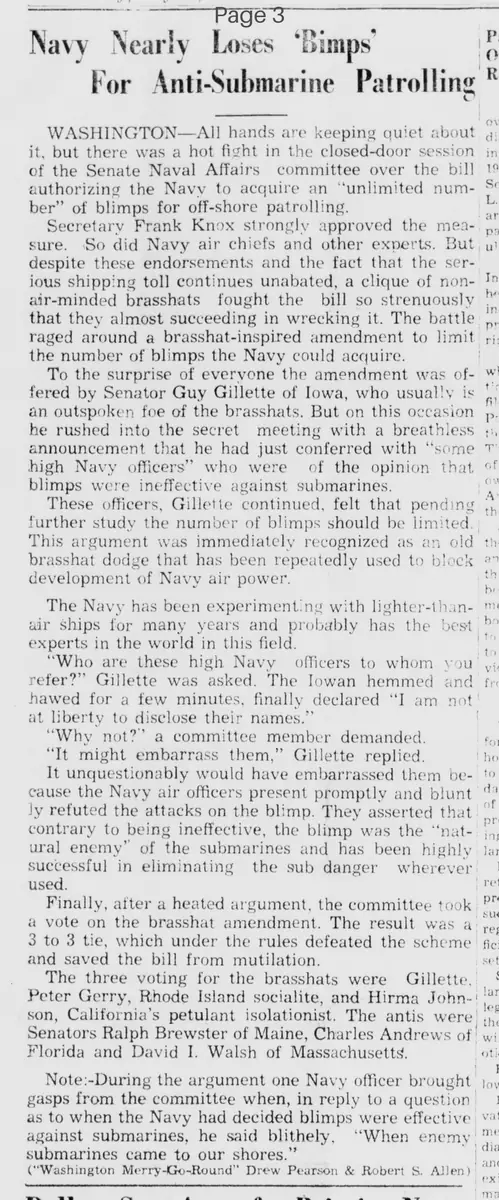
For Anti-Submarine Patrolling
WASHINGTON—All hands are keeping quiet about it, but there was a hot fight in the closed-door session of the Senate Naval Affairs committee over the bill authorizing the Navy to acquire an "unlimited number" of blimps for off-shore patrolling.
Secretary Frank Knox strongly approved the measure. So did Navy air chiefs and other experts. But despite these endorsements and the fact that the serious shipping toll continues unabated, a clique of non-air-minded brasshats fought the bill so strenuously that they almost succeeded in wrecking it. The battle raged around a brasshat-inspired amendment to limit the number of blimps the Navy could acquire.
To the surprise of everyone the amendment was offered by Senator Guy Gillette of Iowa, who usually is an outspoken foe of the brasshats. But on this occasion he rushed into the secret meeting with a breathless announcement that he had just conferred with "some high Navy officers" who were of the opinion that blimps were ineffective against submarines.
These officers, Gillette continued, felt that pending further study the number of blimps should be limited. This argument was immediately recognized as an old brasshat dodge that has been repeatedly used to block development of Navy air power.
The Navy has been experimenting with lighter-than-air ships for many years and probably has the best experts in the world in this field.
"Who are these high Navy officers to whom you refer?" Gillette was asked. The Iowan hemmed and hawed for a few minutes, finally declared "I am not at liberty to disclose their names."
"Why not?" a committee member demanded.
"It might embarrass them," Gillette replied.
It unquestionably would have embarrassed them because the Navy air officers present promptly and bluntly refuted the attacks on the blimp. They asserted that contrary to being ineffective, the blimp was the "natural enemy" of the submarines and has been highly successful in eliminating the sub danger wherever used.
Finally, after a heated argument, the committee took a vote on the brasshat amendment. The result was a 3 to 3 tie, which under the rules defeated the scheme and saved the bill from mutilation.
The three voting for the brasshats were Gillette, Peter Gerry, Rhode Island socialite, and Hiram Johnson, California's petulant isolationist. The antis were Senators Ralph Brewster of Maine, Charles Andrews of Florida and David I. Walsh of Massachusetts.
Note:—During the argument one Navy officer brought gasps from the committee when, in reply to a question as to when the Navy had decided blimps were effective against submarines, he said blithely,
"When enemy submarines came to our shores."
("Washington Merry-Go-Round" Drew Pearson & Robert S. Allen)
What sub-type of article is it?
What themes does it cover?
What keywords are associated?
What entities or persons were involved?
Where did it happen?
Story Details
Key Persons
Location
Washington
Story Details
A secretive Senate committee debate on a bill for unlimited Navy blimps for anti-submarine use nearly fails due to opposition from 'brasshats' via an amendment by Sen. Gillette citing anonymous officers claiming ineffectiveness; Navy air experts refute this, leading to a 3-3 tie vote defeating the amendment and saving the bill.