Thank you for visiting SNEWPapers!
Sign up free
Literary
January 13, 1848
Watchman And Observer
Richmond, Virginia
What is this article about?
Eulogistic prose essay on John Milton's tenacious memory in old age, his poetic style and genius, influences from classical and English poets, and the religious inspiration in his works like Paradise Lost, Comus, and Lycidas, concluding with his enduring legacy.
Clipping
OCR Quality
98%
Excellent
Full Text
MILTON.
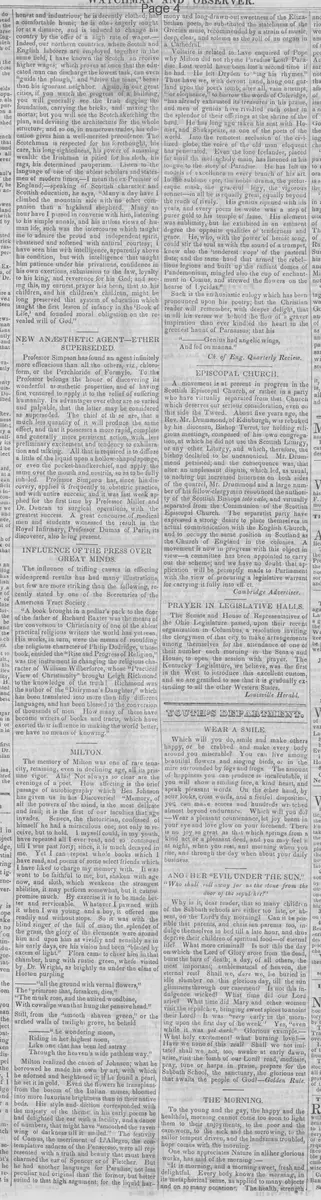
The memory of Milton was one of rare tenacity, retaining, even in declining age, all its pristine vigor. Alas! Not always so clear are the evenings of a poet. How affecting is the brief passage of autobiography which Ben Jonson has given us in his Discoveries! "Memory, of all the powers of the mind, is the most delicate and frail; it is the first of our faculties that age invades. Seneca, the rhetorician, confessed of himself he had a miraculous one; not only to receive, but to hold. I myself could, in my youth, have repeated all I ever read, and so continued till I was past forty; since, it is much decayed in me. Yet I can repeat whole books which I have read, and poems of some select friends which I have liked to charge my memory with. It was wont to be faithful to me; but, shaken with age now, and sloth, which weakens the strongest abilities, it may perform somewhat, but it cannot promise much. By exercise it is to be made better and serviceable. Whatever I pawned with it when I was young and a boy, it offered me readily and without stops. So it was with the blind singer of the fall of man; the splendor of the grass, the glory of the elements were around him and upon him as vividly and sensibly as in his early days, ere his vision had been "blasted by excess of light." Flora came to cheer him in that chamber, hung with rustic green, where visited by Dr. Wright, as brightly as under the elms of Horton purpling
"all the ground with vernal flowers,"
The "primrose that, forsaken, dies,"
"The musk-rose, and the attired woodbine,
With cowslips wan that hung the pensive head."
Still, from the "smooth shaven green," or the arched walls of twilight grove, he beheld
"the wondering moon
Riding in her highest noon,
Like one that has been led astray
Through the heaven's wide pathless way."
Milton realized the canon of Johnson; what he borrowed he made his own by art, with which he adorned and heightened it; if he found a pearl, he set it in gold. Even the flowers he transplanted from the bosom of the Italian muses, bloomed into more luxuriate brightness than in their native beds. His style and diction corresponded with the majesty of the theme: in his early poems he had delighted the ear with a facility, and a dance of numbers, that might have "smoothed the raven wing of darkness till it smiled." The festivity of Comus, the merriment of L'Allegro, the contemplative sadness of the Penseroso, were all represented with a truth and beauty that must have charmed the ear of Spenser or of Fletcher. But he had another language for Paradise, not less peculiar and original than the former, but better suited to that high argument; for the liquid harmony and long-drawn-out sweetness of the Elizabethan poets, he substituted the stateliness of the Grecian muse, recommended by a strain of music, deep, clear, and solemn as the roll of an organ in a Cathedral. Voltaire is related to have enquired of Pope why Milton did not rhyme Paradise Lost? Paradise Lost would have been lost a second time if he had. He left Dryden to "tag his rhymes."
Thus have we, with devout hand, hung our garland upon the poet's tomb; after all, vain attempt; "for eloquence," to borrow the words of Coleridge "has already exhausted its treasures in his praise and men of genius have rivalled each other in the splendor of their offerings at the shrine of the bard. He has long ago taken his seat with Homer, and Shakspeare, as one of the poets of the world. Into the remotest seclusion of the civilized globe, the voice of the old man eloquent has penetrated. Even the lone Icelander, placed far amid the melancholy main, has listened in his tongue to the story of Paradise. He has left us models of excellence in every branch of his art. In the sublime epic, the noble drama, the picturesque mask, the graceful elegy, the vigorous sonnet—in all he is equally great, equally beyond the reach of rivalry. His genius ripened with his years, and every poem he wrote was a step of purer gold to his temple of fame. His element was sublimity, but he exhibited in an eminent degree the opposite qualities of tenderness and grace. He, who, with the power of heroic song, could stir the soul as with the sound of a trumpet, knew also the 'tenderest stops' of the pastoral flute; and the same hand that armed the rebellious legions and built up the radiant domes of Pandemonium, mingled also the cup of enchantment in Comus, and strewed the flowers on the hearse of Lycidas."
Such is the enthusiastic eulogy which has been pronounced upon his poetry; but the Christian reader will remember, with deeper delight, that in all his verses we behold the flow of a graver inspiration than ever kindled the heart in the greenest haunt of Parnassus; that his
“Genius had angelic wings,
And fed on manna."
Ch. of Eng. Quarterly Review.
The memory of Milton was one of rare tenacity, retaining, even in declining age, all its pristine vigor. Alas! Not always so clear are the evenings of a poet. How affecting is the brief passage of autobiography which Ben Jonson has given us in his Discoveries! "Memory, of all the powers of the mind, is the most delicate and frail; it is the first of our faculties that age invades. Seneca, the rhetorician, confessed of himself he had a miraculous one; not only to receive, but to hold. I myself could, in my youth, have repeated all I ever read, and so continued till I was past forty; since, it is much decayed in me. Yet I can repeat whole books which I have read, and poems of some select friends which I have liked to charge my memory with. It was wont to be faithful to me; but, shaken with age now, and sloth, which weakens the strongest abilities, it may perform somewhat, but it cannot promise much. By exercise it is to be made better and serviceable. Whatever I pawned with it when I was young and a boy, it offered me readily and without stops. So it was with the blind singer of the fall of man; the splendor of the grass, the glory of the elements were around him and upon him as vividly and sensibly as in his early days, ere his vision had been "blasted by excess of light." Flora came to cheer him in that chamber, hung with rustic green, where visited by Dr. Wright, as brightly as under the elms of Horton purpling
"all the ground with vernal flowers,"
The "primrose that, forsaken, dies,"
"The musk-rose, and the attired woodbine,
With cowslips wan that hung the pensive head."
Still, from the "smooth shaven green," or the arched walls of twilight grove, he beheld
"the wondering moon
Riding in her highest noon,
Like one that has been led astray
Through the heaven's wide pathless way."
Milton realized the canon of Johnson; what he borrowed he made his own by art, with which he adorned and heightened it; if he found a pearl, he set it in gold. Even the flowers he transplanted from the bosom of the Italian muses, bloomed into more luxuriate brightness than in their native beds. His style and diction corresponded with the majesty of the theme: in his early poems he had delighted the ear with a facility, and a dance of numbers, that might have "smoothed the raven wing of darkness till it smiled." The festivity of Comus, the merriment of L'Allegro, the contemplative sadness of the Penseroso, were all represented with a truth and beauty that must have charmed the ear of Spenser or of Fletcher. But he had another language for Paradise, not less peculiar and original than the former, but better suited to that high argument; for the liquid harmony and long-drawn-out sweetness of the Elizabethan poets, he substituted the stateliness of the Grecian muse, recommended by a strain of music, deep, clear, and solemn as the roll of an organ in a Cathedral. Voltaire is related to have enquired of Pope why Milton did not rhyme Paradise Lost? Paradise Lost would have been lost a second time if he had. He left Dryden to "tag his rhymes."
Thus have we, with devout hand, hung our garland upon the poet's tomb; after all, vain attempt; "for eloquence," to borrow the words of Coleridge "has already exhausted its treasures in his praise and men of genius have rivalled each other in the splendor of their offerings at the shrine of the bard. He has long ago taken his seat with Homer, and Shakspeare, as one of the poets of the world. Into the remotest seclusion of the civilized globe, the voice of the old man eloquent has penetrated. Even the lone Icelander, placed far amid the melancholy main, has listened in his tongue to the story of Paradise. He has left us models of excellence in every branch of his art. In the sublime epic, the noble drama, the picturesque mask, the graceful elegy, the vigorous sonnet—in all he is equally great, equally beyond the reach of rivalry. His genius ripened with his years, and every poem he wrote was a step of purer gold to his temple of fame. His element was sublimity, but he exhibited in an eminent degree the opposite qualities of tenderness and grace. He, who, with the power of heroic song, could stir the soul as with the sound of a trumpet, knew also the 'tenderest stops' of the pastoral flute; and the same hand that armed the rebellious legions and built up the radiant domes of Pandemonium, mingled also the cup of enchantment in Comus, and strewed the flowers on the hearse of Lycidas."
Such is the enthusiastic eulogy which has been pronounced upon his poetry; but the Christian reader will remember, with deeper delight, that in all his verses we behold the flow of a graver inspiration than ever kindled the heart in the greenest haunt of Parnassus; that his
“Genius had angelic wings,
And fed on manna."
Ch. of Eng. Quarterly Review.
What sub-type of article is it?
Essay
What themes does it cover?
Religious
Moral Virtue
What keywords are associated?
Milton
Poetry
Memory
Paradise Lost
Religious Inspiration
Eulogy
Literary Genius
What entities or persons were involved?
Ch. Of Eng. Quarterly Review
Literary Details
Title
Milton
Author
Ch. Of Eng. Quarterly Review
Subject
Eulogy On Milton's Memory And Poetry
Form / Style
Prose Reflection And Eulogy
Key Lines
"Memory, Of All The Powers Of The Mind, Is The Most Delicate And Frail; It Is The First Of Our Faculties That Age Invades."
"The Splendor Of The Grass, The Glory Of The Elements Were Around Him And Upon Him As Vividly And Sensibly As In His Early Days"
Paradise Lost Would Have Been Lost A Second Time If He Had.
He Has Long Ago Taken His Seat With Homer, And Shakspeare, As One Of The Poets Of The World.
“Genius Had Angelic Wings, And Fed On Manna."