Thank you for visiting SNEWPapers!
Sign up free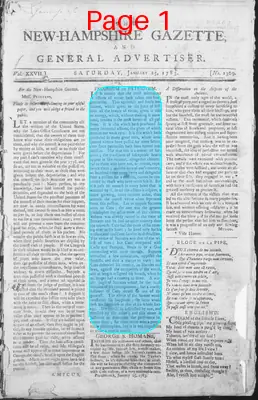
Literary
January 25, 1783
The New Hampshire Gazette And General Advertiser
Portsmouth, Exeter, Rockingham County, New Hampshire
What is this article about?
This essay extols patriotism as the noblest passion, fueling heroic virtues and immortal deeds. It contrasts Socrates' individual wisdom with Cato's selfless defense of Rome's liberties, deeming the latter greater for prioritizing societal welfare over personal happiness.
Clipping
OCR Quality
98%
Excellent
Full Text
ENCOMIUM ON PATRIOTISM.
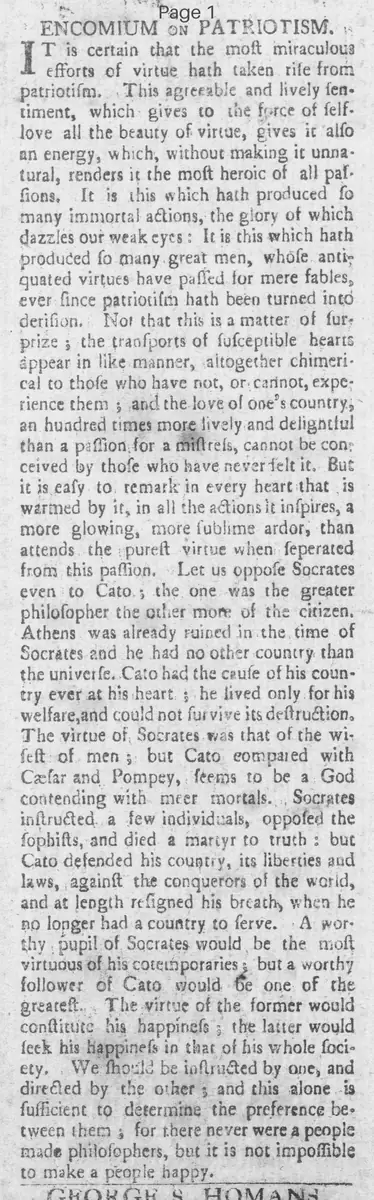
It is certain that the most miraculous efforts of virtue hath taken rise from patriotism. This agreeable and lively sentiment, which gives to the force of self-love all the beauty of virtue, gives it also an energy, which, without making it unnatural, renders it the most heroic of all passions. It is this which hath produced so many immortal actions, the glory of which dazzles our weak eyes: It is this which hath produced so many great men, whose antiquated virtues have passed for mere fables, ever since patriotism hath been turned into derision. Nor that this is a matter of surprise; the transports of susceptible hearts appear in like manner, altogether chimerical to those who have not, or cannot, experience them; and the love of one's country, an hundred times more lively and delightful than a passion or a mistress, Cannot be conceived by those who have never felt it. But it is easy to remark in every heart that is warmed by it, in all the actions it inspires, a more glowing, more sublime ardor, than attends the purest virtue when separated from this passion. Let us oppose Socrates even to Cato.; the one was the greater philosopher the other more of the citizen. Athens was already ruined in the time of Socrates and he had no other country than the universe. Cato had the cause of his country ever at his heart; he lived only for his welfare, and could not survive its destruction. The virtue of Socrates was that of the wisest of men; but Cato compared with Caesar and Pompey, seems to be a God contending with meer mortals. Socrates instructed a few individuals, opposed the sophists, and died a martyr to truth: but Cato defended his country, its liberties and laws, against the conquerors of the world, and at length resigned his breath, when he no longer had a country to serve. A worthy pupil of Socrates would be the most virtuous of his contemporaries; but a worthy follower of Cato would be one of the greatest. The virtue of the former would constitute his happiness: the latter would seek his happiness in that of his whole society. We should be instructed by one, and directed by the other: and this alone is sufficient to determine the preference between them: for there never were a people made philosophers, but it is not impossible to make a people happy.
It is certain that the most miraculous efforts of virtue hath taken rise from patriotism. This agreeable and lively sentiment, which gives to the force of self-love all the beauty of virtue, gives it also an energy, which, without making it unnatural, renders it the most heroic of all passions. It is this which hath produced so many immortal actions, the glory of which dazzles our weak eyes: It is this which hath produced so many great men, whose antiquated virtues have passed for mere fables, ever since patriotism hath been turned into derision. Nor that this is a matter of surprise; the transports of susceptible hearts appear in like manner, altogether chimerical to those who have not, or cannot, experience them; and the love of one's country, an hundred times more lively and delightful than a passion or a mistress, Cannot be conceived by those who have never felt it. But it is easy to remark in every heart that is warmed by it, in all the actions it inspires, a more glowing, more sublime ardor, than attends the purest virtue when separated from this passion. Let us oppose Socrates even to Cato.; the one was the greater philosopher the other more of the citizen. Athens was already ruined in the time of Socrates and he had no other country than the universe. Cato had the cause of his country ever at his heart; he lived only for his welfare, and could not survive its destruction. The virtue of Socrates was that of the wisest of men; but Cato compared with Caesar and Pompey, seems to be a God contending with meer mortals. Socrates instructed a few individuals, opposed the sophists, and died a martyr to truth: but Cato defended his country, its liberties and laws, against the conquerors of the world, and at length resigned his breath, when he no longer had a country to serve. A worthy pupil of Socrates would be the most virtuous of his contemporaries; but a worthy follower of Cato would be one of the greatest. The virtue of the former would constitute his happiness: the latter would seek his happiness in that of his whole society. We should be instructed by one, and directed by the other: and this alone is sufficient to determine the preference between them: for there never were a people made philosophers, but it is not impossible to make a people happy.
What sub-type of article is it?
Essay
What themes does it cover?
Patriotism
Moral Virtue
Political
What keywords are associated?
Patriotism
Virtue
Cato
Socrates
Liberty
Citizen
Society
Literary Details
Title
Encomium On Patriotism.
Key Lines
Let Us Oppose Socrates Even To Cato.; The One Was The Greater Philosopher The Other More Of The Citizen.
Cato Had The Cause Of His Country Ever At His Heart; He Lived Only For His Welfare, And Could Not Survive Its Destruction.
The Virtue Of The Former Would Constitute His Happiness: The Latter Would Seek His Happiness In That Of His Whole Society.
For There Never Were A People Made Philosophers, But It Is Not Impossible To Make A People Happy.