Thank you for visiting SNEWPapers!
Sign up free
Editorial
December 12, 1791
National Gazette
Philadelphia, Philadelphia County, Pennsylvania
What is this article about?
This editorial by Aratus praises the completion of the French Revolution through the king's assent to the constitution crafted by the National Assembly. It highlights the assembly's magnanimity, critiques opponents like Edmund Burke, and analyzes the new government's democratic elements, abolition of aristocracy, and safeguards for liberty.
Clipping
OCR Quality
95%
Excellent
Full Text
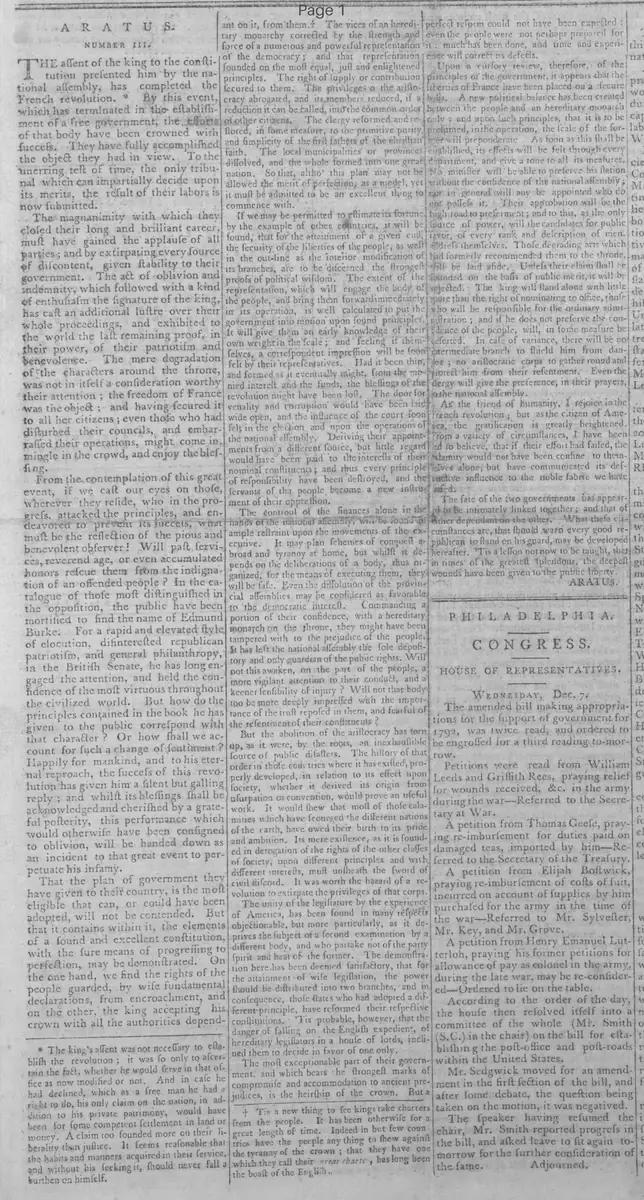
ARATUS.
NUMBER III.
The assent of the king to the constitution presented him by the national assembly, has completed the French revolution. * By this event, which has terminated in the establishment of a free government, the efforts of that body have been crowned with success. They have fully accomplished the object they had in view. To the unerring test of time, the only tribunal which can impartially decide upon its merits, the result of their labors is now submitted.
The magnanimity with which they closed their long and brilliant career, must have gained the applause of all parties; and by extirpating every source of discontent, given stability to their government. The act of oblivion and indemnity, which followed with a kind of enthusiasm the signature of the king, has cast an additional lustre over their whole proceedings, and exhibited to the world the last remaining proof, in their power, of their patriotism and benevolence. The mere degradation of the characters around the throne, was not in itself a consideration worthy their attention; the freedom of France was the object; and having secured it to all her citizens; even those who had disturbed their councils, and embarrassed their operations, might come in, mingle in the crowd, and enjoy the blessing.
From the contemplation of this great event, if we cast our eyes on those, wherever they reside, who in the progress, attacked the principles, and endeavored to prevent its success, what must be the reflection of the pious and benevolent observer! Will past services, reverend age, or even accumulated honors rescue them from the indignation of an offended people? In the catalogue of those most distinguished in the opposition, the public have been mortified to find the name of Edmund Burke. For a rapid and elevated style of elocution, disinterested republican patriotism, and general philanthropy, in the British Senate, he has long engaged the attention, and held the confidence of the most virtuous throughout the civilized world. But how do the principles contained in the book he has given to the public correspond with that character? Or how shall we account for such a change of sentiment? Happily for mankind, and to his eternal reproach, the success of this revolution has given him a silent but galling reply; and whilst its blessings shall be acknowledged and cherished by a grateful posterity, this performance which would otherwise have been consigned to oblivion, will be handed down as an incident to that great event to perpetuate his infamy.
That the plan of government they have given to their country, is the most eligible that can, or could have been adopted, will not be contended. But that it contains within it, the elements of a sound and excellent constitution, with the sure means of progressing to perfection, may be demonstrated. On the one hand, we find the rights of the people guarded, by wise fundamental declarations, from encroachment, and on the other, the king accepting his crown with all the authorities dependent on it, from them. The vices of an hereditary monarchy corrected by the strength and force of a numerous and powerful representation of the democracy; and that representation founded on the most equal, just and enlightened principles. The right of supply or contribution secured to them. The privileges of the aristocracy abrogated, and its members reduced, if a reduction it can be called, into the common order of other citizens. The clergy reformed and restored, in some measure, to the primitive purity and simplicity of the first fathers of the Christian faith. The local municipalities or provinces dissolved, and the whole formed into one great nation. So that, altho' this plan may not be allowed the merit of perfection, as a model, yet it must be admitted to be an excellent thing to commence with.
If we may be permitted to estimate its fortune by the example of other countries, it will be found, that for the attainment of a given end, the security of the liberties of the people, as well in the out-line as the interior modification of its branches, are to be discerned the strongest proofs of political wisdom. The extent of the representation, which will engage the body of the people, and bring them forward immediately in its operation, is well calculated to put the government into motion upon sound principles. It will give them an early knowledge of their own weight in the scale; and feeling it themselves, a correspondent impression will be soon felt by their representatives. Had it been thin, and formed as it eventually might, from the monied interest and the funds, the blessings of the revolution might have been lost. The door for venality and corruption would have been laid wide open, and the influence of the court soon felt in the election and upon the operations of the national assembly, Deriving their appointments from a different source, but little regard would have been paid to the interests of their nominal constituents: and thus every principle of responsibility have been destroyed, and the servants of the people become a new instrument of their oppression.
The controul of the finances alone in the hands of the national assembly, will be found an ample restraint upon the movements of the executive. It may plan schemes of conquest abroad and tyranny at home, but whilst it depends on the deliberations of a body, thus organized, for the means of executing them, they will be false. Even the dissolution of the provincial assemblies may be considered as favorable to the democratic interest. Commanding a portion of their confidence, with a hereditary monarch on the throne, they might have been tampered with to the prejudice of the people. It has left the national assembly the sole depository and only guardian of the public rights. Will not this awaken, on the part of the people, a more vigilant attention to their conduct, and a keener sensibility of injury? Will not that body too be more deeply impressed with the importance of the trust reposed in them, and fearful of the resentment of their constituents?
But the abolition of the aristocracy has torn up, as it were, by the roots, an inexhaustible source of public disasters. The history of that order in those countries where it has existed, properly developed, in relation to its effect upon society, whether it derived its origin from usurpation or convention, would prove an useful work. It would show that most of those calamities which have scourged the different nations of the earth, have owed their birth to its pride and ambition. Its mere existence, as it is founded in derogation of the rights of the other classes of society, upon different principles and with different interests, must unsheath the sword of civil discord. It was worth the bazard of a revolution to extirpate the privileges of that corps.
The unity of the legislature by the experience of America, has been found in many respects objectionable, but more particularly, as it deprives the subject of a second examination by a different body, and who partake not of the party spirit and heat of the former. The demonstration here has been deemed satisfactory, that for the attainment of wise legislation, the power should be distributed into two branches, and in consequence, those states who had adopted a different principle, have reformed their respective constitutions. 'Tis probable, however, that the danger of falling on the English expedient, of hereditary legislators in a house of lords, inclined them to decide in favor of one only.
The most exceptionable part of their government, and which bears the strongest marks of compromise and accommodation to ancient prejudices, is the heirship of the crown. But a perfect reform could not have been expected: even the people were not perhaps prepared for it: much has been done, and time and experience will correct its defects.
Upon a cursory review, therefore, of the principles of the government, it appears that the liberties of France have been placed on a secure basis. A new political balance has been created between the people and an hereditary monarch only; and upon such principles, that it is to be presumed, in the operation, the scale of the former will preponderate As soon as this shall be established, its effects will be felt through every department, and give a tone to all its measures. No minister will be able to preserve his station without the confidence of the national assembly; nor in general will any be appointed who do not possess it. Their approbation will be the high road to preferment; and to this, as the only source of power, will the candidates for public favor, of every rank and description of men, address themselves. Those degrading arts which had formerly recommended them to the throne, will be laid aside. Unless their claim shall be founded on the basis of public merit, it will be rejected. The king will stand alone with little more than the right of nominating to office, those who will be responsible for the ordinary administration; and if he does not preserve the confidence of the people, will, in some measure be deserted. In case of variance, there will be no intermediate branch to shield him from danger; no aristocratic corps to gather round and protect him from their resentment. Even the clergy will give the preference, in their prayers, to the national assembly.
As the friend of humanity, I rejoice in the French revolution: but as the citizen of America, the gratification is greatly heightened. From a variety of circumstances, I have been led to believe, that if their effort had failed, the calamity would not have been confined to themselves alone, but have communicated its destructive influence to the noble fabric we have raised. The fate of the two governments has appeared to be intimately linked together; and that of either dependent on the other. What these circumstances are, that should warn every good republican to stand on his guard, may be developed hereafter. 'Tis a lesson not now to be taught, that in times of the greatest splendour, the deepest wounds have been given to the public liberty.
ARATUS.
* The king's assent was not necessary to establish the revolution; it was so only to ascertain whether he would serve in that office as now modified or not. And in case he had declined, which as a free man he had a right to do, his only claim on the nation, in addition to his civil list, would have been for some competent settlement in land or provision to his private patrimony, would have been more than their liberality alone justice. It seems reasonable that those who had served the public faithfully and without his seeking it, should never fall a burthen on himself.
NUMBER III.
The assent of the king to the constitution presented him by the national assembly, has completed the French revolution. * By this event, which has terminated in the establishment of a free government, the efforts of that body have been crowned with success. They have fully accomplished the object they had in view. To the unerring test of time, the only tribunal which can impartially decide upon its merits, the result of their labors is now submitted.
The magnanimity with which they closed their long and brilliant career, must have gained the applause of all parties; and by extirpating every source of discontent, given stability to their government. The act of oblivion and indemnity, which followed with a kind of enthusiasm the signature of the king, has cast an additional lustre over their whole proceedings, and exhibited to the world the last remaining proof, in their power, of their patriotism and benevolence. The mere degradation of the characters around the throne, was not in itself a consideration worthy their attention; the freedom of France was the object; and having secured it to all her citizens; even those who had disturbed their councils, and embarrassed their operations, might come in, mingle in the crowd, and enjoy the blessing.
From the contemplation of this great event, if we cast our eyes on those, wherever they reside, who in the progress, attacked the principles, and endeavored to prevent its success, what must be the reflection of the pious and benevolent observer! Will past services, reverend age, or even accumulated honors rescue them from the indignation of an offended people? In the catalogue of those most distinguished in the opposition, the public have been mortified to find the name of Edmund Burke. For a rapid and elevated style of elocution, disinterested republican patriotism, and general philanthropy, in the British Senate, he has long engaged the attention, and held the confidence of the most virtuous throughout the civilized world. But how do the principles contained in the book he has given to the public correspond with that character? Or how shall we account for such a change of sentiment? Happily for mankind, and to his eternal reproach, the success of this revolution has given him a silent but galling reply; and whilst its blessings shall be acknowledged and cherished by a grateful posterity, this performance which would otherwise have been consigned to oblivion, will be handed down as an incident to that great event to perpetuate his infamy.
That the plan of government they have given to their country, is the most eligible that can, or could have been adopted, will not be contended. But that it contains within it, the elements of a sound and excellent constitution, with the sure means of progressing to perfection, may be demonstrated. On the one hand, we find the rights of the people guarded, by wise fundamental declarations, from encroachment, and on the other, the king accepting his crown with all the authorities dependent on it, from them. The vices of an hereditary monarchy corrected by the strength and force of a numerous and powerful representation of the democracy; and that representation founded on the most equal, just and enlightened principles. The right of supply or contribution secured to them. The privileges of the aristocracy abrogated, and its members reduced, if a reduction it can be called, into the common order of other citizens. The clergy reformed and restored, in some measure, to the primitive purity and simplicity of the first fathers of the Christian faith. The local municipalities or provinces dissolved, and the whole formed into one great nation. So that, altho' this plan may not be allowed the merit of perfection, as a model, yet it must be admitted to be an excellent thing to commence with.
If we may be permitted to estimate its fortune by the example of other countries, it will be found, that for the attainment of a given end, the security of the liberties of the people, as well in the out-line as the interior modification of its branches, are to be discerned the strongest proofs of political wisdom. The extent of the representation, which will engage the body of the people, and bring them forward immediately in its operation, is well calculated to put the government into motion upon sound principles. It will give them an early knowledge of their own weight in the scale; and feeling it themselves, a correspondent impression will be soon felt by their representatives. Had it been thin, and formed as it eventually might, from the monied interest and the funds, the blessings of the revolution might have been lost. The door for venality and corruption would have been laid wide open, and the influence of the court soon felt in the election and upon the operations of the national assembly, Deriving their appointments from a different source, but little regard would have been paid to the interests of their nominal constituents: and thus every principle of responsibility have been destroyed, and the servants of the people become a new instrument of their oppression.
The controul of the finances alone in the hands of the national assembly, will be found an ample restraint upon the movements of the executive. It may plan schemes of conquest abroad and tyranny at home, but whilst it depends on the deliberations of a body, thus organized, for the means of executing them, they will be false. Even the dissolution of the provincial assemblies may be considered as favorable to the democratic interest. Commanding a portion of their confidence, with a hereditary monarch on the throne, they might have been tampered with to the prejudice of the people. It has left the national assembly the sole depository and only guardian of the public rights. Will not this awaken, on the part of the people, a more vigilant attention to their conduct, and a keener sensibility of injury? Will not that body too be more deeply impressed with the importance of the trust reposed in them, and fearful of the resentment of their constituents?
But the abolition of the aristocracy has torn up, as it were, by the roots, an inexhaustible source of public disasters. The history of that order in those countries where it has existed, properly developed, in relation to its effect upon society, whether it derived its origin from usurpation or convention, would prove an useful work. It would show that most of those calamities which have scourged the different nations of the earth, have owed their birth to its pride and ambition. Its mere existence, as it is founded in derogation of the rights of the other classes of society, upon different principles and with different interests, must unsheath the sword of civil discord. It was worth the bazard of a revolution to extirpate the privileges of that corps.
The unity of the legislature by the experience of America, has been found in many respects objectionable, but more particularly, as it deprives the subject of a second examination by a different body, and who partake not of the party spirit and heat of the former. The demonstration here has been deemed satisfactory, that for the attainment of wise legislation, the power should be distributed into two branches, and in consequence, those states who had adopted a different principle, have reformed their respective constitutions. 'Tis probable, however, that the danger of falling on the English expedient, of hereditary legislators in a house of lords, inclined them to decide in favor of one only.
The most exceptionable part of their government, and which bears the strongest marks of compromise and accommodation to ancient prejudices, is the heirship of the crown. But a perfect reform could not have been expected: even the people were not perhaps prepared for it: much has been done, and time and experience will correct its defects.
Upon a cursory review, therefore, of the principles of the government, it appears that the liberties of France have been placed on a secure basis. A new political balance has been created between the people and an hereditary monarch only; and upon such principles, that it is to be presumed, in the operation, the scale of the former will preponderate As soon as this shall be established, its effects will be felt through every department, and give a tone to all its measures. No minister will be able to preserve his station without the confidence of the national assembly; nor in general will any be appointed who do not possess it. Their approbation will be the high road to preferment; and to this, as the only source of power, will the candidates for public favor, of every rank and description of men, address themselves. Those degrading arts which had formerly recommended them to the throne, will be laid aside. Unless their claim shall be founded on the basis of public merit, it will be rejected. The king will stand alone with little more than the right of nominating to office, those who will be responsible for the ordinary administration; and if he does not preserve the confidence of the people, will, in some measure be deserted. In case of variance, there will be no intermediate branch to shield him from danger; no aristocratic corps to gather round and protect him from their resentment. Even the clergy will give the preference, in their prayers, to the national assembly.
As the friend of humanity, I rejoice in the French revolution: but as the citizen of America, the gratification is greatly heightened. From a variety of circumstances, I have been led to believe, that if their effort had failed, the calamity would not have been confined to themselves alone, but have communicated its destructive influence to the noble fabric we have raised. The fate of the two governments has appeared to be intimately linked together; and that of either dependent on the other. What these circumstances are, that should warn every good republican to stand on his guard, may be developed hereafter. 'Tis a lesson not now to be taught, that in times of the greatest splendour, the deepest wounds have been given to the public liberty.
ARATUS.
* The king's assent was not necessary to establish the revolution; it was so only to ascertain whether he would serve in that office as now modified or not. And in case he had declined, which as a free man he had a right to do, his only claim on the nation, in addition to his civil list, would have been for some competent settlement in land or provision to his private patrimony, would have been more than their liberality alone justice. It seems reasonable that those who had served the public faithfully and without his seeking it, should never fall a burthen on himself.
What sub-type of article is it?
Constitutional
Foreign Affairs
Partisan Politics
What keywords are associated?
French Revolution
National Assembly
Constitution
Edmund Burke
Aristocracy Abolition
Monarchy Reform
Democratic Representation
What entities or persons were involved?
National Assembly
King Of France
Edmund Burke
Aristocracy
Clergy
Editorial Details
Primary Topic
Success Of The French Revolution And New Constitution
Stance / Tone
Strongly Supportive Of The French Revolution
Key Figures
National Assembly
King Of France
Edmund Burke
Aristocracy
Clergy
Key Arguments
King's Assent Completes The Revolution And Establishes Free Government
Act Of Oblivion Demonstrates Magnanimity And Stability
Critique Of Edmund Burke's Opposition As Inconsistent With His Character
New Constitution Guards People's Rights And Corrects Monarchy's Vices
Abolition Of Aristocracy Removes Source Of Discord
Broad Representation Prevents Corruption
Control Of Finances Restrains Executive Power
Hereditary Monarchy Is A Compromise But Reformable