Thank you for visiting SNEWPapers!
Sign up free
Story
February 16, 1939
The Coolidge Examiner
Coolidge, Pinal County, Arizona
What is this article about?
Article discusses the spread of European unrest to the US, affecting the Roosevelt administration and Congress, amid secrecy over potential international crisis post-Munich. Focuses on controversy over US airplane sales to France, defending the policy while critiquing opposition.
Clipping
OCR Quality
98%
Excellent
Full Text
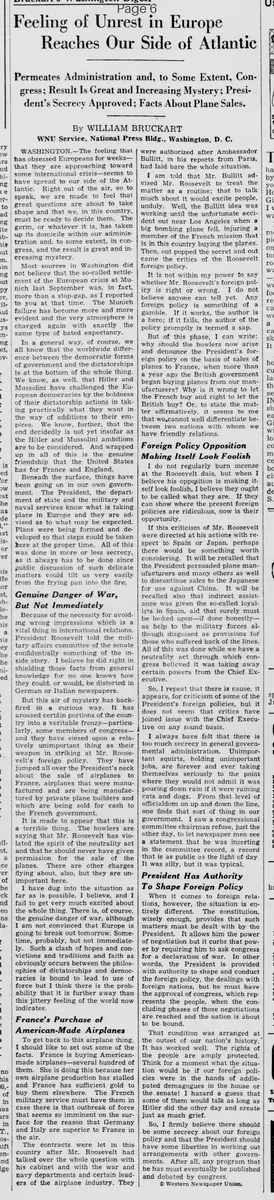
Feeling of Unrest in Europe
Reaches Our Side of Atlantic
Permeates Administration and, to Some Extent, Congress; Result Is Great and Increasing Mystery; President's Secrecy Approved; Facts About Plane Sales.
WASHINGTON.—The feeling that has obsessed Europeans for weeks—that they are approaching toward some international crisis—seems to have spread to our side of the Atlantic. Right out of the air, so to speak, we are made to feel that great questions are about to take shape and that we, in this country, must be ready to decide them. The germ, or whatever it is, has taken up its domicile within our administration and, to some extent, in congress, and the result is great and increasing mystery.
Most sources in Washington did not believe that the so-called settlement of the European crisis at Munich last September was, in fact, more than a stop-gap, as I reported to you at that time. The Munich failure has become more and more evident and the very atmosphere is charged again with exactly the same type of bated expectancy.
In a general way, of course, we all know that the worldwide difference between the democratic forms of government and the dictatorships is at the bottom of the whole thing. We know, as well, that Hitler and Mussolini have challenged the European democracies by the boldness of their dictatorship actions in taking practically what they want in the way of additions to their empires. We know, further, that the end decidedly is not yet insofar as the Hitler and Mussolini ambitions are to be considered. And wrapped up in all of this is the genuine friendship that the United States has for France and England.
Beneath the surface, things have been going on in our own government. The President, the department of state and the military and naval services know what is taking place in Europe and they are advised as to what may be expected. Plans were being formed and developed so that steps could be taken here at the proper time. All of this was done in more or less secrecy, as it always has to be done since public discussion of such delicate matters could tilt us very easily from the frying pan into the fire.
Genuine Danger of War,
But Not Immediately
Because of the necessity for avoiding wrong impressions which is a vital thing in international relations, President Roosevelt told the military affairs committee of the senate confidentially something of the inside story. I believe he did right in shielding those facts from general knowledge for no one knows how they could, or would, be distorted in German or Italian newspapers.
But this air of mystery has backfired in a curious way. It has aroused certain portions of the country into a veritable frenzy—particularly, some members of congress—and they have seized upon a relatively unimportant thing as their weapon in striking at Mr. Roosevelt's foreign policy. They have jumped all over the President's neck about the sale of airplanes to France, airplanes that were manufactured and are being manufactured by private plane builders and which are being sold for cash to the French government.
It is made to appear that this is a terrible thing. The howlers are saying that Mr. Roosevelt has violated the spirit of the neutrality act and that he should never have given permission for the sale of the planes. There are other charges flying about, also, but they are unimportant here.
I have dug into the situation as far as is possible, I believe, and I fail to get very much excited about the whole thing. There is, of course, the genuine danger of war, although I am not convinced that Europe is going to break out tomorrow. Sometime, probably, but not immediately. Such a clash of hopes and convictions and traditions and faith as obviously occurs between the philosophies of dictatorships and democracies is bound to lead to use of force but I think there is the probability that it is further away than this jittery feeling of the world now indicates.
France's Purchase of
American-Made Airplanes
To get back to this airplane thing, I should like to set out some of the facts. France is buying American-made airplanes—several hundred of them. She is doing this because her own airplane production has stalled and France has sufficient gold to buy them elsewhere. The French military service must have them in case there is that outbreak of force that seems so imminent on the surface for the reason that Germany and Italy are superior to France in the air.
The contracts were let in this country after Mr. Roosevelt had talked over the whole question with his cabinet and with the war and navy departments and certain leaders of the airplane industry. They were authorized after Ambassador Bullitt, in his reports from Paris, had laid bare the whole situation. I am told that Mr. Bullitt advised Mr. Roosevelt to treat the matter as a routine: that to talk much about it would excite people, unduly. Well, the Bullitt idea was working until the unfortunate accident out near Los Angeles when a big bombing plane fell, injuring a member of the French mission that is in this country buying the planes. Then, out popped the secret and out came the critics of the Roosevelt foreign policy.
It is not within my power to say whether Mr. Roosevelt's foreign policy is right or wrong. I do not believe anyone can tell yet. Any foreign policy is something of a gamble. If it works, the author is a hero; if it fails, the author of the policy promptly is termed a sap.
But of this phase, I can write: why should the howlers now arise and denounce the President's foreign policy on the basis of sales of planes to France, when more than a year ago the British government began buying planes from our manufacturers? Why is it wrong to let the French buy and right to let the British buy? Or, to state the matter affirmatively, it seems to me that we cannot well differentiate between two nations with whom we have friendly relations.
Foreign Policy Opposition
Making Itself Look Foolish
I do not regularly burn incense at the Roosevelt dais, but when I believe his opposition is making itself look foolish, I believe they ought to be called what they are. If they can show where the present foreign policies are ridiculous, now is their opportunity.
If this criticism of Mr. Roosevelt were directed at his actions with respect to Spain or Japan, perhaps there would be something worth considering. It will be recalled that the President persuaded plane manufacturers and many others as well to discontinue sales to the Japanese for use against China. It will be recalled also that indirect assistance was given the so-called loyalists in Spain, aid that surely must be looked upon—if done honestly—as help to the military forces although disguised as provisions for those who suffered back of the lines.
All of this was done while we have a neutrality act through which congress believed it was taking away certain powers from the Chief Executive.
So, I repeat that there is cause, it appears, for criticism of some of the President's foreign policies, but it does not seem that critics have joined issue with the Chief Executive on any sound basis.
I always have felt that there is too much secrecy in general governmental administration. Unimportant squirts, holding unimportant jobs, are forever and ever taking themselves seriously to the point where they would not admit it was pouring down rain if it were raining cats and dogs. From that level of officialdom on up and down the line, one finds that sort of thing in our government. I saw a congressional committee chairman refuse, just the other day, to let newspaper men see a statement that he was inserting in the committee record, a record that is as public as the light of day. It was silly, but it was typical.
President Has Authority
To Shape Foreign Policy
When it comes to foreign relations, however, the situation is entirely different. The constitution, wisely enough, provides that such matters must be dealt with by the President. It allows him the power of negotiation but it curbs that power by requiring him to ask congress for a declaration of war. In other words, the President is provided with authority to shape and conduct the foreign policy, the dealings with foreign nations, but he must have the approval of congress, which represents the people, when the concluding phases of those negotiations are reached and the nation is about to be bound.
That condition was arranged at the outset of our nation's history. It has worked well. The rights of the people are amply protected. Think for a moment what the situation would be if our foreign policies were in the hands of addle-pated demagogues in the house or the senate! I hazard a guess that some of them would talk as long as Hitler did the other day and create just as much grief.
So, I firmly believe there should be some secrecy about our foreign policy and that the President should have some liberties in working out arrangements with other governments. After all, any program that he has must eventually be published and debated by congress.
© Western Newspaper Union.
Reaches Our Side of Atlantic
Permeates Administration and, to Some Extent, Congress; Result Is Great and Increasing Mystery; President's Secrecy Approved; Facts About Plane Sales.
WASHINGTON.—The feeling that has obsessed Europeans for weeks—that they are approaching toward some international crisis—seems to have spread to our side of the Atlantic. Right out of the air, so to speak, we are made to feel that great questions are about to take shape and that we, in this country, must be ready to decide them. The germ, or whatever it is, has taken up its domicile within our administration and, to some extent, in congress, and the result is great and increasing mystery.
Most sources in Washington did not believe that the so-called settlement of the European crisis at Munich last September was, in fact, more than a stop-gap, as I reported to you at that time. The Munich failure has become more and more evident and the very atmosphere is charged again with exactly the same type of bated expectancy.
In a general way, of course, we all know that the worldwide difference between the democratic forms of government and the dictatorships is at the bottom of the whole thing. We know, as well, that Hitler and Mussolini have challenged the European democracies by the boldness of their dictatorship actions in taking practically what they want in the way of additions to their empires. We know, further, that the end decidedly is not yet insofar as the Hitler and Mussolini ambitions are to be considered. And wrapped up in all of this is the genuine friendship that the United States has for France and England.
Beneath the surface, things have been going on in our own government. The President, the department of state and the military and naval services know what is taking place in Europe and they are advised as to what may be expected. Plans were being formed and developed so that steps could be taken here at the proper time. All of this was done in more or less secrecy, as it always has to be done since public discussion of such delicate matters could tilt us very easily from the frying pan into the fire.
Genuine Danger of War,
But Not Immediately
Because of the necessity for avoiding wrong impressions which is a vital thing in international relations, President Roosevelt told the military affairs committee of the senate confidentially something of the inside story. I believe he did right in shielding those facts from general knowledge for no one knows how they could, or would, be distorted in German or Italian newspapers.
But this air of mystery has backfired in a curious way. It has aroused certain portions of the country into a veritable frenzy—particularly, some members of congress—and they have seized upon a relatively unimportant thing as their weapon in striking at Mr. Roosevelt's foreign policy. They have jumped all over the President's neck about the sale of airplanes to France, airplanes that were manufactured and are being manufactured by private plane builders and which are being sold for cash to the French government.
It is made to appear that this is a terrible thing. The howlers are saying that Mr. Roosevelt has violated the spirit of the neutrality act and that he should never have given permission for the sale of the planes. There are other charges flying about, also, but they are unimportant here.
I have dug into the situation as far as is possible, I believe, and I fail to get very much excited about the whole thing. There is, of course, the genuine danger of war, although I am not convinced that Europe is going to break out tomorrow. Sometime, probably, but not immediately. Such a clash of hopes and convictions and traditions and faith as obviously occurs between the philosophies of dictatorships and democracies is bound to lead to use of force but I think there is the probability that it is further away than this jittery feeling of the world now indicates.
France's Purchase of
American-Made Airplanes
To get back to this airplane thing, I should like to set out some of the facts. France is buying American-made airplanes—several hundred of them. She is doing this because her own airplane production has stalled and France has sufficient gold to buy them elsewhere. The French military service must have them in case there is that outbreak of force that seems so imminent on the surface for the reason that Germany and Italy are superior to France in the air.
The contracts were let in this country after Mr. Roosevelt had talked over the whole question with his cabinet and with the war and navy departments and certain leaders of the airplane industry. They were authorized after Ambassador Bullitt, in his reports from Paris, had laid bare the whole situation. I am told that Mr. Bullitt advised Mr. Roosevelt to treat the matter as a routine: that to talk much about it would excite people, unduly. Well, the Bullitt idea was working until the unfortunate accident out near Los Angeles when a big bombing plane fell, injuring a member of the French mission that is in this country buying the planes. Then, out popped the secret and out came the critics of the Roosevelt foreign policy.
It is not within my power to say whether Mr. Roosevelt's foreign policy is right or wrong. I do not believe anyone can tell yet. Any foreign policy is something of a gamble. If it works, the author is a hero; if it fails, the author of the policy promptly is termed a sap.
But of this phase, I can write: why should the howlers now arise and denounce the President's foreign policy on the basis of sales of planes to France, when more than a year ago the British government began buying planes from our manufacturers? Why is it wrong to let the French buy and right to let the British buy? Or, to state the matter affirmatively, it seems to me that we cannot well differentiate between two nations with whom we have friendly relations.
Foreign Policy Opposition
Making Itself Look Foolish
I do not regularly burn incense at the Roosevelt dais, but when I believe his opposition is making itself look foolish, I believe they ought to be called what they are. If they can show where the present foreign policies are ridiculous, now is their opportunity.
If this criticism of Mr. Roosevelt were directed at his actions with respect to Spain or Japan, perhaps there would be something worth considering. It will be recalled that the President persuaded plane manufacturers and many others as well to discontinue sales to the Japanese for use against China. It will be recalled also that indirect assistance was given the so-called loyalists in Spain, aid that surely must be looked upon—if done honestly—as help to the military forces although disguised as provisions for those who suffered back of the lines.
All of this was done while we have a neutrality act through which congress believed it was taking away certain powers from the Chief Executive.
So, I repeat that there is cause, it appears, for criticism of some of the President's foreign policies, but it does not seem that critics have joined issue with the Chief Executive on any sound basis.
I always have felt that there is too much secrecy in general governmental administration. Unimportant squirts, holding unimportant jobs, are forever and ever taking themselves seriously to the point where they would not admit it was pouring down rain if it were raining cats and dogs. From that level of officialdom on up and down the line, one finds that sort of thing in our government. I saw a congressional committee chairman refuse, just the other day, to let newspaper men see a statement that he was inserting in the committee record, a record that is as public as the light of day. It was silly, but it was typical.
President Has Authority
To Shape Foreign Policy
When it comes to foreign relations, however, the situation is entirely different. The constitution, wisely enough, provides that such matters must be dealt with by the President. It allows him the power of negotiation but it curbs that power by requiring him to ask congress for a declaration of war. In other words, the President is provided with authority to shape and conduct the foreign policy, the dealings with foreign nations, but he must have the approval of congress, which represents the people, when the concluding phases of those negotiations are reached and the nation is about to be bound.
That condition was arranged at the outset of our nation's history. It has worked well. The rights of the people are amply protected. Think for a moment what the situation would be if our foreign policies were in the hands of addle-pated demagogues in the house or the senate! I hazard a guess that some of them would talk as long as Hitler did the other day and create just as much grief.
So, I firmly believe there should be some secrecy about our foreign policy and that the President should have some liberties in working out arrangements with other governments. After all, any program that he has must eventually be published and debated by congress.
© Western Newspaper Union.
What sub-type of article is it?
Political Analysis
Foreign Policy Commentary
What keywords are associated?
European Crisis
Plane Sales France
Roosevelt Policy
Neutrality Act
Munich Agreement
International Tension
What entities or persons were involved?
President Roosevelt
Hitler
Mussolini
Ambassador Bullitt
Where did it happen?
Washington
Story Details
Key Persons
President Roosevelt
Hitler
Mussolini
Ambassador Bullitt
Location
Washington
Event Date
Last September (Munich)
Story Details
The article analyzes the tension from Europe's post-Munich crisis affecting US policy, defends Roosevelt's secrecy and approval of airplane sales to France amid congressional criticism, contrasts with sales to Britain and past actions on Japan and Spain, and affirms presidential authority in foreign affairs.