Thank you for visiting SNEWPapers!
Sign up free
Editorial
January 21, 1829
Phenix Gazette
Alexandria, Virginia
What is this article about?
Editorial discusses Mr. O'Connell's announcement that the Pope refused a concordat requested by the British Government, arguing this avoids interference claims but may delay Catholic Emancipation due to English sentiments, urging forbearance for eventual success.
Clipping
OCR Quality
95%
Excellent
Full Text
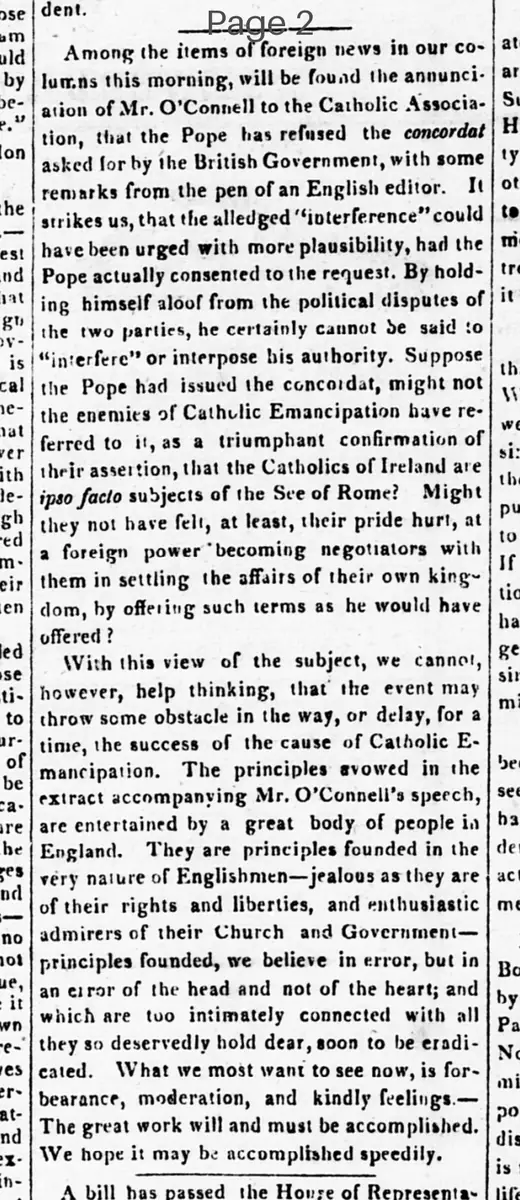
Among the items of foreign news in our columns this morning, will be found the annunciation of Mr. O'Connell to the Catholic Association, that the Pope has refused the concordat asked for by the British Government, with some remarks from the pen of an English editor. It strikes us, that the alleged "interference" could have been urged with more plausibility, had the Pope actually consented to the request. By holding himself aloof from the political disputes of the two parties, he certainly cannot be said to "interfere" or interpose his authority. Suppose the Pope had issued the concordat, might not the enemies of Catholic Emancipation have referred to it, as a triumphant confirmation of their assertion, that the Catholics of Ireland are ipso facto subjects of the See of Rome? Might they not have felt, at least, their pride hurt, at a foreign power becoming negotiators with them in settling the affairs of their own kingdom, by offering such terms as he would have offered?
With this view of the subject, we cannot, however, help thinking, that the event may throw some obstacle in the way, or delay, for a time, the success of the cause of Catholic Emancipation. The principles avowed in the extract accompanying Mr. O'Connell's speech, are entertained by a great body of people in England. They are principles founded in the very nature of Englishmen—jealous as they are of their rights and liberties, and enthusiastic admirers of their Church and Government—principles founded, we believe in error, but in an error of the head and not of the heart; and which are too intimately connected with all they so deservedly hold dear, soon to be eradicated. What we most want to see now, is forbearance, moderation, and kindly feelings.—The great work will and must be accomplished. We hope it may be accomplished speedily.
With this view of the subject, we cannot, however, help thinking, that the event may throw some obstacle in the way, or delay, for a time, the success of the cause of Catholic Emancipation. The principles avowed in the extract accompanying Mr. O'Connell's speech, are entertained by a great body of people in England. They are principles founded in the very nature of Englishmen—jealous as they are of their rights and liberties, and enthusiastic admirers of their Church and Government—principles founded, we believe in error, but in an error of the head and not of the heart; and which are too intimately connected with all they so deservedly hold dear, soon to be eradicated. What we most want to see now, is forbearance, moderation, and kindly feelings.—The great work will and must be accomplished. We hope it may be accomplished speedily.
What sub-type of article is it?
Partisan Politics
Foreign Affairs
Moral Or Religious
What keywords are associated?
Catholic Emancipation
Pope Concordat
British Government
O'connell
Catholic Association
English Principles
Religious Interference
What entities or persons were involved?
Mr. O'connell
Pope
British Government
Catholic Association
English Editor
Editorial Details
Primary Topic
Pope's Refusal Of British Concordat And Its Impact On Catholic Emancipation
Stance / Tone
Supportive Of Catholic Emancipation With Call For Forbearance
Key Figures
Mr. O'connell
Pope
British Government
Catholic Association
English Editor
Key Arguments
Pope's Refusal Avoids Claims Of Interference In British Affairs
Agreement Would Confirm Catholic Subjection To Rome And Hurt English Pride
Event May Delay Catholic Emancipation Due To English Principles
English Opposition Stems From Error Of Head, Not Heart
Forbearance And Moderation Needed For Success