Thank you for visiting SNEWPapers!
Sign up free
Story
March 21, 1954
Atlanta Daily World
Atlanta, Fulton County, Georgia
What is this article about?
Columnist William Gordon recounts Indian visitor Arhan Prakash's reluctance to hitch-hike in the US, fearing mistaken identity as a Black person and associated racial prejudice, illustrated by a Florida anecdote of a traveler preempting suspicion by reporting to the sheriff.
Clipping
OCR Quality
95%
Excellent
Full Text
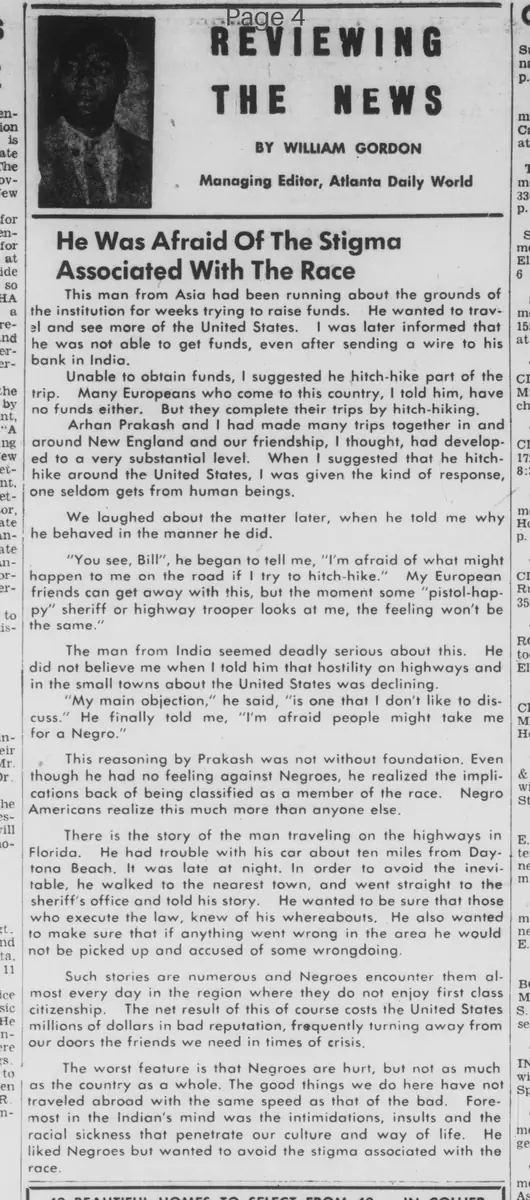
REVIEWING THE NEWS
BY WILLIAM GORDON
Managing Editor, Atlanta Daily World
He Was Afraid Of The Stigma Associated With The Race
This man from Asia had been running about the grounds of the institution for weeks trying to raise funds. He wanted to travel and see more of the United States.
I was later informed that he was not able to get funds, even after sending a wire to his bank in India.
Unable to obtain funds, I suggested he hitch-hike part of the trip. Many Europeans who come to this country, I told him, have no funds either. But they complete their trips by hitch-hiking.
Arhan Prakash and I had made many trips together in and around New England and our friendship, I thought, had developed to a very substantial level. When I suggested that he hitch-hike around the United States, I was given the kind of response, one seldom gets from human beings.
We laughed about the matter later, when he told me why he behaved in the manner he did.
"You see, Bill", he began to tell me, "I'm afraid of what might happen to me on the road if I try to hitch-hike." My European friends can get away with this, but the moment some "pistol-happy" sheriff or highway trooper looks at me, the feeling won't be the same."
The man from India seemed deadly serious about this. He did not believe me when I told him that hostility on highways and in the small towns about the United States was declining.
"My main objection," he said, "is one that I don't like to discuss." He finally told me, "I'm afraid people might take me for a Negro."
This reasoning by Prakash was not without foundation. Even though he had no feeling against Negroes, he realized the implications back of being classified as a member of the race. Negro Americans realize this much more than anyone else.
There is the story of the man traveling on the highways in Florida. He had trouble with his car about ten miles from Daytona Beach. It was late at night. In order to avoid the inevitable, he walked to the nearest town, and went straight to the sheriff's office and told his story. He wanted to be sure that those who execute the law, knew of his whereabouts. He also wanted to make sure that if anything went wrong in the area he would not be picked up and accused of some wrongdoing.
Such stories are numerous and Negroes encounter them almost every day in the region where they do not enjoy first class citizenship.
The net result of this of course costs the United States millions of dollars in bad reputation, frequently turning away from our doors the friends we need in times of crisis.
The worst feature is that Negroes are hurt, but not as much as the country as a whole. The good things we do here have not traveled abroad with the same speed as that of the bad. Foremost in the Indian's mind was the intimidations, insults and the racial sickness that penetrate our culture and way of life. He liked Negroes but wanted to avoid the stigma associated with the race.
BY WILLIAM GORDON
Managing Editor, Atlanta Daily World
He Was Afraid Of The Stigma Associated With The Race
This man from Asia had been running about the grounds of the institution for weeks trying to raise funds. He wanted to travel and see more of the United States.
I was later informed that he was not able to get funds, even after sending a wire to his bank in India.
Unable to obtain funds, I suggested he hitch-hike part of the trip. Many Europeans who come to this country, I told him, have no funds either. But they complete their trips by hitch-hiking.
Arhan Prakash and I had made many trips together in and around New England and our friendship, I thought, had developed to a very substantial level. When I suggested that he hitch-hike around the United States, I was given the kind of response, one seldom gets from human beings.
We laughed about the matter later, when he told me why he behaved in the manner he did.
"You see, Bill", he began to tell me, "I'm afraid of what might happen to me on the road if I try to hitch-hike." My European friends can get away with this, but the moment some "pistol-happy" sheriff or highway trooper looks at me, the feeling won't be the same."
The man from India seemed deadly serious about this. He did not believe me when I told him that hostility on highways and in the small towns about the United States was declining.
"My main objection," he said, "is one that I don't like to discuss." He finally told me, "I'm afraid people might take me for a Negro."
This reasoning by Prakash was not without foundation. Even though he had no feeling against Negroes, he realized the implications back of being classified as a member of the race. Negro Americans realize this much more than anyone else.
There is the story of the man traveling on the highways in Florida. He had trouble with his car about ten miles from Daytona Beach. It was late at night. In order to avoid the inevitable, he walked to the nearest town, and went straight to the sheriff's office and told his story. He wanted to be sure that those who execute the law, knew of his whereabouts. He also wanted to make sure that if anything went wrong in the area he would not be picked up and accused of some wrongdoing.
Such stories are numerous and Negroes encounter them almost every day in the region where they do not enjoy first class citizenship.
The net result of this of course costs the United States millions of dollars in bad reputation, frequently turning away from our doors the friends we need in times of crisis.
The worst feature is that Negroes are hurt, but not as much as the country as a whole. The good things we do here have not traveled abroad with the same speed as that of the bad. Foremost in the Indian's mind was the intimidations, insults and the racial sickness that penetrate our culture and way of life. He liked Negroes but wanted to avoid the stigma associated with the race.
What sub-type of article is it?
Biography
Curiosity
What themes does it cover?
Social Manners
Misfortune
What keywords are associated?
Racial Stigma
Hitch Hiking
India
Negro Misidentification
Sheriff Suspicion
Florida Traveler
What entities or persons were involved?
Arhan Prakash
William Gordon
Where did it happen?
United States, New England, Florida
Story Details
Key Persons
Arhan Prakash
William Gordon
Location
United States, New England, Florida
Story Details
Arhan Prakash, an Indian man, fears hitch-hiking in the US due to potential misidentification as a Negro and resulting racial stigma; anecdote of a traveler in Florida who reports to sheriff to avoid suspicion.