Thank you for visiting SNEWPapers!
Sign up free
Alexandria Daily Gazette, Commercial & Political
Alexandria, Virginia
What is this article about?
Lord Wellington's despatch from Deleytosa on August 3 details the British and Spanish retreat from Talavera after French advances, including failures to hold Puerto de Banos and Perales, interactions with General Cuesta, and withdrawal across the Tagus at Arco Bispo, leaving about 5,000 wounded behind.
Merged-components note: This is a continuation of the dispatch from Lord Wellington regarding British affairs in Spain, split across pages.
Clippings
1 of 2
OCR Quality
Full Text
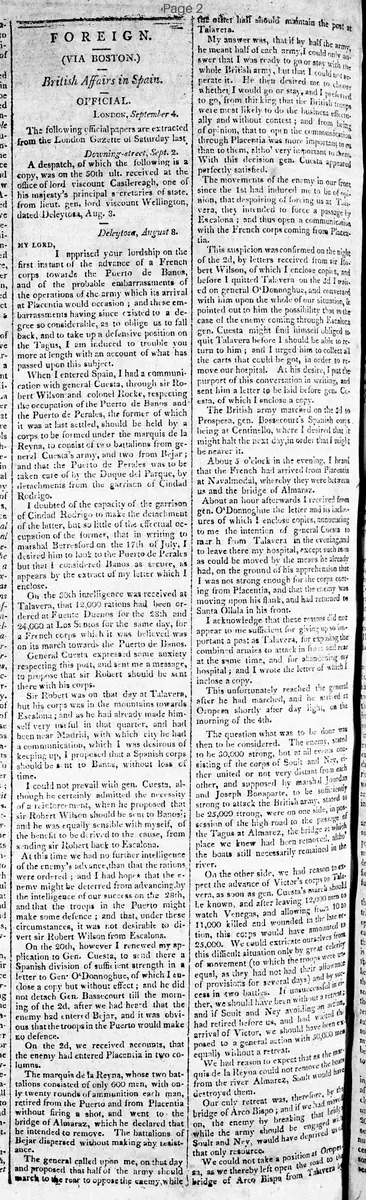
(VIA BOSTON.)
British Affairs in Spain
OFFICIAL.
London, September 4
The following official papers are extracted from the London Gazette of Saturday last
Downing-street, Sept. 2.
A despatch, of which the following is a copy, was on the 30th ult. received at the office of lord viscount Castlereagh, one of his majesty's principal secretaries of state, from lieut. gen. lord viscount Wellington, dated Deleytosa, Aug. 3.
Deleytosa, August 3.
MY LORD,
I apprised your lordship on the first instant of the advance of a French corps towards the Puerto de Banos, and of the probable embarrassments of the operations of the army which its arrival at Placentia would occasion; and these embarrassments having since existed to a degree so considerable, as to oblige us to fall back, and to take up a defensive position on the Tagus, I am induced to trouble you more at length with an account of what has passed upon this subject.
When I entered Spain, I had a communication with general Cuesta, through sir Robert Wilson—and colonel Rocke, respecting the occupation of the Puerto de Banos and the Puerto de Perales, the former of which it was at last settled, should be held by a corps to be formed under the marquis de la Reyna, to consist of two battalions from general Cuesta's army, and two from Bejar; and that the Puerto de Perales was to be taken care of by the Duque del Parque, by detachments from the garrison of Ciudad Rodrigo.
I doubted of the capacity of the garrison of Ciudad Rodrigo to make the detachment of the latter, but so little of the effectual occupation of the former, that in writing to marshal Beresford on the 17th of July, I desired him to look to the Puerto de Perales but that I considered Banos as secure, as appears by the extract of my letter which I enclose.
On the 30th intelligence was received at Talavera, that 12,000 rations had been ordered at Fuente Duenos for the 31st and 24,000 at Los Santos for the same day, for a French corps which it was believed was on its march towards the Puerto de Banos.
General Cuesta expressed some anxiety respecting this post, and sent me a message, to propose that sir Robert should be sent there with his corps.
Sir Robert was on that day at Talavera, but his corps was in the mountains towards Escalona; and as he had already made himself very useful in that quarter, and had been near Madrid, with which city he had a communication, which I was desirous of keeping up, I proposed that a Spanish corps should be sent to Banos, without loss of time.
I could not prevail with gen. Cuesta, although he certainly admitted the necessity of a reinforcement, when he proposed that sir Robert Wilson should be sent to Banos; and he was equally sensible with myself, of the benefit to be derived to the cause, from sending sir Robert back to Escalona.
At this time we had no further intelligence of the enemy's advance,than that the rations were ordered; and I had hopes that the enemy might be deterred from advancing by the intelligence of our success on the 28th, and that the troops in the Puerto might make some defence; and that, under these circumstances, it was not desirable to divert sir Robert Wilson from Escalona.
On the 31st, however I renewed my application to Gen. Cuesta, to send there a Spanish division of sufficient strength in a letter to Gen. O'Donnoghue, of which I enclose a copy but without effect; and he did not detach Gen. Bassecourt till the morning of the 2d, after we had heard that the enemy had entered Bejar, and it was obvious that the troops in the Puerto would make no defence.
On the 2d, we received accounts, that the enemy had entered Placentia in two columns.
The marquis de la Reyna, whose two battalions consisted of only 600 men, with only twenty rounds of ammunition each man, retired from the Puerto and from Placentia without firing a shot, and went to the bridge of Almaraz, which he declared that he intended to remove. The battalions of Bejar dispersed without making any resistance.
The general called upon me, on that day and proposed that half of the army should march to the rear to oppose the enemy, while The other half should maintain the post at Talavera.
My answer was, that if by half the army. he meant half of each army,I could only answer that I was ready to go or stay with the whole British army, but that I could not separate it. He then desired me to choose whether I would go or stay, and I preferred to go, from thinking that the British troops were most likely to do the business effectually and without contest; and from being of opinion, that to open the communication through Placentia was more important to us than to them, altho' very important to them. With this decision gen. Cuesta appeared perfectly satisfied.
The movements of the enemy in our front since the 1st had induced me to be of opinion, that despairing of forcing us at Talavera, they intended to force a passage by Escalona; and thus open a communication with the French corps coming from Placentia.
This suspicion was confirmed on the night of the 2d, by letters received from sir Robert Wilson, of which I enclose copies, and before I quitted Talavera on the 3d I waited on general O'Donnoghue, and conversed with him upon the whole of our situation, & pointed out to him the possibility that in the case of the enemy coming through Escalona gen. Cuesta might find himself obliged to quit Talavera before I should be able to return to him; and I urged him to collect all the carts that could be got, in order to remove our hospital. At his desire, I put the purport of this conversation in writing, and sent him a letter to be laid before gen. Cuesta, of which I enclose a copy.
The British army marched on the 3d to Oropesa, gen. Bassecourt's Spanish corps being at Centinello, where I desired that it might halt the next day,in order that I might be nearer it.
About 5 o'clock in the evening. I heard that the French had arrived from Placentia at Navalmoral, whereby they were between us and the bridge of Almaraz.
About an hour afterwards I received from gen. O'Donnoghue the letter and its enclosures of which I enclose copies, announcing to me the intention of general Cuesta to march from Talavera in the evening,and to leave there my hospital, except such men as could be moved by the means he already had, on the ground of his apprehension that I was not strong enough for the corps coming from Placentia, and that the enemy was moving upon his flank. and had returned to Santa Olalla in his front.
I acknowledge that these reasons did not appear to me sufficient for giving up so important a post as Talavera, for exposing the combined armies to attack in front and rear at the same time, and for abandoning my hospital; and I wrote the letter of which I enclose a copy.
This unfortunately reached the general after he had marched, and he arrived at Oropesa shortly after day light, on the morning of the 4th.
The question what was to be done was then to be considered. The enemy, consisting of the corps of Soult and Ney, said to be 30,000 strong, but at all events considerably strong, were on one side, in possession of the high road to the passage of the Tagus at Almaraz, the bridge at which place we knew had been removed, altho' the boats still necessarily remained in the river.
On the other side, we had reason to expect the advance of Victor's corps to Talavera, as soon as gen. Cuesta's march should be known, and after leaving watch Venegas, and allowing from 12,000 men to 11,000 killed and wounded in the late action, this corps would have amounted to 25,000.
We could extricate ourselves from this difficult situation only by great celerity of movement (to which the troops were unequal, as they had not had equal, as they had not had of provisions for several days) and by success in two battles.
If unsuccessful in either, we should have been without a retreat? and if Soult and Ney avoiding an action, had retired before us, and had waited the arrival of Victor, we should have been exposed to a general action with 50,000 men equally without a retreat.
We had reason to expect that as the marquis de la Reyna could not remove the boats from the river Almaraz, Soult would have destroyed them.
Our only retreat was, therefore, by the bridge of Arco Bispo; and if we had moved on, the enemy while the army should be breaking engaged with that bridge Soult and Ney, would have deprived us ba, as we thereby left open the road to from Takvera Oropesa th that only resource.
We could not take a position at Oropesa bridge of Arco Bispo from Takvera.
; and after considering the whole, [it was] advisable to retire to the bridge of Arco; but after maturely [considering it], I was of opinion that it [was better to cross] and to take up a defensive position [on the other side]. I was induced to adopt this last opinion, [considering] the [force the] French have now at least 30,000 [men across the] Tagus. [The] sooner the defensive line should be tak[en up], [the bett]er; and I was likewise of opinion that [we should leave a corps of 12,000 to watch the pass of] Ve[gas?], and [the rest d]isposable to oppose to the combined [force at Abrantes?]. [The fewer troops we leave at Badajoz, the more likely were the troops to be] p[repared] to defend it. Accordingly I marched on the 4th, and [crossed] the Tagus by the bridge of Arco [on the same day, leaving the] passage of Almaraz and the lower parts [open]. [I am now] in which I am well situated to defend [myself], and have continued my course to this [place, cross]er [on] the night of the 5th, and he is still [on] the Tagus. General Cuesta crossed the [river at the] bridge of the Arco Bispo. About 2000 of the wounded have been [b]rought away from Talavera; the remain[der it is] not [possible or] consistent with humanity to at[tempt to remove under the] circumstances. [As there are about 5,000 wounded there, and I doubted whether] it would have been [possible under a]ny circumstances, it would have been [impossible or] inconsistent with humanity to at[tempt it]. [There are about 5,000 wounded there: and I doubted whether] the French would treat our sol[di]diers wounded on the 27th and who fell [into their hands well]. From the treatment which some of the [wounded have experienced from] the hands of the enemy, [and from the manner in which I have always treated the wounded, who have fal]l[en] into my hands, I expect that these men [will] be well treated; and I have only to la[ment] that a new occurrence of events, over [w]hich, from circumstances, I had [no] control, should have placed the ar[my] in a situation to be obliged to leave any [o]f them behind. I have the honor to be, &c. (Signed) ARTHUR WELLESLEY.
What sub-type of article is it?
What keywords are associated?
What entities or persons were involved?
Where did it happen?
Foreign News Details
Primary Location
Spain
Event Date
August 3
Key Persons
Outcome
retreat across the tagus at arco bispo; about 2000 wounded brought away from talavera, remainder of about 5000 left behind; french corps advanced through puerto de banos and placentia without resistance; defensive position taken up on the tagus.
Event Details
Lord Wellington reports on French advances towards Puerto de Banos and Perales, failures in Spanish reinforcements, retreat from Talavera due to threats from Soult and Ney's corps from Placentia and Victor's from the front, decision to cross Tagus and take defensive position, leaving hospital wounded behind.