Thank you for visiting SNEWPapers!
Sign up free
Domestic News
January 7, 1892
Iuka Reporter
Iuka, Tishomingo County, Mississippi
What is this article about?
Expert advice from Mr. Saunders, Superintendent of gardens in Washington, emphasizes lowering night temperatures in greenhouses to ensure robust plant growth, better fruit quality, and avoid moisture loss, contrary to uniform high heat practices.
Clipping
OCR Quality
98%
Excellent
Full Text
NIGHT TEMPERATURE FOR PLANTS.
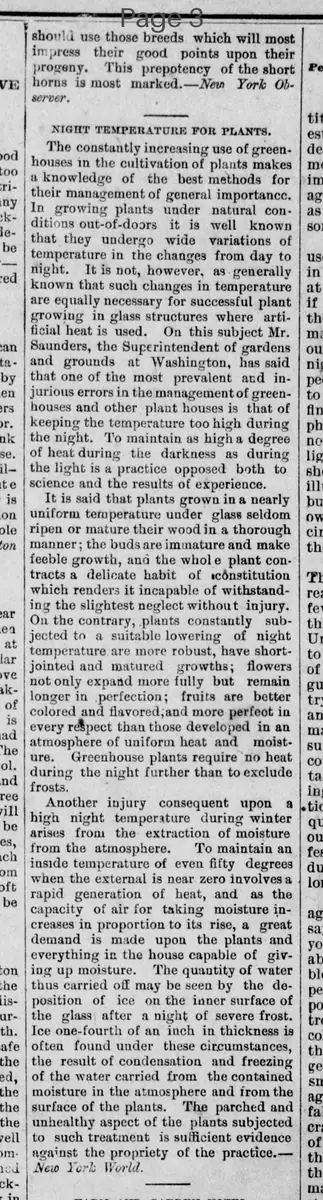
The constantly increasing use of green-houses in the cultivation of plants makes a knowledge of the best methods for their management of general importance. In growing plants under natural conditions out-of-doors it is well known that they undergo wide variations of temperature in the changes from day to night. It is not, however, as generally known that such changes in temperature are equally necessary for successful plant growing in glass structures where artificial heat is used. On this subject Mr. Saunders, the Superintendent of gardens and grounds at Washington, has said that one of the most prevalent and injurious errors in the management of green-houses and other plant houses is that of keeping the temperature too high during the night. To maintain as high a degree of heat during the darkness as during the light is a practice opposed both to science and the results of experience. It is said that plants grown in a nearly uniform temperature under glass seldom ripen or mature their wood in a thorough manner; the buds are immature and make feeble growth, and the whole plant contracts a delicate habit of constitution which renders it incapable of withstanding the slightest neglect without injury. On the contrary, plants constantly subjected to a suitable lowering of night temperature are more robust, have short-jointed and matured growths; flowers not only expand more fully but remain longer in perfection; fruits are better colored and flavored; and more perfect in every respect than those developed in an atmosphere of uniform heat and moisture. Greenhouse plants require no heat during the night further than to exclude frosts. Another injury consequent upon a high night temperature during winter arises from the extraction of moisture from the atmosphere. To maintain an inside temperature of even fifty degrees when the external is near zero involves a rapid generation of heat, and as the capacity of air for taking moisture increases in proportion to its rise, a great demand is made upon the plants and everything in the house capable of giving up moisture. The quantity of water thus carried off may be seen by the deposition of ice on the inner surface of the glass after a night of severe frost. Ice one-fourth of an inch in thickness is often found under these circumstances, the result of condensation and freezing of the water carried from the contained moisture in the atmosphere and from the surface of the plants. The parched and unhealthy aspect of the plants subjected to such treatment is sufficient evidence against the propriety of the practice.—New York World.
The constantly increasing use of green-houses in the cultivation of plants makes a knowledge of the best methods for their management of general importance. In growing plants under natural conditions out-of-doors it is well known that they undergo wide variations of temperature in the changes from day to night. It is not, however, as generally known that such changes in temperature are equally necessary for successful plant growing in glass structures where artificial heat is used. On this subject Mr. Saunders, the Superintendent of gardens and grounds at Washington, has said that one of the most prevalent and injurious errors in the management of green-houses and other plant houses is that of keeping the temperature too high during the night. To maintain as high a degree of heat during the darkness as during the light is a practice opposed both to science and the results of experience. It is said that plants grown in a nearly uniform temperature under glass seldom ripen or mature their wood in a thorough manner; the buds are immature and make feeble growth, and the whole plant contracts a delicate habit of constitution which renders it incapable of withstanding the slightest neglect without injury. On the contrary, plants constantly subjected to a suitable lowering of night temperature are more robust, have short-jointed and matured growths; flowers not only expand more fully but remain longer in perfection; fruits are better colored and flavored; and more perfect in every respect than those developed in an atmosphere of uniform heat and moisture. Greenhouse plants require no heat during the night further than to exclude frosts. Another injury consequent upon a high night temperature during winter arises from the extraction of moisture from the atmosphere. To maintain an inside temperature of even fifty degrees when the external is near zero involves a rapid generation of heat, and as the capacity of air for taking moisture increases in proportion to its rise, a great demand is made upon the plants and everything in the house capable of giving up moisture. The quantity of water thus carried off may be seen by the deposition of ice on the inner surface of the glass after a night of severe frost. Ice one-fourth of an inch in thickness is often found under these circumstances, the result of condensation and freezing of the water carried from the contained moisture in the atmosphere and from the surface of the plants. The parched and unhealthy aspect of the plants subjected to such treatment is sufficient evidence against the propriety of the practice.—New York World.
What sub-type of article is it?
Agriculture
What keywords are associated?
Greenhouse Management
Night Temperature
Plant Cultivation
Mr Saunders
What entities or persons were involved?
Mr. Saunders
Where did it happen?
Washington
Domestic News Details
Primary Location
Washington
Key Persons
Mr. Saunders
Event Details
Mr. Saunders advises that greenhouses should have lower night temperatures to mimic natural conditions, promoting robust plant growth, better flowering and fruiting, and preventing moisture loss and plant delicacy from uniform high heat.