Thank you for visiting SNEWPapers!
Sign up free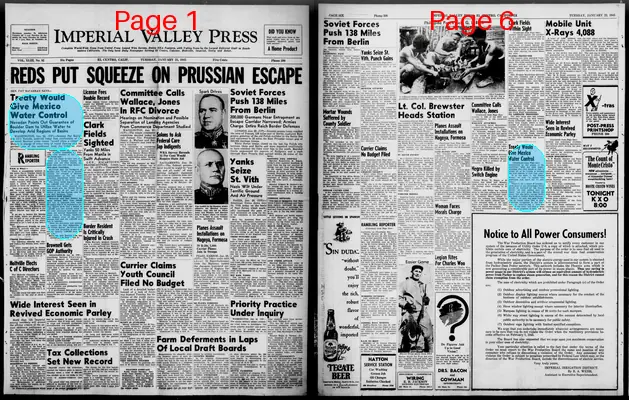
Imperial Valley Press
El Centro, Imperial County, California
What is this article about?
Senator Pat McCarran testified before the Senate Foreign Relations Committee against the proposed Mexican water treaty, arguing it would give Mexico control over Colorado River water essential for U.S. Southwest development, despite existing water deficits.
Merged-components note: US-Mexico water treaty affecting southwest US, relabeled to domestic_news; continuation across pages.
Clippings
1 of 2
OCR Quality
Full Text
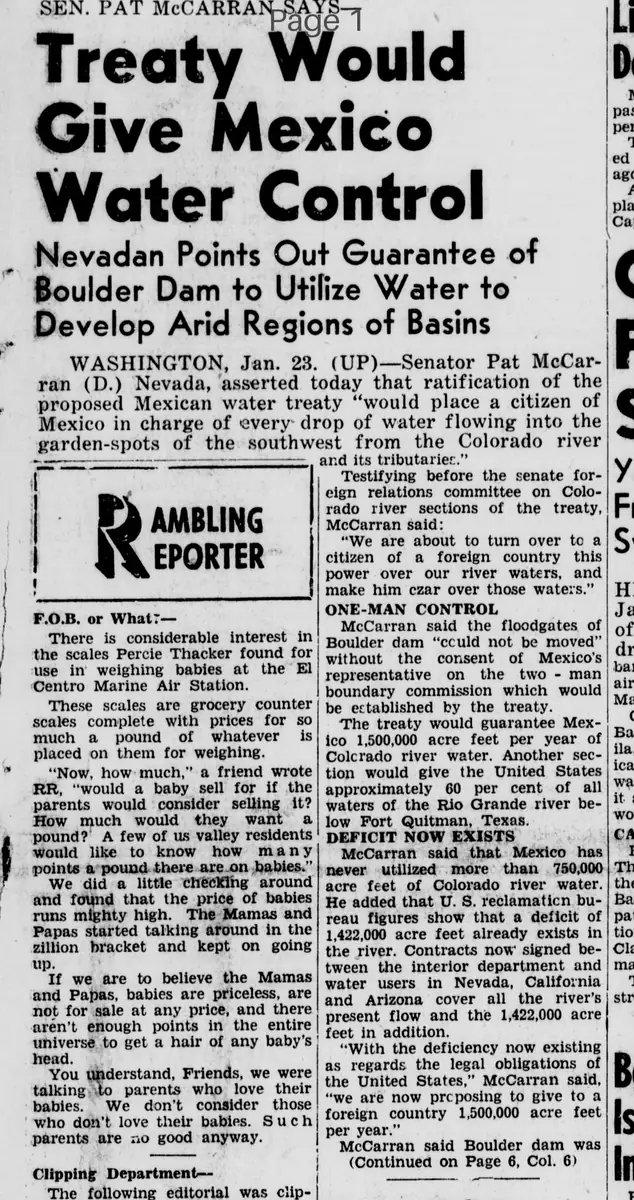
Nevadan Points Out Guarantee of Boulder Dam to Utilize Water to Develop Arid Regions of Basins
WASHINGTON, Jan. 23. (UP)—Senator Pat McCarran (D.) Nevada, asserted today that ratification of the proposed Mexican water treaty "would place a citizen of Mexico in charge of every drop of water flowing into the garden-spots of the southwest from the Colorado river and its tributaries."
Testifying before the senate foreign relations committee on Colorado river sections of the treaty, McCarran said:
"We are about to turn over to a citizen of a foreign country this power over our river waters, and make him czar over those waters."
ONE-MAN CONTROL
McCarran said the floodgates of Boulder dam "could not be moved" without the consent of Mexico's representative on the two-man boundary commission which would be established by the treaty.
The treaty would guarantee Mexico 1,500,000 acre feet per year of Colorado river water. Another section would give the United States approximately 60 per cent of all waters of the Rio Grande river below Fort Quitman, Texas.
DEFICIT NOW EXISTS
McCarran said that Mexico has never utilized more than 750,000 acre feet of Colorado river water.
He added that U. S. reclamation bureau figures show that a deficit of 1,422,000 acre feet already exists in the river. Contracts now signed between the interior department and water users in Nevada, California and Arizona cover all the river's present flow and the 1,422,000 acre feet in addition.
"With the deficiency now existing as regards the legal obligations of the United States," McCarran said, "we are now proposing to give to a foreign country 1,500,000 acre feet per year."
McCarran said Boulder dam was
(Continued on Page 6, Col. 6)
Treaty Would Give Mexico Water Control
(Continued from Page One)
constructed by the people of the southwest "with the clear understanding that they would be able to utilize all of its waters to develop the arid regions of that vast area."
"It is the duty of the United States," he said, "to uphold that guarantee and carry out its contracts."
"There is not a shred of consideration given to any advantages which should be received by the United States," he said, adding that the treaty "not only gives Mexico the water, but also great storage facilities built at United States expense."
Mexico, he said, has been forbidden by treaty since 1853 to block American navigation in the Colorado by constructing a diversion dam on the river, "yet that is what this treaty proposes to allow her to do."
What sub-type of article is it?
What keywords are associated?
What entities or persons were involved?
Where did it happen?
Domestic News Details
Primary Location
Washington
Event Date
Jan. 23.
Key Persons
Event Details
Senator Pat McCarran testified before the Senate Foreign Relations Committee, asserting that the proposed Mexican water treaty would give Mexico control over Colorado River waters via a two-man boundary commission, preventing U.S. operation of Boulder Dam without Mexican consent. He highlighted existing water deficits and U.S. contracts, arguing against guaranteeing Mexico 1,500,000 acre feet annually despite their lower usage, and noted the treaty allows Mexico to build a diversion dam prohibited since 1853.