Thank you for visiting SNEWPapers!
Sign up free
Story
June 17, 1943
Marion Progress
Marion, Mcdowell County, North Carolina
What is this article about?
Hawaii's large sugar and pineapple plantations have significantly contributed labor, equipment, and land to the WWII war effort, while nearly maintaining peacetime production levels. Mobilization began immediately after the Pearl Harbor attack.
Clipping
OCR Quality
98%
Excellent
Full Text
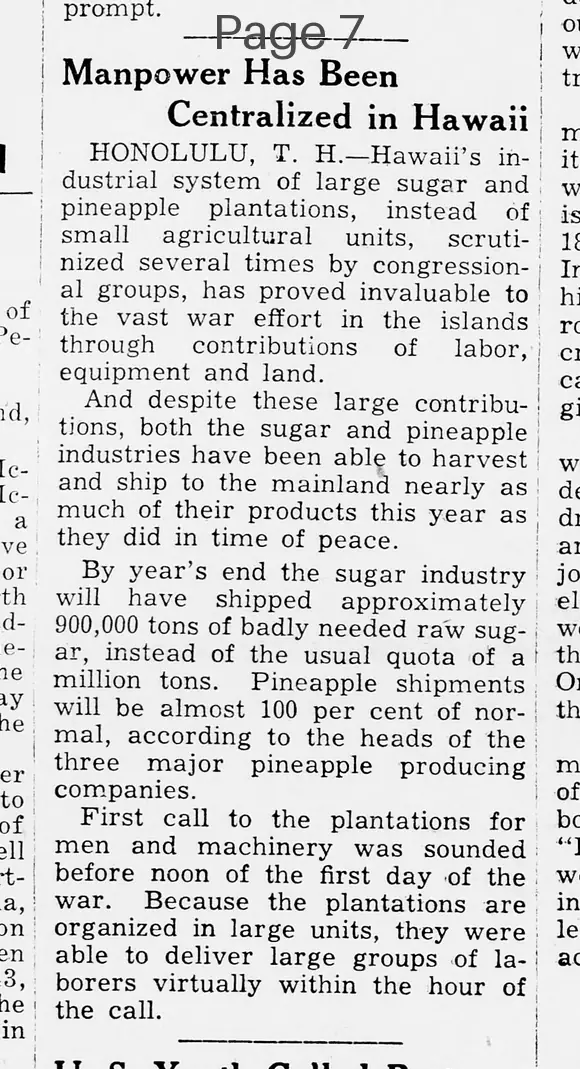
Manpower Has Been
Centralized in Hawaii
HONOLULU, T. H.-Hawaii's industrial system of large sugar and pineapple plantations, instead of small agricultural units, scrutinized several times by congressional groups, has proved invaluable to the vast war effort in the islands through contributions of labor, equipment and land.
And despite these large contributions, both the sugar and pineapple industries have been able to harvest and ship to the mainland nearly as much of their products this year as they did in time of peace.
By year's end the sugar industry will have shipped approximately 900,000 tons of badly needed raw sugar, instead of the usual quota of a million tons. Pineapple shipments will be almost 100 per cent of normal, according to the heads of the three major pineapple producing companies.
First call to the plantations for men and machinery was sounded before noon of the first day of the war. Because the plantations are organized in large units, they were able to deliver large groups of laborers virtually within the hour of the call.
Centralized in Hawaii
HONOLULU, T. H.-Hawaii's industrial system of large sugar and pineapple plantations, instead of small agricultural units, scrutinized several times by congressional groups, has proved invaluable to the vast war effort in the islands through contributions of labor, equipment and land.
And despite these large contributions, both the sugar and pineapple industries have been able to harvest and ship to the mainland nearly as much of their products this year as they did in time of peace.
By year's end the sugar industry will have shipped approximately 900,000 tons of badly needed raw sugar, instead of the usual quota of a million tons. Pineapple shipments will be almost 100 per cent of normal, according to the heads of the three major pineapple producing companies.
First call to the plantations for men and machinery was sounded before noon of the first day of the war. Because the plantations are organized in large units, they were able to deliver large groups of laborers virtually within the hour of the call.
What sub-type of article is it?
Historical Event
What themes does it cover?
Triumph
Survival
What keywords are associated?
Hawaii War Effort
Sugar Plantations
Pineapple Industry
Labor Mobilization
Wwii Contribution
Where did it happen?
Honolulu, T. H., Hawaii
Story Details
Location
Honolulu, T. H., Hawaii
Event Date
First Day Of The War
Story Details
Hawaii's large plantations quickly provided labor and resources to the war effort starting on the first day of the war, while sustaining near-normal sugar and pineapple production for the year.