Thank you for visiting SNEWPapers!
Sign up free
Letter to Editor
June 18, 1805
Portland Gazette
Portland, Cumberland County, Maine
What is this article about?
James Elliot, a Vermont Republican, writes to his constituents warning of proposed constitutional amendments by Virginians and others that would diminish small states' influence in the Senate and presidency, urging preservation of the Constitution and Union to maintain national balance.
Clipping
OCR Quality
90%
Excellent
Full Text
From the Vermont Herald.
Mr. Eylsor to his Constituents.
LETTER VII.
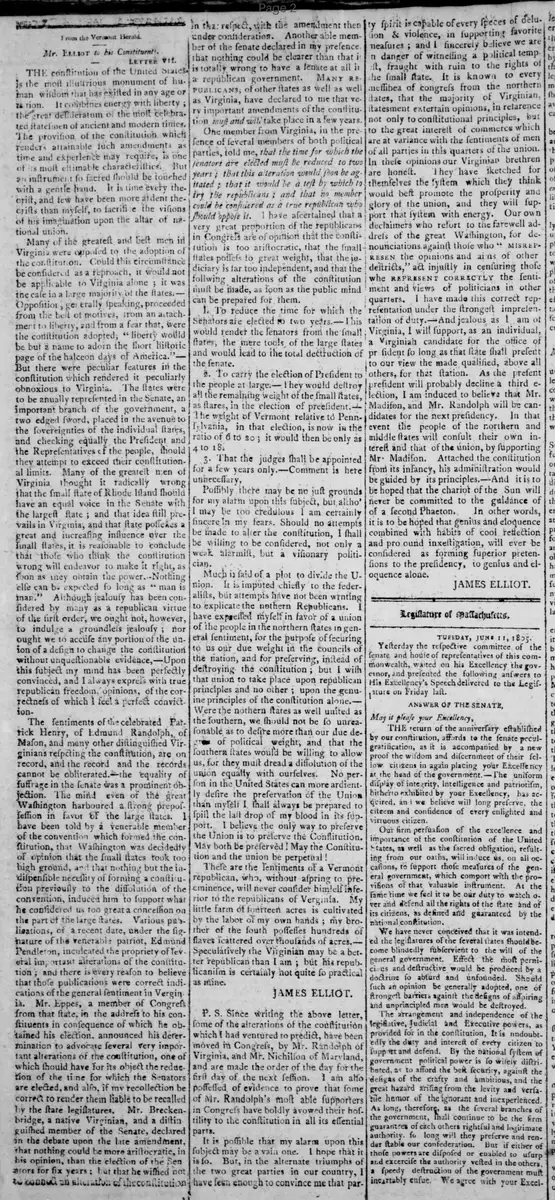
THE constitution of the United States is the most illustrious monument of human wisdom that has existed in any age or nation. It combines energy with liberty; the great desideratum of the most celebrated statesmen of ancient and modern times. The provision of the constitution which renders attainable such amendments as time and experience may require, is one of its most estimable characteristics. But an instrument so sacred should be touched with a gentle hand. It is time everything orifist, and few have been more assiduous the citizens than myself, to sacrifice the visions of his imagination upon the altar of national union.
Many of the greatest and best men in Virginia were opposed to the adoption of the constitution. Could this circumstance be considered as a reproach, it would not be applicable to Virginia alone; it was the case in a large majority of the states. Opposition, generally speaking, proceeded from the best of motives, from an attachment to liberty, and from a fear that, were the constitution adopted, "liberty would be but a name to adorn the short historic page of the halcyon days of America."
But there were peculiar features in the constitution which rendered it peculiarly obnoxious to Virginia. The states were to be annually represented in the Senate, an important branch of the government, a two-edged sword, placed in the avenue to the sovereignties of the individual states, and checking equally the President and the Representatives of the people, should they attempt to exceed their constitutional limits. Many of the greatest men of Virginia thought it radically wrong that the small state of Rhode Island should have an equal voice in the Senate with the largest state; and that idea still prevails in Virginia, and that state possesses a great and increasing influence over the small states. It is reasonable to conclude that those who think the constitution wrong will endeavor to make it right, as soon as they obtain the power. Nothing else can be expected so long as "man is man." Although jealousy has been considered by many as a republican virtue of the first order, we ought not, however, to indulge a groundless jealousy; nor ought we to accuse any portion of the union of a design to change the constitution without unquestionable evidence. Upon this subject my mind has been perfectly convinced, and I always express with true republican freedom, "opinions, of the correctness of which I feel a perfect conviction."
The sentiments of the celebrated Patrick Henry, of Edmund Randolph, of Mason, and many other distinguished Virginians respecting the constitution, are on record, and the record cannot be obliterated. The equality of suffrage in the Senate was a prominent objection. The mind even of the great Washington harboured a strong prepossession in favour of the large states. I have been told by a venerable member of the convention which formed the constitution, that Washington was decidedly of opinion that the small states took too high ground, and that nothing but the indispensable necessity of forming a constitution previously to the dissolution of the convention, induced him to support what he considered as too great a concession on the part of the large states. Various publications, of a recent date, under the signature of the venerable patriot, Edmund Pendleton, inculcated the propriety of several important alterations of the constitution; and there is every reason to believe that those publications were correct indications of the general sentiment in Virginia. Mr. Eppes, a member of Congress from that state, in the address to his constituents in consequence of which he obtained his election, announced his determination to advocate several very important alterations of the constitution, one of which should have for its object the reduction of the time for which the Senators are elected, and also, if my recollection be correct, to render them liable to be recalled by the state legislatures. Mr. Breckenridge, a native Virginian, and a distinguished member of the Senate, declared in the debate upon the late amendment, that nothing could be more aristocratic, in his opinion, than the election of the Senators for six years; but that he wished not to counsel an alteration of the constitution in that respect, with the amendment then under consideration. Another able member of the Senate declared in my presence, that nothing could be clearer than that it is totally wrong to have a Senate at all in a republican government. Many Republican members of other states as well as Virginia, have declared to me that very important amendments of the constitution must and will take place in a few years.
One member from Virginia, in the presence of several members of both political parties, told me, that the time for which the Senators are elected must be reduced to two years; that this alteration would be agitated; that it would be a test by which to try the republicans; and that no member could be considered as a true republican who should oppose it. I have ascertained that a very great proportion of the republicans in Congress are of opinion that the constitution is too aristocratic, that the small states possess too great weight, that the judiciary is far too independent, and that the following alterations of the constitution must be made, as soon as the public mind can be prepared for them.
1. To reduce the time for which the Senators are elected to two years. This would render the senators from the small states, the mere tools of the large states and would lead to the total destruction of the Senate.
2. To carry the election of President to the people at large: They would destroy all the remaining weight of the small states, as states, in the election of president. The weight of Vermont relative to Pennsylvania, in that election, is now in the ratio of 6 to 20; it would then be only as 4 to 18.
3. That the judges shall be appointed for a few years only. Comment is here unnecessary.
Possibly there may be no just grounds for my alarm upon this subject, but although I may be too credulous I am certainly sincere in my fears. Should no attempts be made to alter the constitution, I shall be willing to be considered, not only a weak alarmist, but a visionary politician.
Much is said of a plot to divide the Union. It is imputed chiefly to the federalists, but attempts have not been wanting to exculpate the northern Republicans. I have expressed myself in favor of a union of the people in the northern states in general sentiment, for the purpose of securing to us our due weight in the councils of the nation, and for preserving, instead of destroying the constitution; but I wish that union to take place upon republican principles and no other; upon the genuine principles of the constitution alone. Were the northern states as well united as the southern, we should not be so unreasonable as to desire more than our due degree of political weight, and that the southern states would be willing to allow us, for they must dread a dissolution of the union equally with ourselves. No person in the United States can more ardently desire the preservation of the Union than myself. I shall always be prepared to spill the last drop of my blood in its support. I believe the only way to preserve the Union is to preserve the Constitution. May both be preserved! May the Constitution and the union be perpetual!
These are the sentiments of a Vermont republican, who, without aspiring to pre-eminence, will never consider himself inferior to the republicans of Virginia. My little farm of fourteen acres is cultivated by the labor of my own hands; my brother of the south possesses hundreds of slaves scattered over thousands of acres. Speculatively the Virginian may be a better republican than I am; but his republicanism is certainly not quite so practical as mine.
JAMES ELLIOT.
P. S. Since writing the above letter, some of the alterations of the constitution which I had ventured to predict, have been moved in Congress, by Mr. Randolph of Virginia, and Mr. Nicholson of Maryland, and are made the order of the day for the first day of the next session. I am also possessed of evidence to prove that some of Mr. Randolph's most able supporters in Congress have boldly avowed their hostility to the constitution in all its essential parts.
It is possible that my alarm upon this subject may be a vain one. I hope that it is so. But, in the alternate triumphs of the two great parties in our country, I have seen enough to convince me that party spirit is capable of every species of delusion & violence, in supporting favorite measures; and I sincerely believe we are in danger of witnessing a political tempest, fraught with ruin to the rights of the small states. It is known to every member of congress from the northern states, that the majority of Virginian statesmen entertain opinions, in reference not only to constitutional principles, but to the great interest of commerce which are at variance with the sentiments of men of all parties in this quarter of the union. In these opinions our Virginian brethren are honest. They have sketched for themselves the system which they think would best promote the prosperity and glory of the union, and they will support that system with energy. Our own declaimers who resort to the farewell address of the great Washington, for denunciations against those who "Misrepresent the opinions and aims of other districts," act unjustly in censuring those who REPRESENT CORRECTLY the Sentiment and views of politicians in other quarters. I have made this correct representation under the strongest impression of duty. And jealous as I am of Virginia, I will support, as an individual, a Virginian candidate for the office of president so long as that state shall present to our view the man most qualified, above all others, for that station. As the present president will probably decline a third election, I am induced to believe that Mr. Madison, and Mr. Randolph will be candidates for the next presidency. In that event the people of the northern and middle states will consult their own interest and that of the union, by supporting Mr. Madison. Attached to the constitution from its infancy, his administration would be guided by its principles. And it is to be hoped that the chariot of the Sun will never be committed to the guidance of a second Phaeton. In other words, it is to be hoped that genius and eloquence combined with habits of cool reflection and profound investigation, will ever be considered as forming superior pretensions to the presidency, to genius and eloquence alone.
JAMES ELLIOT.
Mr. Eylsor to his Constituents.
LETTER VII.
THE constitution of the United States is the most illustrious monument of human wisdom that has existed in any age or nation. It combines energy with liberty; the great desideratum of the most celebrated statesmen of ancient and modern times. The provision of the constitution which renders attainable such amendments as time and experience may require, is one of its most estimable characteristics. But an instrument so sacred should be touched with a gentle hand. It is time everything orifist, and few have been more assiduous the citizens than myself, to sacrifice the visions of his imagination upon the altar of national union.
Many of the greatest and best men in Virginia were opposed to the adoption of the constitution. Could this circumstance be considered as a reproach, it would not be applicable to Virginia alone; it was the case in a large majority of the states. Opposition, generally speaking, proceeded from the best of motives, from an attachment to liberty, and from a fear that, were the constitution adopted, "liberty would be but a name to adorn the short historic page of the halcyon days of America."
But there were peculiar features in the constitution which rendered it peculiarly obnoxious to Virginia. The states were to be annually represented in the Senate, an important branch of the government, a two-edged sword, placed in the avenue to the sovereignties of the individual states, and checking equally the President and the Representatives of the people, should they attempt to exceed their constitutional limits. Many of the greatest men of Virginia thought it radically wrong that the small state of Rhode Island should have an equal voice in the Senate with the largest state; and that idea still prevails in Virginia, and that state possesses a great and increasing influence over the small states. It is reasonable to conclude that those who think the constitution wrong will endeavor to make it right, as soon as they obtain the power. Nothing else can be expected so long as "man is man." Although jealousy has been considered by many as a republican virtue of the first order, we ought not, however, to indulge a groundless jealousy; nor ought we to accuse any portion of the union of a design to change the constitution without unquestionable evidence. Upon this subject my mind has been perfectly convinced, and I always express with true republican freedom, "opinions, of the correctness of which I feel a perfect conviction."
The sentiments of the celebrated Patrick Henry, of Edmund Randolph, of Mason, and many other distinguished Virginians respecting the constitution, are on record, and the record cannot be obliterated. The equality of suffrage in the Senate was a prominent objection. The mind even of the great Washington harboured a strong prepossession in favour of the large states. I have been told by a venerable member of the convention which formed the constitution, that Washington was decidedly of opinion that the small states took too high ground, and that nothing but the indispensable necessity of forming a constitution previously to the dissolution of the convention, induced him to support what he considered as too great a concession on the part of the large states. Various publications, of a recent date, under the signature of the venerable patriot, Edmund Pendleton, inculcated the propriety of several important alterations of the constitution; and there is every reason to believe that those publications were correct indications of the general sentiment in Virginia. Mr. Eppes, a member of Congress from that state, in the address to his constituents in consequence of which he obtained his election, announced his determination to advocate several very important alterations of the constitution, one of which should have for its object the reduction of the time for which the Senators are elected, and also, if my recollection be correct, to render them liable to be recalled by the state legislatures. Mr. Breckenridge, a native Virginian, and a distinguished member of the Senate, declared in the debate upon the late amendment, that nothing could be more aristocratic, in his opinion, than the election of the Senators for six years; but that he wished not to counsel an alteration of the constitution in that respect, with the amendment then under consideration. Another able member of the Senate declared in my presence, that nothing could be clearer than that it is totally wrong to have a Senate at all in a republican government. Many Republican members of other states as well as Virginia, have declared to me that very important amendments of the constitution must and will take place in a few years.
One member from Virginia, in the presence of several members of both political parties, told me, that the time for which the Senators are elected must be reduced to two years; that this alteration would be agitated; that it would be a test by which to try the republicans; and that no member could be considered as a true republican who should oppose it. I have ascertained that a very great proportion of the republicans in Congress are of opinion that the constitution is too aristocratic, that the small states possess too great weight, that the judiciary is far too independent, and that the following alterations of the constitution must be made, as soon as the public mind can be prepared for them.
1. To reduce the time for which the Senators are elected to two years. This would render the senators from the small states, the mere tools of the large states and would lead to the total destruction of the Senate.
2. To carry the election of President to the people at large: They would destroy all the remaining weight of the small states, as states, in the election of president. The weight of Vermont relative to Pennsylvania, in that election, is now in the ratio of 6 to 20; it would then be only as 4 to 18.
3. That the judges shall be appointed for a few years only. Comment is here unnecessary.
Possibly there may be no just grounds for my alarm upon this subject, but although I may be too credulous I am certainly sincere in my fears. Should no attempts be made to alter the constitution, I shall be willing to be considered, not only a weak alarmist, but a visionary politician.
Much is said of a plot to divide the Union. It is imputed chiefly to the federalists, but attempts have not been wanting to exculpate the northern Republicans. I have expressed myself in favor of a union of the people in the northern states in general sentiment, for the purpose of securing to us our due weight in the councils of the nation, and for preserving, instead of destroying the constitution; but I wish that union to take place upon republican principles and no other; upon the genuine principles of the constitution alone. Were the northern states as well united as the southern, we should not be so unreasonable as to desire more than our due degree of political weight, and that the southern states would be willing to allow us, for they must dread a dissolution of the union equally with ourselves. No person in the United States can more ardently desire the preservation of the Union than myself. I shall always be prepared to spill the last drop of my blood in its support. I believe the only way to preserve the Union is to preserve the Constitution. May both be preserved! May the Constitution and the union be perpetual!
These are the sentiments of a Vermont republican, who, without aspiring to pre-eminence, will never consider himself inferior to the republicans of Virginia. My little farm of fourteen acres is cultivated by the labor of my own hands; my brother of the south possesses hundreds of slaves scattered over thousands of acres. Speculatively the Virginian may be a better republican than I am; but his republicanism is certainly not quite so practical as mine.
JAMES ELLIOT.
P. S. Since writing the above letter, some of the alterations of the constitution which I had ventured to predict, have been moved in Congress, by Mr. Randolph of Virginia, and Mr. Nicholson of Maryland, and are made the order of the day for the first day of the next session. I am also possessed of evidence to prove that some of Mr. Randolph's most able supporters in Congress have boldly avowed their hostility to the constitution in all its essential parts.
It is possible that my alarm upon this subject may be a vain one. I hope that it is so. But, in the alternate triumphs of the two great parties in our country, I have seen enough to convince me that party spirit is capable of every species of delusion & violence, in supporting favorite measures; and I sincerely believe we are in danger of witnessing a political tempest, fraught with ruin to the rights of the small states. It is known to every member of congress from the northern states, that the majority of Virginian statesmen entertain opinions, in reference not only to constitutional principles, but to the great interest of commerce which are at variance with the sentiments of men of all parties in this quarter of the union. In these opinions our Virginian brethren are honest. They have sketched for themselves the system which they think would best promote the prosperity and glory of the union, and they will support that system with energy. Our own declaimers who resort to the farewell address of the great Washington, for denunciations against those who "Misrepresent the opinions and aims of other districts," act unjustly in censuring those who REPRESENT CORRECTLY the Sentiment and views of politicians in other quarters. I have made this correct representation under the strongest impression of duty. And jealous as I am of Virginia, I will support, as an individual, a Virginian candidate for the office of president so long as that state shall present to our view the man most qualified, above all others, for that station. As the present president will probably decline a third election, I am induced to believe that Mr. Madison, and Mr. Randolph will be candidates for the next presidency. In that event the people of the northern and middle states will consult their own interest and that of the union, by supporting Mr. Madison. Attached to the constitution from its infancy, his administration would be guided by its principles. And it is to be hoped that the chariot of the Sun will never be committed to the guidance of a second Phaeton. In other words, it is to be hoped that genius and eloquence combined with habits of cool reflection and profound investigation, will ever be considered as forming superior pretensions to the presidency, to genius and eloquence alone.
JAMES ELLIOT.
What sub-type of article is it?
Political
Persuasive
Reflective
What themes does it cover?
Constitutional Rights
Politics
What keywords are associated?
Us Constitution
Senate Equality
Small States Rights
Virginia Republicans
Union Preservation
Constitutional Amendments
Presidential Election
What entities or persons were involved?
James Elliot
His Constituents
Letter to Editor Details
Author
James Elliot
Recipient
His Constituents
Main Argument
the author warns that virginians and other republicans seek amendments to the us constitution to reduce small states' influence in the senate, presidency, and judiciary, which would undermine the balance favoring large states; he urges preservation of the constitution to maintain the union.
Notable Details
References Opposition By Patrick Henry, Edmund Randolph, George Mason
Cites Washington's Views On Small Vs. Large States
Mentions Proposed Amendments: Reduce Senate Terms To 2 Years, Direct Presidential Election By People, Short Term Judicial Appointments
Postscript Notes Motions By Randolph And Nicholson