Thank you for visiting SNEWPapers!
Sign up free
Editorial
May 14, 1833
The New Hampshire Gazette
Portsmouth, Rockingham County, New Hampshire
What is this article about?
Editorial from North-American Review urges planting trees on personal, rural, and urban lands for protection, beauty, and moral reasons, criticizes neglect of burial sites, and advocates diverse tree species in public commons.
Clipping
OCR Quality
98%
Excellent
Full Text
AGRICULTURAL
AMERICAN FOREST TREES.
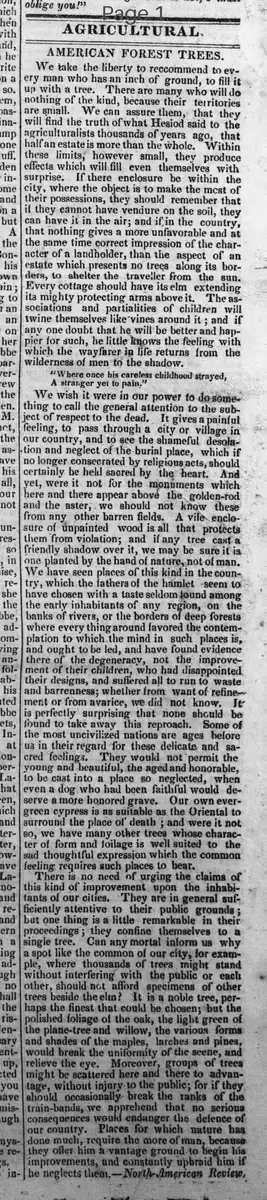
We take the liberty to recommend to every man who has an inch of ground, to fill it up with a tree. There are many who will do nothing of the kind, because their territories are small. We can assure them, that they will find the truth of what Hesiod said to the agriculturalists thousands of years ago, that half an estate is more than the whole. Within these limits, however small, they produce effects which will fill even themselves with surprise. If their enclosure be within the city, where the object is to make the most of their possessions, they should remember that if they cannot have verdure on the soil, they can have it in the air; and if in the country, that nothing gives a more unfavorable and at the same time correct impression of the character of a landholder, than the aspect of an estate which presents no trees along its borders, to shelter the traveler from the sun. Every cottage should have its elm extending its mighty protecting arms above it. The associations and partialities of children will twine themselves like vines around it; and if any one doubt that he will be better and happier for such, he little knows the feeling with which the wayfarer in life returns from the wilderness of men to the shadow.
"Where once his careless childhood strayed,
A stranger yet to pain."
We wish it were in our power to do something to call the general attention to the subject of respect to the dead. It gives a painful feeling, to pass through a city or village in our country, and to see the shameful desolation and neglect of the burial place, which if no longer consecrated by religious acts, should certainly be held sacred by the heart. And yet, were it not for the monuments which here and there appear above the golden-rod and the aster, we should not know these from any other barren fields. A vile enclosure of unpainted wood is all that protects them from violation; and if any tree cast a friendly shadow over it, we may be sure it is one planted by the hand of nature, not of man. We have seen places of this kind in the country, which the fathers of the hamlet seem to have chosen with a taste seldom found among the early inhabitants of any region, on the banks of rivers, or the borders of deep forests where every thing around favored the contemplation to which the mind in such places is, and ought to be led, and have found evidence there of the degeneracy, not the improvement of their children, who had disappointed their designs, and suffered all to run to waste and barrenness; whether from want of refinement or from avarice, we did not know. It is perfectly surprising that none should be found to take away this reproach. Some of the most uncivilized nations are ages before us in their regard for these delicate and sacred feelings. They would not permit the young and beautiful, the aged and honorable, to be cast into a place so neglected, when even a dog who had been faithful would deserve a more honored grave. Our own evergreen cypress is as suitable as the Oriental to surround the place of death; and were it not so, we have many other trees whose character of form and foliage is well suited to the sad thoughtful expression which the common feeling requires such places to bear.
There is no need of urging the claims of this kind of improvement upon the inhabitants of our cities. They are in general sufficiently attentive to their public grounds; but one thing is a little remarkable in their proceedings; they confine themselves to a single tree. Can any mortal inform us why a spot like the common of our city, for example, where thousands of trees might stand without interfering with the public or each other, should not afford specimens of other trees beside the elm? It is a noble tree, perhaps the finest that could be chosen; but the polished foliage of the oak, the light green of the plane-tree and willow, the various forms and shades of the maples, larches and pines, would break the uniformity of the scene, and relieve the eye. Moreover, groups of trees might be scattered here and there to advantage, without injury to the public; or if they should occasionally break the ranks of the train-bands, we apprehend that no serious consequences would endanger the defence of our country. Places of which nature has done much, require the more of man, because they offer him a vantage ground to begin his improvements, and constantly upbraid him if he neglects them.—North-American Review.
AMERICAN FOREST TREES.
We take the liberty to recommend to every man who has an inch of ground, to fill it up with a tree. There are many who will do nothing of the kind, because their territories are small. We can assure them, that they will find the truth of what Hesiod said to the agriculturalists thousands of years ago, that half an estate is more than the whole. Within these limits, however small, they produce effects which will fill even themselves with surprise. If their enclosure be within the city, where the object is to make the most of their possessions, they should remember that if they cannot have verdure on the soil, they can have it in the air; and if in the country, that nothing gives a more unfavorable and at the same time correct impression of the character of a landholder, than the aspect of an estate which presents no trees along its borders, to shelter the traveler from the sun. Every cottage should have its elm extending its mighty protecting arms above it. The associations and partialities of children will twine themselves like vines around it; and if any one doubt that he will be better and happier for such, he little knows the feeling with which the wayfarer in life returns from the wilderness of men to the shadow.
"Where once his careless childhood strayed,
A stranger yet to pain."
We wish it were in our power to do something to call the general attention to the subject of respect to the dead. It gives a painful feeling, to pass through a city or village in our country, and to see the shameful desolation and neglect of the burial place, which if no longer consecrated by religious acts, should certainly be held sacred by the heart. And yet, were it not for the monuments which here and there appear above the golden-rod and the aster, we should not know these from any other barren fields. A vile enclosure of unpainted wood is all that protects them from violation; and if any tree cast a friendly shadow over it, we may be sure it is one planted by the hand of nature, not of man. We have seen places of this kind in the country, which the fathers of the hamlet seem to have chosen with a taste seldom found among the early inhabitants of any region, on the banks of rivers, or the borders of deep forests where every thing around favored the contemplation to which the mind in such places is, and ought to be led, and have found evidence there of the degeneracy, not the improvement of their children, who had disappointed their designs, and suffered all to run to waste and barrenness; whether from want of refinement or from avarice, we did not know. It is perfectly surprising that none should be found to take away this reproach. Some of the most uncivilized nations are ages before us in their regard for these delicate and sacred feelings. They would not permit the young and beautiful, the aged and honorable, to be cast into a place so neglected, when even a dog who had been faithful would deserve a more honored grave. Our own evergreen cypress is as suitable as the Oriental to surround the place of death; and were it not so, we have many other trees whose character of form and foliage is well suited to the sad thoughtful expression which the common feeling requires such places to bear.
There is no need of urging the claims of this kind of improvement upon the inhabitants of our cities. They are in general sufficiently attentive to their public grounds; but one thing is a little remarkable in their proceedings; they confine themselves to a single tree. Can any mortal inform us why a spot like the common of our city, for example, where thousands of trees might stand without interfering with the public or each other, should not afford specimens of other trees beside the elm? It is a noble tree, perhaps the finest that could be chosen; but the polished foliage of the oak, the light green of the plane-tree and willow, the various forms and shades of the maples, larches and pines, would break the uniformity of the scene, and relieve the eye. Moreover, groups of trees might be scattered here and there to advantage, without injury to the public; or if they should occasionally break the ranks of the train-bands, we apprehend that no serious consequences would endanger the defence of our country. Places of which nature has done much, require the more of man, because they offer him a vantage ground to begin his improvements, and constantly upbraid him if he neglects them.—North-American Review.
What sub-type of article is it?
Agriculture
Moral Or Religious
Social Reform
What keywords are associated?
Tree Planting
American Forest Trees
Burial Grounds Neglect
Urban Greenery
Moral Respect For Dead
Environmental Improvement
What entities or persons were involved?
Hesiod
North American Review
Editorial Details
Primary Topic
Recommendation For Planting American Forest Trees And Respecting Burial Grounds
Stance / Tone
Exhortative Advocacy For Environmental And Moral Improvements
Key Figures
Hesiod
North American Review
Key Arguments
Planting Trees On Even Small Plots Yields Greater Benefits Than Leaving Land Bare
Trees Provide Shelter, Aesthetic Value, And Emotional Associations, Especially For Children
Neglect Of Burial Grounds Is Shameful And Contrasts With Respect In Uncivilized Nations
Suitable Trees Like Cypress Should Surround Cemeteries To Honor The Dead
Urban Public Spaces Should Feature Variety Of Trees Beyond Just Elms For Visual Relief
Groups Of Trees Enhance Natural Landscapes Without Harming Public Use