Thank you for visiting SNEWPapers!
Sign up free
Editorial
January 22, 1800
Gazette Of The United States, & Philadelphia Daily Advertiser
Philadelphia, Philadelphia County, Pennsylvania
What is this article about?
An anonymous communication in The Gazette criticizes Pennsylvania Governor Thomas McKean for arbitrarily removing competent prothonotaries and registers who supported the Revolution, arguing it undermines republican principles, freedom of election, and public trust in appointments. It contrasts this with British practices and calls for removals only for public good.
Clipping
OCR Quality
98%
Excellent
Full Text
The Gazette.
PHILADELPHIA, WEDNESDAY EVENING, JANUARY 22
Justum et tenacem propositi virum,
Non civium ardor prava jubentium,
Mente quatit solida. Non vultus instantis tyranni
Mente quatit solida.
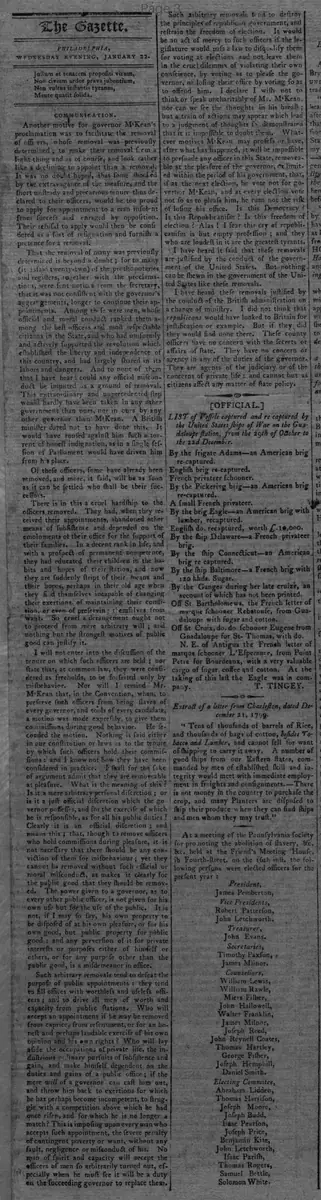
COMMUNICATION.
Another motive for governor McKean's proclamation was to facilitate the removal of officers, whose removal was previously determined; to make their removal seem a light thing and as of course, and look rather like a declining to appoint than a removal.
It was no doubt hoped, that some shocked by the extravagance of the measure, and the short unsteady and precarious tenure thus declared to their officers, would be too proud to apply for appointment to a man insolent from success and enraged by opposition.
Their refusal to apply would then be considered as a sort of resignation and furnish a pretence for a removal.
That the removal of many was previously determined is beyond a doubt; for to many (it is said twenty-two) of the prothonotaries and registers, together with the proclamations, were sent notices from the secretary, that it was not consistent with the governor's engagements, longer to continue their appointments. Among these were men, whose official and moral conduct ranked them among the best officers and most respectable citizens in the State, and who had uniformly and actively supported the revolution which established the liberty and independence of this country, and had largely borne in its labors and dangers. And to none of them that I have heard could any official misconduct be imputed as a ground of removal.
This extraordinary and unprecedented step would hardly have been taken in any other government than ours, nor in ours by any other governor than McKean. A British minister dared not to have done this. It would have roused against him such a torrent of honest indignation, as in a single session of Parliament would have driven him from his place.
Of these officers, some have already been removed, and more, it is said, will be as soon as it can be settled who shall be their successors.
There is in this a cruel hardship to the officers removed. They had, when they received their appointments, abandoned other means of subsistence and depended on the emoluments of their office for the support of their families. In a decent rank in life, and with a prospect of permanent competence, they had educated their children in the habits and hopes of their station, and now they are suddenly stripped of their means and their hopes, perhaps in their old age when they find themselves incapable of changing their exertions of maintaining their condition, or even of preserving themselves from want. So cruel a derangement ought not to proceed from mere arbitrary will; and nothing but the strongest motives of public good can justify it.
I will not enter into the discussion of the tenure on which such officers are held; nor state that, at common law, they were considered as freeholds, to be forfeited only by misbehavior. Nor will I remind Mr. McKean that, in the Convention, when, to preserve such officers from being slaves of every governor, and tools of every candidate, a motion was made expressly to give them commissions during good behavior. He seconded the motion. Nothing is said either in our constitution or laws as to the tenure by which such officers hold their commissions: and I know not how they have been considered in practice. I shall for the sake of argument admit that they are removable at pleasure. What is the meaning of this? Is it a mere arbitrary personal discretion; or is it a just official discretion which the governor possesses, and for the exercise of which he is responsible, as for all his public duties? Clearly it is an official discretion; and means this; that, though to remove officers who hold commissions during pleasure, it is not necessary that there should be any conviction of them for misbehavior; yet they cannot be removed without such official or moral misconduct, as makes it clearly for the public good that they should be removed. The power given to a governor, as to every other public officer, is not given for his own use but for the use of the public. It is not, if I may so say, his own property to be disposed of at his own pleasure, or for his own good, but public property for public good: and any perversion of it for private interests or purposes either of himself or others, or for any purpose other than the public good, is a misdemeanor in office.
Such arbitrary removals tend to defeat the purpose of public appointments: they tend to fill offices with worthless and useless officers; and to drive all men of worth and capacity from public stations. Who will accept an appointment if he may be removed from caprice, from resentment, or for an honest and perhaps laudable exercise of his own opinion and his own rights? Who will lay aside the occupations of private life, the industrious or lucrative pursuits of subsistence and gain, and make himself dependent on the duties and gains of a public office; if the mere will of a governor can cast him out, and throw him back to exertions for which he has perhaps become incompetent, to struggle with a competition above which he had once risen, and for which he is no longer a match? This is imposing upon every man who accepts such appointment, the severe penalty of contingent poverty or want, without any fault, negligence or misconduct of his. No man of spirit and capacity will accept the offices of men so arbitrarily turned out, especially when he must see it will be a duty on the succeeding governor to replace them.
Such arbitrary removals tend to destroy the principles of republican government, and restrain the freedom of election. It would be an act of mercy to such officers if the legislature would pass a law to disqualify them for voting at elections and not leave them in the cruel dilemma of violating their own conscience, by voting as to please the governor, or losing their office by voting so as to offend him. I declare I wish not to think or speak uncharitably of Mr. McKean. Nor can we see the thoughts in his breast; but a train of actions may appear which lead to a judgment of thoughts demonstrated that it is impossible to doubt them. Whatever motives McKean may profess or have, after what has happened, it will be impossible to persuade any officer in this State, removable at the pleasure of the governor, or limited within the period of his government, that, if at the next election, he vote not for governor McKean, and at every election vote not so as to please him, he runs not the risk of losing his office. Is this Democracy? Is this Republicanism? Is this freedom of election? Alas! I fear this cry of republicanism is but empty profession; and they who are loudest in it are the greatest tyrants.
I have heard it said that these removals are justified by the conduct of the government of the United States. But nothing can be shown in the government of the United States like these removals.
I have heard these removals justified by the conduct of the British administration on a change of ministry. I did not think that republicans would have looked to Britain for justification or example. But if they did they would find none there. These county officers have no concern with the secrets or affairs of state. They have no concern or agency in any of the duties of the governor. They are agents of the judiciary or of the concerns of private life: and cannot but as citizens affect any matter of state policy.
PHILADELPHIA, WEDNESDAY EVENING, JANUARY 22
Justum et tenacem propositi virum,
Non civium ardor prava jubentium,
Mente quatit solida. Non vultus instantis tyranni
Mente quatit solida.
COMMUNICATION.
Another motive for governor McKean's proclamation was to facilitate the removal of officers, whose removal was previously determined; to make their removal seem a light thing and as of course, and look rather like a declining to appoint than a removal.
It was no doubt hoped, that some shocked by the extravagance of the measure, and the short unsteady and precarious tenure thus declared to their officers, would be too proud to apply for appointment to a man insolent from success and enraged by opposition.
Their refusal to apply would then be considered as a sort of resignation and furnish a pretence for a removal.
That the removal of many was previously determined is beyond a doubt; for to many (it is said twenty-two) of the prothonotaries and registers, together with the proclamations, were sent notices from the secretary, that it was not consistent with the governor's engagements, longer to continue their appointments. Among these were men, whose official and moral conduct ranked them among the best officers and most respectable citizens in the State, and who had uniformly and actively supported the revolution which established the liberty and independence of this country, and had largely borne in its labors and dangers. And to none of them that I have heard could any official misconduct be imputed as a ground of removal.
This extraordinary and unprecedented step would hardly have been taken in any other government than ours, nor in ours by any other governor than McKean. A British minister dared not to have done this. It would have roused against him such a torrent of honest indignation, as in a single session of Parliament would have driven him from his place.
Of these officers, some have already been removed, and more, it is said, will be as soon as it can be settled who shall be their successors.
There is in this a cruel hardship to the officers removed. They had, when they received their appointments, abandoned other means of subsistence and depended on the emoluments of their office for the support of their families. In a decent rank in life, and with a prospect of permanent competence, they had educated their children in the habits and hopes of their station, and now they are suddenly stripped of their means and their hopes, perhaps in their old age when they find themselves incapable of changing their exertions of maintaining their condition, or even of preserving themselves from want. So cruel a derangement ought not to proceed from mere arbitrary will; and nothing but the strongest motives of public good can justify it.
I will not enter into the discussion of the tenure on which such officers are held; nor state that, at common law, they were considered as freeholds, to be forfeited only by misbehavior. Nor will I remind Mr. McKean that, in the Convention, when, to preserve such officers from being slaves of every governor, and tools of every candidate, a motion was made expressly to give them commissions during good behavior. He seconded the motion. Nothing is said either in our constitution or laws as to the tenure by which such officers hold their commissions: and I know not how they have been considered in practice. I shall for the sake of argument admit that they are removable at pleasure. What is the meaning of this? Is it a mere arbitrary personal discretion; or is it a just official discretion which the governor possesses, and for the exercise of which he is responsible, as for all his public duties? Clearly it is an official discretion; and means this; that, though to remove officers who hold commissions during pleasure, it is not necessary that there should be any conviction of them for misbehavior; yet they cannot be removed without such official or moral misconduct, as makes it clearly for the public good that they should be removed. The power given to a governor, as to every other public officer, is not given for his own use but for the use of the public. It is not, if I may so say, his own property to be disposed of at his own pleasure, or for his own good, but public property for public good: and any perversion of it for private interests or purposes either of himself or others, or for any purpose other than the public good, is a misdemeanor in office.
Such arbitrary removals tend to defeat the purpose of public appointments: they tend to fill offices with worthless and useless officers; and to drive all men of worth and capacity from public stations. Who will accept an appointment if he may be removed from caprice, from resentment, or for an honest and perhaps laudable exercise of his own opinion and his own rights? Who will lay aside the occupations of private life, the industrious or lucrative pursuits of subsistence and gain, and make himself dependent on the duties and gains of a public office; if the mere will of a governor can cast him out, and throw him back to exertions for which he has perhaps become incompetent, to struggle with a competition above which he had once risen, and for which he is no longer a match? This is imposing upon every man who accepts such appointment, the severe penalty of contingent poverty or want, without any fault, negligence or misconduct of his. No man of spirit and capacity will accept the offices of men so arbitrarily turned out, especially when he must see it will be a duty on the succeeding governor to replace them.
Such arbitrary removals tend to destroy the principles of republican government, and restrain the freedom of election. It would be an act of mercy to such officers if the legislature would pass a law to disqualify them for voting at elections and not leave them in the cruel dilemma of violating their own conscience, by voting as to please the governor, or losing their office by voting so as to offend him. I declare I wish not to think or speak uncharitably of Mr. McKean. Nor can we see the thoughts in his breast; but a train of actions may appear which lead to a judgment of thoughts demonstrated that it is impossible to doubt them. Whatever motives McKean may profess or have, after what has happened, it will be impossible to persuade any officer in this State, removable at the pleasure of the governor, or limited within the period of his government, that, if at the next election, he vote not for governor McKean, and at every election vote not so as to please him, he runs not the risk of losing his office. Is this Democracy? Is this Republicanism? Is this freedom of election? Alas! I fear this cry of republicanism is but empty profession; and they who are loudest in it are the greatest tyrants.
I have heard it said that these removals are justified by the conduct of the government of the United States. But nothing can be shown in the government of the United States like these removals.
I have heard these removals justified by the conduct of the British administration on a change of ministry. I did not think that republicans would have looked to Britain for justification or example. But if they did they would find none there. These county officers have no concern with the secrets or affairs of state. They have no concern or agency in any of the duties of the governor. They are agents of the judiciary or of the concerns of private life: and cannot but as citizens affect any matter of state policy.
What sub-type of article is it?
Partisan Politics
Constitutional
What keywords are associated?
Officer Removals
Governor Mckean
Arbitrary Appointments
Republican Government
Freedom Of Election
Public Good
What entities or persons were involved?
Governor Mckean
Prothonotaries And Registers
British Ministers
Editorial Details
Primary Topic
Criticism Of Governor Mckean's Arbitrary Removal Of Officers
Stance / Tone
Strongly Critical Of Arbitrary Removals And Their Threat To Republicanism
Key Figures
Governor Mckean
Prothonotaries And Registers
British Ministers
Key Arguments
Removals Were Pre Determined And Disguised As Routine
Removed Officers Were Competent, Loyal Revolution Supporters Without Misconduct
Arbitrary Removals Cause Hardship And Deter Qualified Candidates
Such Actions Undermine Public Good And Constitute Misdemeanor In Office
They Threaten Freedom Of Election And Republican Principles
No Justification From U.S. Or British Practices