Thank you for visiting SNEWPapers!
Sign up free
Story
October 19, 1833
The Liberator
Boston, Suffolk County, Massachusetts
What is this article about?
Samuel Chilton of Tinsbury near Bath experienced multiple episodes of profound sleep lasting weeks to months in 1694, 1696, and 1697-1698. Despite medical interventions, he remained insensible but sustained himself, awakening healthy each time with no recollection.
Clipping
OCR Quality
98%
Excellent
Full Text
MISCELLANEOUS.
[From Frazer's English Magazine.]
THE EXTRAORDINARY SLEEPER.
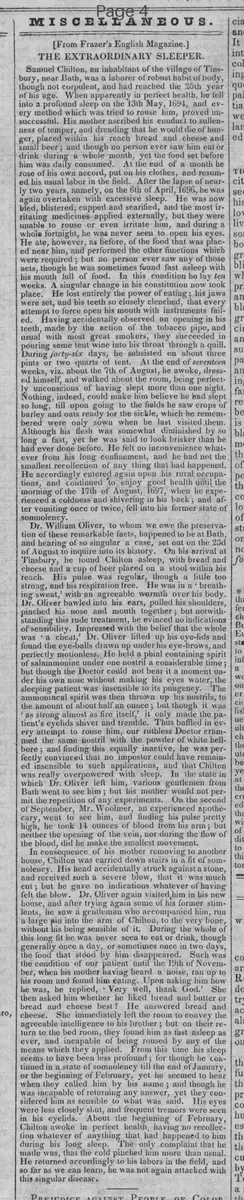
Samuel Chilton, an inhabitant of the village of Tinsbury, near Bath, was a laborer of robust habit of body though not corpulent, and had reached the 25th year of his age. When apparently in perfect health, he fell into a profound sleep on the 13th May, 1694, and every method which was tried to rouse him, proved unsuccessful. His mother ascribed his conduct to sullenness of temper, and dreading that he would die of hunger, placed within his reach bread and cheese and small beer; and though no person ever saw him eat or drink during a whole month, yet the food set before him was daily consumed. At the end of a month he rose of his own accord, put on his clothes, and resumed his usual labor in the field. After the lapse of nearly two years, namely, on the 6th of April, 1696, he was again overtaken with excessive sleep. He was now bled, blistered, cupped and scarified, and the most irritating medicines applied externally, but they were unable to rouse or even irritate him, and during a whole fortnight, he was never seen to open his eyes. He ate, however, as before, of the food that was placed near him, and performed the other functions which were required; but no person ever saw any of those acts, though he was sometimes found fast asleep with his mouth full of food. In this condition he lay ten weeks. A singular change in his constitution now took place. He lost entirely the power of eating; his jaws were set, and his teeth so closely clenched, that every attempt to force open his mouth with instruments failed. Having accidentally observed an opening in his teeth, made by the action of the tobacco pipe, and usual with most great smokers, they succeeded in pouring some tent wine into his throat through a quill. During forty-six days, he subsisted on about three pints or two quarts of tent. At the end of seventeen weeks, viz. about the 7th of August, he awoke, dressed himself, and walked about the room, being perfectly unconscious of having slept more than one night. Nothing, indeed, could make him believe he had slept so long, till upon going to the fields he saw crops of barley and oats ready for the sickle, which he remembered were only sown when he last visited them. Although his flesh was somewhat diminished by so long a fast, yet he was said to look brisker than he had ever done before. He felt no inconvenience whatever from his long confinement, and he had not the smallest recollection of any thing that had happened. He accordingly entered again upon his rural occupations, and continued to enjoy good health until the morning of the 17th of August, 1697, when he experienced a coldness and shivering in his back; and after vomiting once or twice, fell into his former state of somnolency.
Dr. William Oliver, to whom we owe the preservation of these remarkable facts, happened to be at Bath, and hearing of so singular a case, set out on the 23d of August to inquire into its history. On his arrival at Tinsbury, he found Chilton asleep, with bread and cheese and a cup of beer placed on a stool within his reach. His pulse was regular, though a little too strong, and his respiration free. He was in a 'breathing sweat,' with an agreeable warmth over his body. Dr. Oliver bawled into his ears, pulled his shoulders, pinched his nose and mouth together; but notwithstanding this rude treatment, he evinced no indications of sensibility. Impressed with the belief that the whole was 'a cheat,' Dr. Oliver lifted up his eye-lids and found the eye-balls drawn up under his eye-brows, and perfectly motionless. He held a phial containing spirit of salammoniac under one nostril a considerable time; but though the Doctor could not bear it a moment under his own nose without making his eyes water, the sleeping patient was insensible to its pungency. The ammoniacal spirit was then thrown up his nostrils, to the amount of about half an ounce; but though it was 'as strong almost as fire itself,' it only made the patient's eyelids shiver and tremble. Thus baffled in every attempt to rouse him, our ruthless Doctor crammed the same nostril with the powder of white hellebore; and finding this equally inactive, he was perfectly convinced that no impostor could have remained insensible to such applications, and that Chilton was really overpowered with sleep. In the state in which Dr. Oliver left him, various gentlemen from Bath went to see him; but his mother would not permit the repetition of any experiments. On the second of September, Mr. Woolmer, an experienced apothecary, went to see him, and finding his pulse pretty high, he took 14 ounces of blood from his arm; but neither the opening of the vein, nor during the flow of the blood, did he make the smallest movement. In consequence of his mother removing to another house, Chilton was carried down stairs in a fit of somnolency. His head accidentally struck against a stone, and received such a severe blow, that it was much cut; but he gave no indications whatever of having felt the blow. Dr. Oliver again visited him in his new house, and after trying again some of his former stimulants, he saw a gentleman who accompanied him, run a large pin into the arm of Chilton, to the very bone, without his being sensible of it. During the whole of this long fit he was never seen to eat or drink, though generally once a day, or sometimes once in two days, the food that stood by him disappeared. Such was the condition of our patient until the 19th of November, when his mother having heard a noise, ran up to his room and found him eating. Upon asking him how he was, he replied, 'Very well, thank God.' She then asked him whether he liked bread and butter or bread and cheese best? He answered bread and cheese. She immediately left the room to convey the agreeable intelligence to his brother; but on their return to the bed room, they found him as fast asleep as ever, and incapable of being roused by any of the means which they applied. From this time his sleep seems to have been less profound; for though he continued in a state of somnolency till the end of January, or the beginning of February, yet he seemed to hear when they called him by his name; and though he was incapable of returning any answer, yet they considered him as sensible to what was said. His eyes were less closely shut, and frequent tremors were seen in his eyelids. About the beginning of February, Chilton awoke in perfect health, having no recollection whatever of anything that had happened to him during his long sleep. The only complaint that he made was, that the cold pinched him more than usual. He returned accordingly to his labors in the field, and so far as we can learn, he was not again attacked with this singular disease.
[From Frazer's English Magazine.]
THE EXTRAORDINARY SLEEPER.
Samuel Chilton, an inhabitant of the village of Tinsbury, near Bath, was a laborer of robust habit of body though not corpulent, and had reached the 25th year of his age. When apparently in perfect health, he fell into a profound sleep on the 13th May, 1694, and every method which was tried to rouse him, proved unsuccessful. His mother ascribed his conduct to sullenness of temper, and dreading that he would die of hunger, placed within his reach bread and cheese and small beer; and though no person ever saw him eat or drink during a whole month, yet the food set before him was daily consumed. At the end of a month he rose of his own accord, put on his clothes, and resumed his usual labor in the field. After the lapse of nearly two years, namely, on the 6th of April, 1696, he was again overtaken with excessive sleep. He was now bled, blistered, cupped and scarified, and the most irritating medicines applied externally, but they were unable to rouse or even irritate him, and during a whole fortnight, he was never seen to open his eyes. He ate, however, as before, of the food that was placed near him, and performed the other functions which were required; but no person ever saw any of those acts, though he was sometimes found fast asleep with his mouth full of food. In this condition he lay ten weeks. A singular change in his constitution now took place. He lost entirely the power of eating; his jaws were set, and his teeth so closely clenched, that every attempt to force open his mouth with instruments failed. Having accidentally observed an opening in his teeth, made by the action of the tobacco pipe, and usual with most great smokers, they succeeded in pouring some tent wine into his throat through a quill. During forty-six days, he subsisted on about three pints or two quarts of tent. At the end of seventeen weeks, viz. about the 7th of August, he awoke, dressed himself, and walked about the room, being perfectly unconscious of having slept more than one night. Nothing, indeed, could make him believe he had slept so long, till upon going to the fields he saw crops of barley and oats ready for the sickle, which he remembered were only sown when he last visited them. Although his flesh was somewhat diminished by so long a fast, yet he was said to look brisker than he had ever done before. He felt no inconvenience whatever from his long confinement, and he had not the smallest recollection of any thing that had happened. He accordingly entered again upon his rural occupations, and continued to enjoy good health until the morning of the 17th of August, 1697, when he experienced a coldness and shivering in his back; and after vomiting once or twice, fell into his former state of somnolency.
Dr. William Oliver, to whom we owe the preservation of these remarkable facts, happened to be at Bath, and hearing of so singular a case, set out on the 23d of August to inquire into its history. On his arrival at Tinsbury, he found Chilton asleep, with bread and cheese and a cup of beer placed on a stool within his reach. His pulse was regular, though a little too strong, and his respiration free. He was in a 'breathing sweat,' with an agreeable warmth over his body. Dr. Oliver bawled into his ears, pulled his shoulders, pinched his nose and mouth together; but notwithstanding this rude treatment, he evinced no indications of sensibility. Impressed with the belief that the whole was 'a cheat,' Dr. Oliver lifted up his eye-lids and found the eye-balls drawn up under his eye-brows, and perfectly motionless. He held a phial containing spirit of salammoniac under one nostril a considerable time; but though the Doctor could not bear it a moment under his own nose without making his eyes water, the sleeping patient was insensible to its pungency. The ammoniacal spirit was then thrown up his nostrils, to the amount of about half an ounce; but though it was 'as strong almost as fire itself,' it only made the patient's eyelids shiver and tremble. Thus baffled in every attempt to rouse him, our ruthless Doctor crammed the same nostril with the powder of white hellebore; and finding this equally inactive, he was perfectly convinced that no impostor could have remained insensible to such applications, and that Chilton was really overpowered with sleep. In the state in which Dr. Oliver left him, various gentlemen from Bath went to see him; but his mother would not permit the repetition of any experiments. On the second of September, Mr. Woolmer, an experienced apothecary, went to see him, and finding his pulse pretty high, he took 14 ounces of blood from his arm; but neither the opening of the vein, nor during the flow of the blood, did he make the smallest movement. In consequence of his mother removing to another house, Chilton was carried down stairs in a fit of somnolency. His head accidentally struck against a stone, and received such a severe blow, that it was much cut; but he gave no indications whatever of having felt the blow. Dr. Oliver again visited him in his new house, and after trying again some of his former stimulants, he saw a gentleman who accompanied him, run a large pin into the arm of Chilton, to the very bone, without his being sensible of it. During the whole of this long fit he was never seen to eat or drink, though generally once a day, or sometimes once in two days, the food that stood by him disappeared. Such was the condition of our patient until the 19th of November, when his mother having heard a noise, ran up to his room and found him eating. Upon asking him how he was, he replied, 'Very well, thank God.' She then asked him whether he liked bread and butter or bread and cheese best? He answered bread and cheese. She immediately left the room to convey the agreeable intelligence to his brother; but on their return to the bed room, they found him as fast asleep as ever, and incapable of being roused by any of the means which they applied. From this time his sleep seems to have been less profound; for though he continued in a state of somnolency till the end of January, or the beginning of February, yet he seemed to hear when they called him by his name; and though he was incapable of returning any answer, yet they considered him as sensible to what was said. His eyes were less closely shut, and frequent tremors were seen in his eyelids. About the beginning of February, Chilton awoke in perfect health, having no recollection whatever of anything that had happened to him during his long sleep. The only complaint that he made was, that the cold pinched him more than usual. He returned accordingly to his labors in the field, and so far as we can learn, he was not again attacked with this singular disease.
What sub-type of article is it?
Medical Curiosity
Extraordinary Event
Biography
What themes does it cover?
Misfortune
Recovery
What keywords are associated?
Prolonged Sleep
Medical Anomaly
Sleeping Sickness
Samuel Chilton
Tinsbury
Dr. Oliver
What entities or persons were involved?
Samuel Chilton
Dr. William Oliver
Chilton's Mother
Where did it happen?
Tinsbury, Near Bath
Story Details
Key Persons
Samuel Chilton
Dr. William Oliver
Chilton's Mother
Location
Tinsbury, Near Bath
Event Date
1694 1698
Story Details
Samuel Chilton suffered three episodes of prolonged, profound sleep: one month in 1694, seventeen weeks in 1696 with initial eating then only tent wine, and five months in 1697-1698. Despite medical tests confirming genuineness, he sustained himself unseen, awoke healthy each time unaware of the duration, and resumed labor.