Thank you for visiting SNEWPapers!
Sign up free
Editorial
October 14, 1802
Alexandria Advertiser And Commercial Intelligencer
Alexandria, Virginia
What is this article about?
An October 9 editorial in Richmond denounces President Thomas Jefferson's letters to James Callender, published in the Recorder, for endorsing seditious writings that abused George Washington, attacked the U.S. Constitution as a Tory plot, justified insurrections like Fries' Rebellion, and undermined government stability, thereby exposing Jefferson's lack of impartiality, patriotism, and moral integrity.
Clipping
OCR Quality
98%
Excellent
Full Text
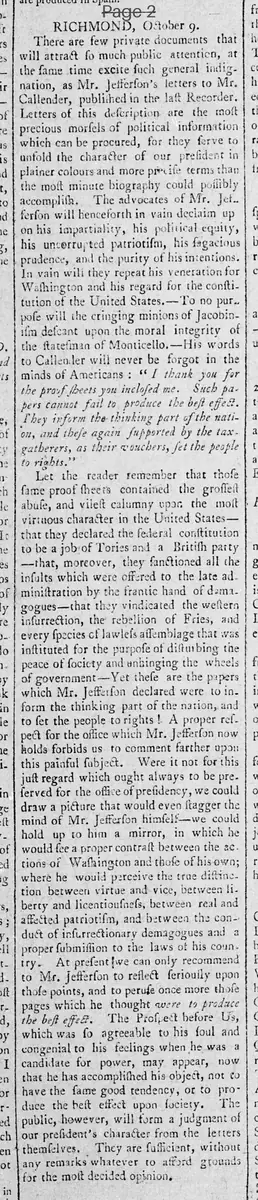
RICHMOND, October 9.
There are few private documents that will attract so much public attention, at the same time excite such general indignation, as Mr. Jefferson's letters to Mr. Callender, published in the last Recorder. Letters of this description are the most precious morsels of political information which can be procured, for they serve to unfold the character of our president in plainer colours and more precise terms than the most minute biography could possibly accomplish. The advocates of Mr. Jefferson will henceforth in vain declaim upon his impartiality, his political equity, his uncorrupted patriotism, his sagacious prudence, and the purity of his intentions. In vain will they repeat his veneration for Washington and his regard for the constitution of the United States. To no purpose will the cringing minions of Jacobinism descant upon the moral integrity of the statesman of Monticello. His words to Callender will never be forgot in the minds of Americans: "I thank you for the proof sheets you enclosed me. Such papers cannot fail to produce the best effect. They inform the thinking part of the nation, and these again supported by the tax-gatherers, as their vouchers, set the people to rights."
Let the reader remember that those same proof sheets contained the grossest abuse, and vilest calumny upon the most virtuous character in the United States--that they declared the federal constitution to be a job of Tories and a British party--that, moreover, they sanctioned all the insults which were offered to the late administration by the frantic hand of demagogues--that they vindicated the western insurrection, the rebellion of Fries, and every species of lawless assemblage that was instituted for the purpose of disturbing the peace of society and unhinging the wheels of government--Yet these are the papers which Mr. Jefferson declared were to inform the thinking part of the nation, and to set the people to rights! A proper respect for the office which Mr. Jefferson now holds forbids us to comment farther upon this painful subject. Were it not for this just regard which ought always to be preserved for the office of presidency, we could draw a picture that would even stagger the mind of Mr. Jefferson himself--we could hold up to him a mirror, in which he would see a proper contrast between the actions of Washington and those of his own; where he would perceive the true distinction between virtue and vice, between liberty and licentiousness, between real and affected patriotism, and between the conduct of insurrectionary demagogues and a proper submission to the laws of his country. At present we can only recommend to Mr. Jefferson to reflect seriously upon those points, and to peruse once more those pages which he thought were to produce the best effect. The Prospect before Us, which was so agreeable to his soul and congenial to his feelings when he was a candidate for power, may appear, now that he has accomplished his object, not to have the same good tendency, or to produce the best effect upon society. The public, however, will form a judgment of our president's character from the letters themselves. They are sufficient, without any remarks whatever to afford grounds for the most decided opinion.
There are few private documents that will attract so much public attention, at the same time excite such general indignation, as Mr. Jefferson's letters to Mr. Callender, published in the last Recorder. Letters of this description are the most precious morsels of political information which can be procured, for they serve to unfold the character of our president in plainer colours and more precise terms than the most minute biography could possibly accomplish. The advocates of Mr. Jefferson will henceforth in vain declaim upon his impartiality, his political equity, his uncorrupted patriotism, his sagacious prudence, and the purity of his intentions. In vain will they repeat his veneration for Washington and his regard for the constitution of the United States. To no purpose will the cringing minions of Jacobinism descant upon the moral integrity of the statesman of Monticello. His words to Callender will never be forgot in the minds of Americans: "I thank you for the proof sheets you enclosed me. Such papers cannot fail to produce the best effect. They inform the thinking part of the nation, and these again supported by the tax-gatherers, as their vouchers, set the people to rights."
Let the reader remember that those same proof sheets contained the grossest abuse, and vilest calumny upon the most virtuous character in the United States--that they declared the federal constitution to be a job of Tories and a British party--that, moreover, they sanctioned all the insults which were offered to the late administration by the frantic hand of demagogues--that they vindicated the western insurrection, the rebellion of Fries, and every species of lawless assemblage that was instituted for the purpose of disturbing the peace of society and unhinging the wheels of government--Yet these are the papers which Mr. Jefferson declared were to inform the thinking part of the nation, and to set the people to rights! A proper respect for the office which Mr. Jefferson now holds forbids us to comment farther upon this painful subject. Were it not for this just regard which ought always to be preserved for the office of presidency, we could draw a picture that would even stagger the mind of Mr. Jefferson himself--we could hold up to him a mirror, in which he would see a proper contrast between the actions of Washington and those of his own; where he would perceive the true distinction between virtue and vice, between liberty and licentiousness, between real and affected patriotism, and between the conduct of insurrectionary demagogues and a proper submission to the laws of his country. At present we can only recommend to Mr. Jefferson to reflect seriously upon those points, and to peruse once more those pages which he thought were to produce the best effect. The Prospect before Us, which was so agreeable to his soul and congenial to his feelings when he was a candidate for power, may appear, now that he has accomplished his object, not to have the same good tendency, or to produce the best effect upon society. The public, however, will form a judgment of our president's character from the letters themselves. They are sufficient, without any remarks whatever to afford grounds for the most decided opinion.
What sub-type of article is it?
Partisan Politics
Constitutional
Moral Or Religious
What keywords are associated?
Jefferson Letters
Callender Proof Sheets
Political Integrity
Federal Constitution
Fries Rebellion
Washington Virtue
Jacobinism
Presidential Character
What entities or persons were involved?
Thomas Jefferson
James Callender
George Washington
Editorial Details
Primary Topic
Criticism Of Jefferson's Endorsement Of Callender's Seditious Writings
Stance / Tone
Indignant Condemnation Of Jefferson's Character And Patriotism
Key Figures
Thomas Jefferson
James Callender
George Washington
Key Arguments
Jefferson's Letters To Callender Reveal His True Lack Of Impartiality And Patriotism
The Proof Sheets Endorsed Abuse Against Washington And The Virtuous
They Portrayed The U.S. Constitution As A Tory And British Plot
They Justified Insurrections Like The Western Insurrection And Fries' Rebellion
Such Writings Disturb Peace And Unhinge Government
Contrast Jefferson's Actions With Washington's Virtue
Recommend Jefferson Reflect On His Support For Licentiousness Over Liberty