Thank you for visiting SNEWPapers!
Sign up free
The Milwaukee Leader
Milwaukee, Milwaukee County, Wisconsin
What is this article about?
In 1925, racing motorist Capt. Malcolm Campbell and adventurer K. Lee Guinness hunt for buried pirate treasure on Cocos Island using a historical map. They battle jungle, heat, fire, and uncertainty but return empty-handed after weeks of searching, vowing to try again.
Merged-components note: Image spatially overlaps and illustrates the pirate gold story.
Clipping
OCR Quality
Full Text
By CHARLES B. Driscoll
Capt. Malcolm Campbell is known to the world as a famous racing motorist. All American motorists recall his winning the world's speed record at something like 207 miles an hour at Daytona Beach, Fla. The record has since passed to one of Capt. Campbell's countrymen, but there's no telling when Campbell may take the wheel and win it back again.
Capt. Campbell is a lover of adventure. But would you ever have taken him for a fellow who would go seeking buried treasure in earnest? Oh, yes, he has imagination, too! And when a man has love of adventure in his soul, coupled with a lively imagination, he can hardly keep away from this romantic business of seeking buried treasure.
Capt. Campbell went on a treasure-hunting expedition to Cocos Island, in company with K. Lee Guinness, another racing motorist and gentleman adventurer, in 1925. I understand he is writing a book about his adventure. When and if it is on the market, I certainly will be an interested reader. Capt. Campbell has told something of his romantic voyage in lectures and in short newspaper sketches, and the story sounds thrilling, as he presents it.
Cocos Island lies about 400 miles off the coast of Costa Rica, in the Pacific ocean. It is the most noted of all treasure islands. It is the mecca of nearly every adventurer who wants to find pirate gold and has the means to get from where he is to where he wants to be.
The island is owned by Great Britain, and is generally uninhabited. It was inhabited for many years by a peculiar old man who called himself king or governor of the island. He was a treasure-seeker who went to the treasure place and fell in love with the scenery and atmosphere of it. Recent visitors do not mention seeing him, so I presume he is dead.
Heavy jungle growth covers the island, which is low near the shore, but rises to about 3,000 feet in the center. The jungle and hills, sweltering under tropical heat, combine to discourage treasure-seekers. Although several determined parties go to Cocos Island every year to get the treasure, few stay at the island more than a week, and almost none last a month.
The job of getting the treasure is one that should not be undertaken by a party that isn't willing to put up with tropical heat and hard labor for at least two months, and three months if necessary.
The treasure of Cocos Island has been described in other tales in this series. I will be brief in referring to its history here.
There are three separate treasures that are generally reputed to be hidden on Cocos, but the one about which there is the most specific information for present-day treasure-seekers is the treasure of Lima.
It was at the time of the uprisings among the Spanish colonies in South America, when revolutionists followed the lead of Bolivar the Liberator, that the statesman in the capital of Peru became alarmed about the probable fate of the vast treasure of that city. This was in the first years of the 19th century.
When it was reported that revolutionists were about to march upon Lima, the fathers of the city looked about for a way to escape with their riches.
They employed the only disengaged large vessel in the harbor, which was the Mary Dear, British, under command of Capt. Tomson, or, as it is sometimes written, Thompson.
For a certain sum, Tomson agreed to transport the treasure from Lima to Spain, or to any intermediate port the owners might decide upon.
A week was spent in loading the ship with gold and silver, precious stones, golden statues, altar plate, money and gold and silver bars. When she sailed out of Lima harbor the Mary Dear carried a treasure reputed to be worth 40 million dollars.
Once out on the high seas, Tomson called his bully boys and had them throw all the grandees overboard.
He then made for Cocos Island, where the treasure was put away in a cave.
He joined Benito Bonito, a well known pirate of that day, and the two went out after more loot.
Tomson felt that the treasure of Lima alone was hardly enough to retire upon, especially if one had to divide with the crew. He was a canny Scot, and was not desirous of looking forward to an old age of want and penury.
The story generally accepted says that the pirates were overtaken by an avenging warship, and that Bonito committed suicide. All the others except two were killed. The two, including Capt. Tomson, were permitted to live when they represented to the navy men that they could lead them to the Lima treasure on Cocos Island.
The prisoners were taken to the island, escaped there, and fled into the interior, where they lived for a long time.
A whaler took off the two refugees, half dead, and one of them died aboard the whaler. The survivor was Tomson.
It was in 1844 that Tomson turned up in Newfoundland, the guest of a certain Keating. Tomson had a map of Cocos, with cross marking the spot where the treasure lies. He told Keating. They fitted out an expedition, and Tomson died on the eve of sailing.
The expedition proceeded to Cocos, under command of Keating and a Capt. Boag. They found the cave, with a stone slab for door that turned upon an axis, disclosing the most dazzling treasure that ever the eyes of man have rested upon.
That night the crew mutinied, demanding a share of the treasure that the bosses had found. There was plenty to go around, but treasure always makes men mad with avarice. Keating and Boag promised to share with the crew, but slipped away in the night in a rowboat, and hid in the interior of the island until the crew had sailed away with the ship.
They couldn't bear to divide the treasure, so they stayed there with it.
Keating came away from the island on a whaler, several months later, and returned to Newfoundland with about 15 thousand dollars' worth of gold, which was all he could carry about his person.
Tradition says Keating locked Boag within the treasure cave, to starve. Anyway, Boag was never seen again.
Capt. Campbell obtained Keating's map, with the cross mark at the site of the treasure. Keating's death occurred about 1870, and the map has passed through several hands and has inspired at least two expeditions directly.
There had been many expeditions that had gone to Cocos without the map.
Lee Guinness owned a yacht; Campbell owned the map. Together they would get the treasure. They took along shovels and spades, dynamite and food.
The Adventuress was a yacht of 250 tons. There was a crew of 12, and there were five gentlemen adventurers, including Campbell and Guinness. One of the adventurers was an old sea captain.
They found two inlets where boats could land. One is Wafer Bay, and the other Chatham Bay.
The chart indicated that the treasure was to be found by stepping off 40 paces in a certain direction from the place where high tide touched in the creek bed, and then turning and pacing some more.
But there was uncertainty as to the creek referred to, and the treasure-hunters were not even sure into which bay the creek flowed. However, they selected a creek that flowed into Chatham Bay as the one giving most promise. They waited for the high tide to make its mark, paced off the 40 paces, and then looked off in the direction indicated by the chart.
No bare rock, such as described in the chart, was found in the direction indicated. Unless—and here the party paused and disagreed—unless a certain rock out in the surf was meant!
Campbell was of opinion that this was indeed the rock of the treasure cave. The map said that the rock would be recognized by a hole, big enough to take a man's thumb, into which an iron bar was to be inserted in order to open the door to the cave.
Eventually Campbell made his way out to the rock in the surf, and examined it all over in search of the keyhole, but failed to find it.
Next day there was exploring inland. A party chopped its way through the jungle, uphill, to a big rock. That was a tough day's work, and nothing found.
Next day the Adventuress weighed anchor and went to Wafer Bay, since a majority decided that it was this bay that was outlined in the chart.
The treasure-hunters found a beautiful bay, with a beach, a fine creek, a good swimming pool some distance up the creek, and the remains of huts and other relics of many treasure-seeking expeditions.
A rocky hillside a mile inland was selected as the site of the treasure cave this time, and the party chopped its toilsome way through the brush, vines, trees and creepers.
On the way they passed a pit that measured about 20 feet wide and 12 feet deep which had been dug by some other party that had thought it was on the track of the treasure.
The tired workers reached their objective at sundown, and went right back again. They felt the need of rest and sleep.
Next day they went back to the rock, but careful searching failed to disclose the keyhole.
Back to Chatham Bay, and more climbing, chopping, crawling through jungle.
Campbell and two seamen decided to spend the night on the shore. The jungle came right down to the beach, and the adventurers had to burn brush all over the ground to kill the centipedes, before they could lie down to sleep.
After lunch next day they set fire to the jungle on the side of a steep hill, hoping to clear their way, so that they might get about more easily. It turned out to be a pretty good fire.
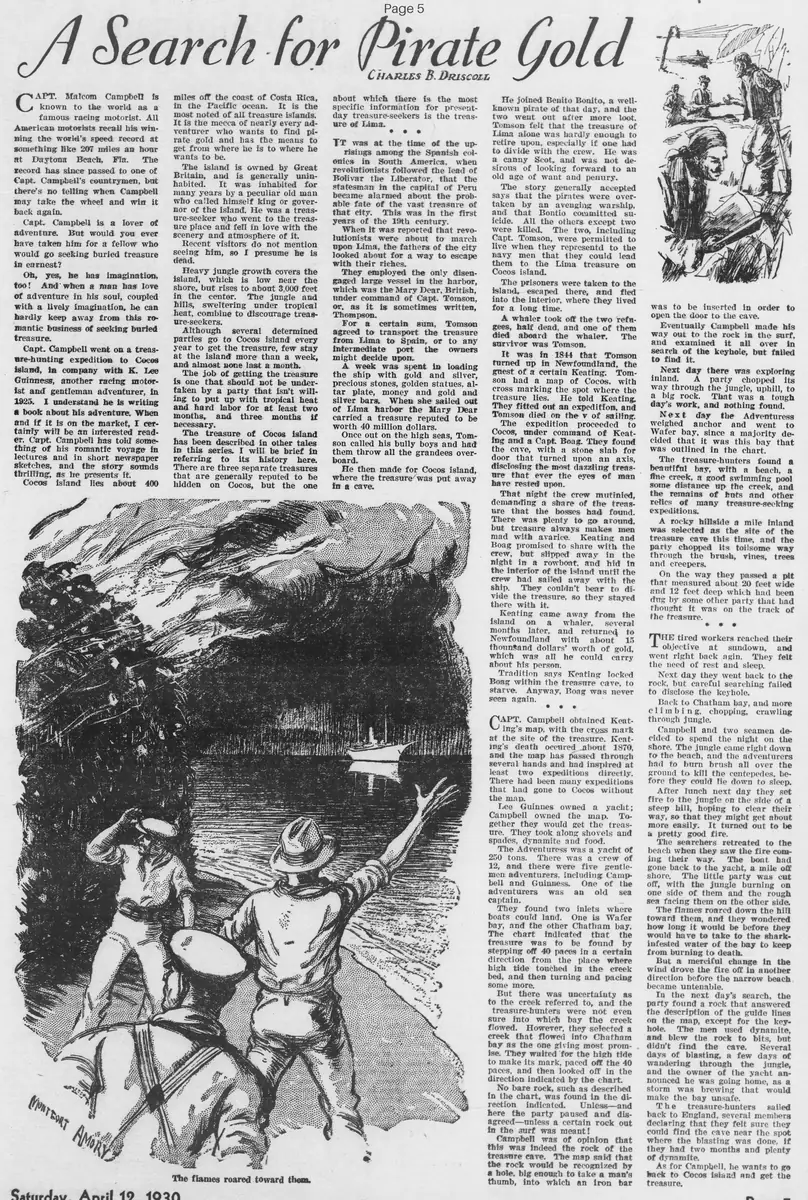
The searchers retreated to the beach when they saw the fire coming their way. The boat had gone back to the yacht, a mile off shore. The little party was cut off, with the jungle burning on one side of them and the rough sea facing them on the other side.
The flames roared down the hill toward them, and they wondered how long it would be before they would have to take to the shark-infested water of the bay to keep from burning to death.
But a merciful change in the wind drove the fire off in another direction before the narrow beach became untenable.
In the next day's search, the party found a rock that answered the description of the guide lines on the map, except for the keyhole. The men used dynamite, and blew the rock to bits, but didn't find the cave. Several days of blasting, a few days of wandering through the jungle, and the owner of the yacht announced he was going home, as a storm was brewing that would make the bay unsafe.
The treasure-hunters sailed back to England, several members declaring that they felt sure they could find the cave near the spot where the blasting was done, if they had two months and plenty of dynamite.
As for Campbell, he wants to go back to Cocos Island and get the treasure.
What sub-type of article is it?
What themes does it cover?
What keywords are associated?
What entities or persons were involved?
Where did it happen?
Story Details
Key Persons
Location
Cocos Island, Pacific Ocean, Off Costa Rica
Event Date
1925
Story Details
Capt. Malcolm Campbell and K. Lee Guinness lead a 1925 expedition to Cocos Island seeking the Lima treasure using Keating's map. They explore bays, chop through jungle, face fire and dangers, but fail to find the cave despite blasting rocks, returning without success.