Thank you for visiting SNEWPapers!
Sign up free
The National Intelligencer And Washington Advertiser
Washington, District Of Columbia
What is this article about?
Proceedings of the U.S. House of Representatives from January 3-5, 1804, including Dr. Mitchill's proposal for tonnage duties on foreign vessels for lighthouses, a message from President Jefferson on the contingent fund, debates on military and navy appropriations, a resolution on Indian trade, discussions on reprinting laws, and a resolution to inquire into the conduct of Justice Samuel Chase.
Clipping
OCR Quality
Full Text
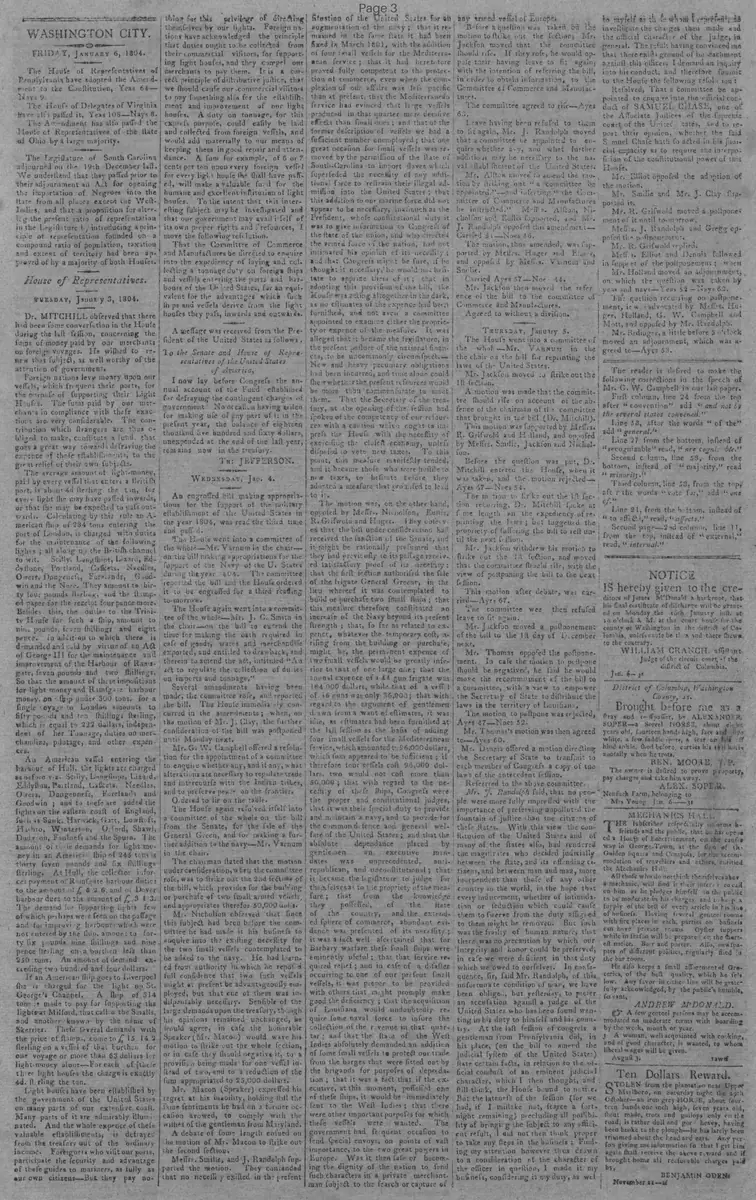
TUESDAY, JANUARY 3, 1804.
Dr. MITCHILL observed that there had been some conversation in the House during the last session, concerning the sums of money paid by our merchants on foreign voyages. He wished to renew that subject, as well worthy of the attention of government.
Foreign nations levy money upon our vessels, which frequent their ports, for the purpose of supporting their Light Houses. The sums paid by our merchants in compliance with these exactions are very considerable. The contribution which strangers are thus obliged to make, constitute a fund, that goes a great way toward defraying the expense of those establishments, to the great relief of their own subjects.
The average amount of light-money, paid by every vessel that enters a British port, is about 4d sterling the ton, for every light she may have passed inwards, or that she may be expected to pass outwards. Calculating by this rule an American ship of 284 tons entering the port of London, is charged with duties for the maintenance of the following lights; all along up the British channel to wit. Scilly, Longships, Lizard, Eddystone, Portland, Caskets, Needles, Owers, Dungeness, Forelands, Goodwin and the Nore. They amount to thirty four pounds sterling, and the stamped paper for the receipt four pence more.
Besides this, the duties to the Trinity House for such a ship, amount to nine pounds, seven shillings and eight pence. In addition to which there is demanded and paid by virtue of an Act of George III for the maintenance and improvement of the Harbour of Ramsgate, seven pounds and two shillings.
So that the amount of these impositions for light money and Ramsgate harbour money, on a ship under 300 tons, for a single voyage to London amounts to fifty pounds and ten shillings sterling, which is equal to 222 dollars, independent of her Tonnage, duties on merchandise, pilotage, and other expenses.
An American vessel entering the harbour of Hull, the lights are charged as before viz. Scilly, Longships, Lizard, Eddystone, Portland, Caskets, Needles, Owers, Dungeness, Forelands and Goodwin: and to these are added the lights on the eastern coast of England, such as Sunk, Harwich, Gat, Lowestoft, Hasbro, Winterton, Orford, Shambles, Dudgeon, Foulness and the Spurns. The amount of the demands for light money in an American ship of 245 tons is thirty seven pounds and x shillings sterling. At Hull, the collector enforces payment of Ramsgate harbour duties to the amount of £6 a 6 and of Dover harbour dues to the amount of £3 1 3.
The demand for supporting lights few perhaps were seen on the passage and for improving harbours which were not entered by the ship, amount to forty six pounds nine shillings and nine pence sterling on a burthen less than 250 tons. An amount of demand exceeding two hundred and four dollars.
If an American ship goes to Liverpool he is charged for the lights up St. George's Channel. A ship of 314 tons is made to pay for supporting the lights at Milford, that called the Smalls, and another known by the name of Skerries. These several demands with the price of stamp, come to £15 14 2 sterling on a vessel of that burthen for one voyage or more than 63 dollars for light-money alone--For each of these three light houses the charge is exactly 4d. sterling the ton.
Light houses have been established by the government of the United States on many parts of our extensive coast. Many parts of it are admirably illuminated. And the whole expense of these valuable establishments, is defrayed from the treasury out of the ordinary income. Foreigners who visit our ports, participate the security and advantage of these guides to mariners, as fully as our own citizens--But they pay nothing for this privilege of directing themselves by our lights. Foreign nations have acknowledged the principle that duties ought to be collected from their commercial visitors, for supporting light houses, and they compel our merchants to pay them. It is a correct principle of distributive justice, that we should cause our commercial visitors to pay something also for the establishment and improvement of our light houses. A duty on tonnage, for this express purpose, could easily be laid and collected from foreign vessels, and would add materially to our means of keeping them in good repair and attendance. A sum or example, of 6 or 7 cents per ton upon every foreign vessel for every light house he shall have passed, will make a valuable fund for the humane and excellent institution of light houses. To the intent that this interesting subject may be investigated and that our government may avail itself of its own proper rights and resources, I move the following resolution.
That the Committee of Commerce and Manufactures be directed to enquire into the expediency of laying and collecting a tonnage duty on foreign ships and vessels entering the ports and harbours of the United States, for an equivalent for the advantages which such ships and vessels derive from the light houses they pass, inwards and outwards.
A message was received from the President of the United States as follows.
To the Senate and House of Representatives of the United States of America,
I now lay before Congress the annual account of the Fund established for defraying the contingent charges of government No occasion having arisen for making use of any part of it in the present year, the balance of eighteen thousand five hundred and sixty dollars, unexpended at the end of the last year, remains now in the treasury.
TH: JEFFERSON.
WEDNESDAY, JAN. 4.
An engrossed bill making appropriations for the support of the military establishment of the United States in the year 1804, was read the third time and passed.
The House went into a committee of the whole--Mr. Varnum in the chair---on the bill making appropriations for the Support of the Navy of the U. States during the year 1804. The committee reported the bill and the House ordered it to be engrossed for a third reading to-morrow.
The House again went into a committee of the whole--Mr. I. C. Smith in the chair on the bill to extend the time for making the oath required in case of goods, wares and merchandise exported, and entitled to drawback, and therein to amend the act, intituled "An act to regulate the collection of duties on imports and tonnage."
Several amendments having been made, the committee rose, and reported the bill. The House immediately concurred in the amendments; when, on the motion of Mr. I. Clay, the further consideration of the bill was postponed until Monday next.
Mr. G. W. Campbell offered a resolution for the appointment of a committee to enquire whether any, and if any, what alterations are necessary to regulate trade and intercourse with the Indian tribes. and to preserve peace on the frontier.
Ordered to lie on the table.
The House again resolved itself into a committee of the whole on the bill from the Senate, for the sale of the General Green, and for making a further addition to the navy--Mr. Varnum in the chair.
The chairman stated that the motion under consideration, when the committee rose, was to strike out the 2nd section of the bill, which provides for the building or purchase of two small armed vessels and appropriates therefor 50,000 dollars.
Mr. Nicholson observed that since this subject had been before the committee he had made it his business to acquire into the existing necessity for the two small vessels contemplated to be added to the navy. He had learned from authority in which he reposed full confidence that two such vessels might at present be advantageously employed, but that one of them was indispensably necessary. Sensible of the large demands upon the treasury, though his opinions remained unchanged, he would agree, in case the honorable Speaker (Mr. Macon) would waive his motion to strike out the whole section, or in case they should negative it, to a provision being made for one vessel instead of two, and to a reduction of the sum appropriated to 25,000 dollars.
Mr. Macon (Speaker) expressed his regret at his inability, holding still the same sentiments he had on a former occasion avowed, to comply with the wishes of the gentleman from Maryland.
A debate of some length ensued on that motion of Mr. Macon to strike out the second section.
Messrs. Smilie, and J. Randolph supported the motion. They conceded that no necessity existed in the present situation of the United States for augmentation of the navy; that it remained in the same state it had been fixed in March 1801. with the addition of four small vessels for the Mediterranean service; that it had heretofore proved fully competent to the protection of commerce, even when the complexion of our affairs was less pacific than at present, that the Mediterranean service had evinced that large vessels produced in that quarter more decisive effects than small ones; and that of the former description of vessels we had a sufficient number unemployed; that one great occasion for small vessels was removed by the permission of the state of South-Carolina to import slaves which superseded the necessity of any additional force to restrain their illegal admission into the United States ; that this addition to our marine force did not appear to be necessary, inasmuch as the President, whose constitutional duty it was to give information to Congress of the state of the union, and who directed the armed force of the nation, had not intimated his opinion of its necessity ; and that Congress might be sure, if he thought it necessary, he would not hesitate to apprise them of it; that in adopting this provision of the bill, the House was acting altogether in the dark, as no estimates of the expense had been furnished, and not even a committee appointed to examine either the propriety or expense of the measure. It was alleged that it became the legislature, in the present posture of the national finances, to be uncommonly circumspect.--New and heavy pecuniary obligations had been incurred, and time alone could show whether the present resources would be more than commensurate to meet them. That the Secretary of the Treasury, at the opening of the session had spoken of the competency of our resources with a caution which ought to impress the House with the necessity of exercising the closest economy, unless disposed to vote new taxes. To this point, this measure manifestly tended, and it became those who were hostile to new taxes, to hesitate before they adopted a measure that promised to lead to it.
The motion was, on the other hand, opposed by Messrs. Nicholson, Eustis, R. Griswold and Huger. They observed that the bill under consideration had received the sanction of the Senate, and it might be rationally presumed that they had previously to its passage received satisfactory proof of its necessity: that the 1st section authorized the sale of the frigate General Greene, in the lieu whereof it was contemplated to build or purchase two small ships ; that this measure therefore constituted no increase of the Navy beyond its present strength ; that, so far as related to expense, whatever the temporary cost, arising from the building or purchase, might be, the permanent expense of two small vessels would be greatly inferior to that of one large one; that the annual expense of a 44 gun frigate was 104,000 dollars, while that of a vessel of 16 guns was only 36,000; that with regard to the argument of gentlemen drawn from want of estimates, it was idle, as estimates had been furnished at the last session as the basis of adding four small vessels for the Mediterranean service, which amounted to 96,000 dollars, which sum appeared to be sufficient; if therefore four vessels cost 96,000 dollars, two would not cost more than 50,000: that with regard to the necessity of these ships, Congress were the proper and constitutional judges, that it was their special duty to provide and maintain a navy, and to provide for the common defence and general welfare of the United States; and that the absolute dependance placed by gentlemen on executive mandates was unprecedented, anti-republican, and unconstitutional; that it became the legislature to judge for themselves as to the propriety of the measure; that from the knowledge they possessed, of the state of the country, and the extended sphere of commerce, abundant evidence was presented of its necessity; it was a fact well ascertained that for Barbary warfare small ships were eminently useful; that that service required relief; and in case of a disaster occurring to one of our present small vessels, it was proper to be provided with others that might promptly make good the deficiency ; that the acquisition of Louisiana would undoubtedly require one naval force to insure the collection of the revenue in that quarter; and that the trade of the West Indies absolutely demanded an addition of some small vessels to protect our trade from the barges that were fitted out by the brigands for purposes of depredation : that it was a fact that if the executive, at this moment, possessed one of these ships, it would be immediately sent to the West Indies: that there were other important purposes for which these vessels were wanted. The government had frequent occasion to send Special envoys, on points of vast importance, to the two great powers in Europe. Was it then safe or becoming the dignity of the nation to send such characters in a private merchantman subject to the search or capture of any armed vessel of Europe
Before a question was taken on the motion to strike out the section Mr. Jackson moved that the committee should rise. If they rose, he would oppose their having leave to sit again with the intention of referring the bill, in order to obtain information, to the Committee of Commerce and Manufactures.
The committee agreed to rise--Ayes 63.
Leave having been refused to them to sit again, Mr. I. Randolph moved that a committee be appointed to enquire whether any, and what further additions may be necessary to the naval establishment of the United States.
Mr. Alston moved to amend the motion by striking out "a committee be appointed,"-and inserting " the Committee of Commerce and Manufactures be instructed." Messrs. Alston, Nicholson and Eustis supported, and Mr. I. Randolph opposed this amendment--Carried 51--Noes 46.
The motion, thus amended, was supported by Messrs. Huger and Eustis, and opposed by Messrs. Varnum and Smilie.
Carried Ayes 57 Noes 14.
Mr. Jackson then moved the reference of the bill to the committee of Commerce and Manufactures.
Agreed to without a division.
THURSDAY, January 5.
The House went into a committee of the whole--Mr. Varnum in the chair on the bill for reprinting the laws of the United States.
Mr. Jackson moved to strike out the 1st section.
A motion was made that the committee should rise on account of the absence of the chairman of the committee that brought in the bill (Dr. Mitchill).
This motion was supported by Messrs. R. Griswold and Holland, and opposed by Messrs. Smilie, Jackson and Nicholson.
Before the question was put, Dr. Mitchill entered the House, when it was taken, and the motion rejected. Ayes 47- Noes 54.
The motion to strike out the 1st section recurring, Dr. Mitchill spoke at some length on the expediency of reprinting the laws ; but suggested the propriety of suffering the bill to rest until the next session.
Mr. Jackson withdrew his motion to strike out the 1st section, and moved that the committee should rise, with the view of postponing the bill to the next session.
This motion after debate, was carried--Ayes 67.
The committee were then refused leave to sit again.
Mr. Jackson moved a postponement of the bill to the 1st day of December next.
Mr. Thomas opposed the postponement. In case the motion to postpone should be negatived', he said he would move the recommitment of the bill to a committee, with a view to empower the Secretary of State to distribute the laws in the territory of Louisiana.
The motion to postpone was rejected, Ayes 47-Noes 52.
Mr. Thomas's motion was then agreed to--Ayes 60.
Mr. Dennis offered a motion directing the Secretary of State to transmit to each member of Congress a copy of the laws of the antecedent session.
Referred to the above committee.
Mr. I. Randolph said, that no people were more fully impressed with the importance of preserving unpolluted the fountain of justice than the citizens of these states. With this view the constitution of the United States and of many of the states also, had rendered the magistrates who decided judicially between the state, and its offending citizens, and between man and man, more independent than those of any other country in the world, in the hope that every inducement, whether of intimation or seduction which could cause them to swerve from the duty assigned to them might be removed. But such was the frailty of human nature, that there was no precaution by which our integrity and honor could be preserved, in case we were deficient in that duty which we owed to ourselves. In consequence, sir, said Mr. Randolph, of this unfortunate condition of man, we have been obliged, but yesterday, to prefer an accusation against a judge of the United States who has been found wanting in his duty to himself and his country. At the last session of congress a gentleman from Pennsylvania did, in his place, (on the bill to amend the judiciary system of the United States) state certain facts, in relation to the official conduct of an eminent judicial character, which I then thought, and still think, the House bound to notice. But the lateness of the session (for we had, if I mistake not, scarce a fortnight remaining) precluding all possibility of bringing the subject to any decisive result, I did not then think proper to take any steps in the business : Finding my attention however thus drawn to a consideration of the character of the officer in question, I made it my business, considering it my duty, as well to myself as the whole I represent; to investigate the charges then made and the official character of the judge. in general. The result having convinced me that there exist ground of impeachment against this officer, I demand an inquiry into his conduct, and therefore submit to the House the following resolution:
Resolved, That a Committee be appointed to enquire into the official conduct of SAMUEL CHASE, one of the Associate Justices of the supreme court of the United States, and to report their opinion, whether the said Samuel Chase hath so acted in his judicial capacity as to require the interposition of the constitutional power of this House.
Mr. Elliot opposed the adoption of the motion.
Mr. Smilie and Mr. J. Clay supported it.
Mr. R. Griswold moved a postponement of it until to-morrow.
Messrs. J. Randolph and Gregg opposed the postponement.
Mr. R. Griswold replied:
Messrs. Elliot and Dennis followed in support of the postponement ; when Mr. Holland moved an adjournment; on which the question was taken by yeas and nays-Yeas 59 -Nays 62.
The question recurring on postponement, it was advocated by Messrs. Huger, Holland, G. W. Campbell and Mott, and opposed by Mr. Randolph.
Mr. Bedinger, a little before 5 o'clock moved an adjournment, which was agreed to-Ayes 53.
What sub-type of article is it?
What themes does it cover?
What keywords are associated?
What entities or persons were involved?
Where did it happen?
Story Details
Key Persons
Location
House Of Representatives, United States
Event Date
January 3 5, 1804
Story Details
Dr. Mitchill proposes resolution for tonnage duties on foreign vessels to fund U.S. lighthouses; President Jefferson reports on contingent fund balance; House passes military appropriations, debates navy funding and additions including sale of General Greene and purchase of small vessels, considers Indian trade regulation, discusses reprinting laws with postponement, and John Randolph introduces resolution for committee inquiry into Justice Samuel Chase's official conduct for potential impeachment.