Thank you for visiting SNEWPapers!
Sign up free
Editorial
May 19, 1774
The Virginia Gazette
Williamsburg, Virginia
What is this article about?
A mock address from Britain's King, Lords, and Commons to Americans defends parliamentary authority over colonies, refutes settler patriotism claims, dismisses charter exemptions from taxation, criticizes lack of representation requests, and rejects internal-external tax distinctions, portraying colonies as ungrateful dependents.
Clipping
OCR Quality
98%
Excellent
Full Text
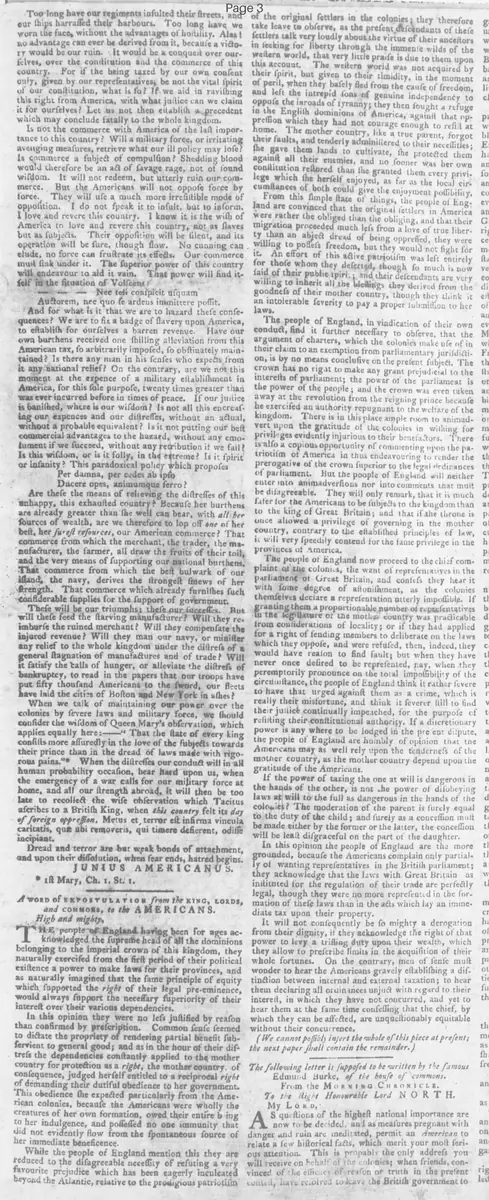
A word of expostulation from the King, Lords, and Commons, to the Americans.
High and mighty
The people of England having been for a long time possessed of a country belonging to the imperial crown of this kingdom, they naturally exercised from the first period of their political existence a power to make laws for their provinces, and as naturally imagined that the same principle of equity which supported the right of their legal pre-eminence, would always support the necessary superiority of their interest over their various dependencies.
In this opinion they were no less justified by reason than confirmed by prescription. Common sense seemed to dictate the propriety of rendering partial benefit subservient to general good; and as in the hour of their distress the dependencies constantly applied to the mother country for protection as a right, the mother country, of consequence, judged herself entitled to a reciprocal right of demanding their dutiful obedience to her government.
This obedience she expected particularly from the American colonies, because the Americans were wholly the creatures of her own formation, owed their entire being to her indulgence, and possessed no one immunity that did not evidently flow from the spontaneous source of her immediate beneficence.
While the people of England mention this they are reduced to the disagreeable necessity of refuting a very favourite prejudice which has been eagerly inculcated beyond the Atlantic, relative to the prodigious patriotism of the original settlers in the colonies; they therefore take leave to observe, as the present descendants of these settlers talk very loudly about the virtue of their ancestors in seeking for liberty through the immense wilds of the western world, that very little praise is due to them upon this account. The western world was not acquired by their spirit, but given to their timidity, in the moment of peril, when they basely fled from the cause of freedom, and left the intrepid sons of genuine independency to oppose the inroads of tyranny; they then sought a refuge in the English dominions of America, against that oppression which they had not courage enough to resist at home. The mother country, like a true parent, forgot their faults, and tenderly administered to their necessities; she gave them lands to cultivate, she protected them against all their enemies, and no sooner was her own constitution restored than she granted them every privilege which she herself enjoyed, as far as the local circumstances of both could give the enjoyment possibility.
From this simple state of things, the people of England are convinced that the original settlers in America were rather the obliged than the obliging, and that their migration proceeded much less from a love of true liberty than an abject dread of being oppressed, they were willing to possess freedom, but they would not fight for it. An effort of this active patriotism was left entirely for those whom they deserted, though so much is now said of their public spirit; and their descendants are very willing to inherit all the blessings they derived from the goodness of their mother country, though they think it an intolerable severity to pay a proper submission to her laws.
The people of England, in vindication of their own conduct, find it further necessary to observe, that the argument of charters, which the colonies make use of in their claim to an exemption from parliamentary jurisdiction, is by no means conclusive on the present subject. The crown has no right to make any grant prejudicial to the interests of parliament; the power of the parliament is the power of the people; and the crown was even taken away at the revolution from the reigning prince because he exercised an authority repugnant to the welfare of the kingdom. There is in this place ample room to animadvert upon the gratitude of the colonies in wishing for privileges evidently injurious to their benefactors. There is also a copious opportunity of commenting on the patriotism of America in thus endeavouring to render the prerogative of the crown superior to the legal ordinances of parliament. But the people of England will neither enter into animadversions nor into comments that must be disagreeable. They will only remark, that it is much safer for the Americans to be subjects to the kingdom than to the king of Great Britain: and that if the throne is once allowed a privilege of governing in the mother country, contrary to the established principles of law, it will very speedily contend for the same privilege in the provinces of America.
The people of England now proceed to the chief complaint of the colonies, the want of representatives in the parliament of Great Britain, and confess they hear it with some degree of astonishment, as the colonies themselves declare a representation utterly impossible. If granting them a proportionable number of representatives in the legislature of the mother country was practicable from considerations of locality; or if they had applied for a right of sending members to deliberate on the laws which they oppose, and were refused, then, indeed, they would have reason to find fault: but when they have never once desired to be represented, nay, when they peremptorily pronounce on the total impossibility of the circumstance, the people of England think it rather severe to have that urged against them as a crime, which is really their misfortune, and think it severer still to find their justice continually impeached, for the purpose of resisting their constitutional authority. If a discretionary power is any where to be lodged in the present dispute, the people of England are humbly of opinion that the Americans may as well rely upon the tenderness of the mother country, as the mother country depend upon the gratitude of the Americans.
If the power of taxing the one at will is dangerous in the hands of the other, is not the power of disobeying laws at will to the full as dangerous in the hands of the colonies? The moderation of the parent is surely equal to the duty of the child: and surely as a concession must be made either by the former or the latter, the concession will be least disgraceful on the part of the daughter.
In this opinion the people of England are the more grounded, because the Americans complain only partially of wanting representatives in the British parliament; they acknowledge that the laws with Great Britain as instituted for the regulation of their trade are perfectly legal, though they were no more represented in the formation of these laws than in the acts which lay an immediate tax upon their property.
It will not consequently be so mighty a derogation from their dignity, if they acknowledge the right of that power to levy a trifling duty upon their wealth, which they allow to prescribe limits in the acquisition of their whole fortunes. On the contrary, men of sense must wonder to hear the Americans gravely establishing a distinction between internal and external taxation; to hear them declaring all ordinances unjust with regard to their interest, in which they have not concurred, and yet to hear them at the same time confessing that the chief, by which they can be affected, are unquestionably equitable without their concurrence.
(We cannot possibly insert the whole of this piece at present; the next paper shall contain the remainder.)
High and mighty
The people of England having been for a long time possessed of a country belonging to the imperial crown of this kingdom, they naturally exercised from the first period of their political existence a power to make laws for their provinces, and as naturally imagined that the same principle of equity which supported the right of their legal pre-eminence, would always support the necessary superiority of their interest over their various dependencies.
In this opinion they were no less justified by reason than confirmed by prescription. Common sense seemed to dictate the propriety of rendering partial benefit subservient to general good; and as in the hour of their distress the dependencies constantly applied to the mother country for protection as a right, the mother country, of consequence, judged herself entitled to a reciprocal right of demanding their dutiful obedience to her government.
This obedience she expected particularly from the American colonies, because the Americans were wholly the creatures of her own formation, owed their entire being to her indulgence, and possessed no one immunity that did not evidently flow from the spontaneous source of her immediate beneficence.
While the people of England mention this they are reduced to the disagreeable necessity of refuting a very favourite prejudice which has been eagerly inculcated beyond the Atlantic, relative to the prodigious patriotism of the original settlers in the colonies; they therefore take leave to observe, as the present descendants of these settlers talk very loudly about the virtue of their ancestors in seeking for liberty through the immense wilds of the western world, that very little praise is due to them upon this account. The western world was not acquired by their spirit, but given to their timidity, in the moment of peril, when they basely fled from the cause of freedom, and left the intrepid sons of genuine independency to oppose the inroads of tyranny; they then sought a refuge in the English dominions of America, against that oppression which they had not courage enough to resist at home. The mother country, like a true parent, forgot their faults, and tenderly administered to their necessities; she gave them lands to cultivate, she protected them against all their enemies, and no sooner was her own constitution restored than she granted them every privilege which she herself enjoyed, as far as the local circumstances of both could give the enjoyment possibility.
From this simple state of things, the people of England are convinced that the original settlers in America were rather the obliged than the obliging, and that their migration proceeded much less from a love of true liberty than an abject dread of being oppressed, they were willing to possess freedom, but they would not fight for it. An effort of this active patriotism was left entirely for those whom they deserted, though so much is now said of their public spirit; and their descendants are very willing to inherit all the blessings they derived from the goodness of their mother country, though they think it an intolerable severity to pay a proper submission to her laws.
The people of England, in vindication of their own conduct, find it further necessary to observe, that the argument of charters, which the colonies make use of in their claim to an exemption from parliamentary jurisdiction, is by no means conclusive on the present subject. The crown has no right to make any grant prejudicial to the interests of parliament; the power of the parliament is the power of the people; and the crown was even taken away at the revolution from the reigning prince because he exercised an authority repugnant to the welfare of the kingdom. There is in this place ample room to animadvert upon the gratitude of the colonies in wishing for privileges evidently injurious to their benefactors. There is also a copious opportunity of commenting on the patriotism of America in thus endeavouring to render the prerogative of the crown superior to the legal ordinances of parliament. But the people of England will neither enter into animadversions nor into comments that must be disagreeable. They will only remark, that it is much safer for the Americans to be subjects to the kingdom than to the king of Great Britain: and that if the throne is once allowed a privilege of governing in the mother country, contrary to the established principles of law, it will very speedily contend for the same privilege in the provinces of America.
The people of England now proceed to the chief complaint of the colonies, the want of representatives in the parliament of Great Britain, and confess they hear it with some degree of astonishment, as the colonies themselves declare a representation utterly impossible. If granting them a proportionable number of representatives in the legislature of the mother country was practicable from considerations of locality; or if they had applied for a right of sending members to deliberate on the laws which they oppose, and were refused, then, indeed, they would have reason to find fault: but when they have never once desired to be represented, nay, when they peremptorily pronounce on the total impossibility of the circumstance, the people of England think it rather severe to have that urged against them as a crime, which is really their misfortune, and think it severer still to find their justice continually impeached, for the purpose of resisting their constitutional authority. If a discretionary power is any where to be lodged in the present dispute, the people of England are humbly of opinion that the Americans may as well rely upon the tenderness of the mother country, as the mother country depend upon the gratitude of the Americans.
If the power of taxing the one at will is dangerous in the hands of the other, is not the power of disobeying laws at will to the full as dangerous in the hands of the colonies? The moderation of the parent is surely equal to the duty of the child: and surely as a concession must be made either by the former or the latter, the concession will be least disgraceful on the part of the daughter.
In this opinion the people of England are the more grounded, because the Americans complain only partially of wanting representatives in the British parliament; they acknowledge that the laws with Great Britain as instituted for the regulation of their trade are perfectly legal, though they were no more represented in the formation of these laws than in the acts which lay an immediate tax upon their property.
It will not consequently be so mighty a derogation from their dignity, if they acknowledge the right of that power to levy a trifling duty upon their wealth, which they allow to prescribe limits in the acquisition of their whole fortunes. On the contrary, men of sense must wonder to hear the Americans gravely establishing a distinction between internal and external taxation; to hear them declaring all ordinances unjust with regard to their interest, in which they have not concurred, and yet to hear them at the same time confessing that the chief, by which they can be affected, are unquestionably equitable without their concurrence.
(We cannot possibly insert the whole of this piece at present; the next paper shall contain the remainder.)
What sub-type of article is it?
Constitutional
Taxation
Imperialism
What keywords are associated?
American Colonies
British Parliament
Taxation Rights
Representation Complaint
Colonial Charters
Mother Country
Settler Patriotism
Parliamentary Authority
What entities or persons were involved?
King, Lords, And Commons
People Of England
American Colonies
Parliament
Crown
Editorial Details
Primary Topic
Defense Of British Parliamentary Authority Over American Colonies
Stance / Tone
Pro British, Expostulatory, Critical Of Colonial Ingratitude
Key Figures
King, Lords, And Commons
People Of England
American Colonies
Parliament
Crown
Key Arguments
Colonies Owe Existence And Protection To Britain, Demanding Obedience
Original Settlers Fled Persecution Rather Than Fought For Liberty
Charters Do Not Exempt Colonies From Parliamentary Jurisdiction
Crown Cannot Grant Privileges Harmful To Parliament's Interests
Colonies Never Requested Representation, Rendering Complaints Invalid
Distinction Between Internal And External Taxation Is Illogical
Trade Regulation Laws Are Accepted Without Representation
Americans Should Submit To Trifling Duties As Dutiful Children
Obedience To Parliament Safer Than Subjection To Crown Alone
Reciprocal Rights: Protection Requires Dutiful Obedience