Thank you for visiting SNEWPapers!
Sign up free
Story
September 4, 1951
Atlanta Daily World
Atlanta, Fulton County, Georgia
What is this article about?
A bill amending the GI Bill makes sellers liable to veterans for excess payments on VA-guaranteed property loans exceeding appraised value, with penalties and enforcement options. Includes background on side payments and current housing trends, noting 1949 non-farm house starts.
Clipping
OCR Quality
95%
Excellent
Full Text
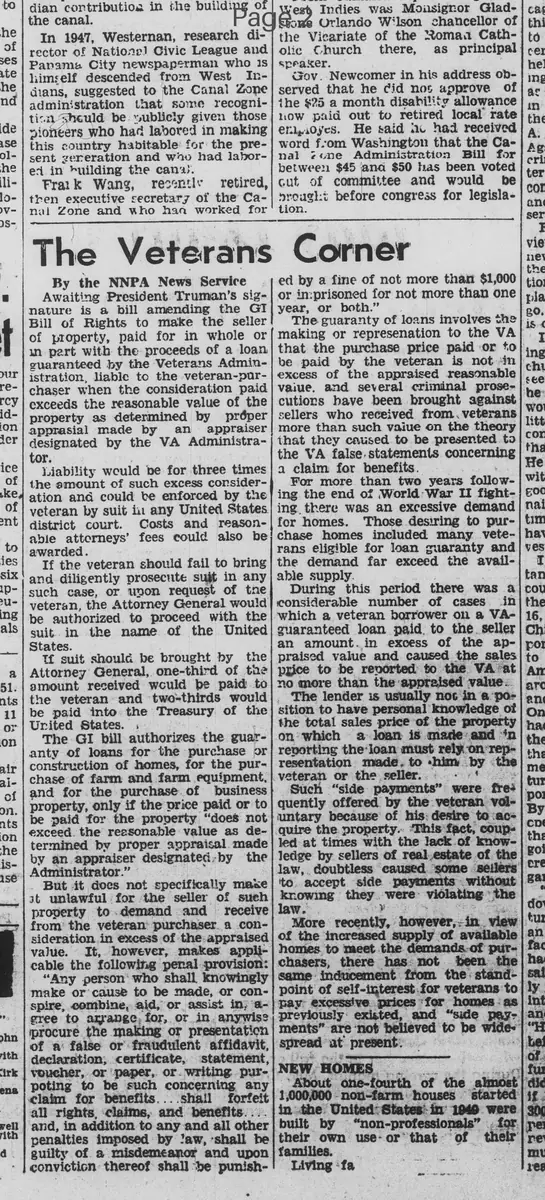
The Veterans Corner
By the NNPA News Service
Awaiting President Truman's signature is a bill amending the GI Bill of Rights to make the seller of property, paid for in whole or in part with the proceeds of a loan guaranteed by the Veterans Administration, liable to the veteran-purchaser when the consideration paid exceeds the reasonable value of the property as determined by proper appraisal made by an appraiser designated by the VA Administrator.
But it does not specifically make it unlawful for the seller of such property to demand and receive from the veteran purchaser a consideration in excess of the appraised value. It, however, makes applicable the following penal provision:
"Any person who shall knowingly make or cause to be made, or conspire, combine, aid, or assist in, agree to arrange for, or in anywise procure the making or presentation of a false or fraudulent affidavit, declaration, certificate, statement, voucher, or paper, or writing purporting to be such concerning any claim for benefits....shall forfeit all rights, claims, and benefits....and, in addition to any and all other penalties imposed by law, shall be guilty of a misdemeanor and upon conviction thereof shall be punished by a fine of not more than $1,000 or imprisoned for not more than one year, or both."
The guaranty of loans involves the making or representation to the VA that the purchase price paid or to be paid by the veteran is not in excess of the appraised reasonable value, and several criminal prosecutions have been brought against sellers who received from veterans more than such value on the theory that they caused to be presented to the VA false statements concerning a claim for benefits.
Liability would be for three times the amount of such excess consideration and could be enforced by the veteran by suit in any United States district court. Costs and reasonable attorneys' fees could also be awarded.
If the veteran should fail to bring and diligently prosecute suit in any such case, or upon request of the veteran, the Attorney General would be authorized to proceed with the suit in the name of the United States.
If suit should be brought by the Attorney General, one-third of the amount received would be paid to the veteran and two-thirds would be paid into the Treasury of the United States.
The GI bill authorizes the guaranty of loans for the purchase or construction of homes, for the purchase of farm and farm equipment, and for the purchase of business property, only if the price paid or to be paid for the property "does not exceed the reasonable value as determined by proper appraisal made by an appraiser designated by the Administrator."
The lender is usually not in a position to have personal knowledge of the total sales price of the property on which a loan is made and in reporting the loan must rely on representation made to him by the veteran or the seller.
Such "side payments" were frequently offered by the veteran voluntarily because of his desire to acquire the property. This fact, coupled at times with the lack of knowledge by sellers of real estate of the law, doubtless caused some sellers to accept side payments without knowing they were violating the law.
More recently, however, in view of the increased supply of available homes to meet the demands of purchasers, there has not been the same inducement from the standpoint of self-interest for veterans to pay excessive prices for homes as previously existed, and "side payments" are not believed to be widespread at present.
NEW HOMES
About one-fourth of the almost 1,000,000 non-farm houses started in the United States in 1949 were built by "non-professionals" for their own use-or that of their families.
Living fa
By the NNPA News Service
Awaiting President Truman's signature is a bill amending the GI Bill of Rights to make the seller of property, paid for in whole or in part with the proceeds of a loan guaranteed by the Veterans Administration, liable to the veteran-purchaser when the consideration paid exceeds the reasonable value of the property as determined by proper appraisal made by an appraiser designated by the VA Administrator.
But it does not specifically make it unlawful for the seller of such property to demand and receive from the veteran purchaser a consideration in excess of the appraised value. It, however, makes applicable the following penal provision:
"Any person who shall knowingly make or cause to be made, or conspire, combine, aid, or assist in, agree to arrange for, or in anywise procure the making or presentation of a false or fraudulent affidavit, declaration, certificate, statement, voucher, or paper, or writing purporting to be such concerning any claim for benefits....shall forfeit all rights, claims, and benefits....and, in addition to any and all other penalties imposed by law, shall be guilty of a misdemeanor and upon conviction thereof shall be punished by a fine of not more than $1,000 or imprisoned for not more than one year, or both."
The guaranty of loans involves the making or representation to the VA that the purchase price paid or to be paid by the veteran is not in excess of the appraised reasonable value, and several criminal prosecutions have been brought against sellers who received from veterans more than such value on the theory that they caused to be presented to the VA false statements concerning a claim for benefits.
Liability would be for three times the amount of such excess consideration and could be enforced by the veteran by suit in any United States district court. Costs and reasonable attorneys' fees could also be awarded.
If the veteran should fail to bring and diligently prosecute suit in any such case, or upon request of the veteran, the Attorney General would be authorized to proceed with the suit in the name of the United States.
If suit should be brought by the Attorney General, one-third of the amount received would be paid to the veteran and two-thirds would be paid into the Treasury of the United States.
The GI bill authorizes the guaranty of loans for the purchase or construction of homes, for the purchase of farm and farm equipment, and for the purchase of business property, only if the price paid or to be paid for the property "does not exceed the reasonable value as determined by proper appraisal made by an appraiser designated by the Administrator."
The lender is usually not in a position to have personal knowledge of the total sales price of the property on which a loan is made and in reporting the loan must rely on representation made to him by the veteran or the seller.
Such "side payments" were frequently offered by the veteran voluntarily because of his desire to acquire the property. This fact, coupled at times with the lack of knowledge by sellers of real estate of the law, doubtless caused some sellers to accept side payments without knowing they were violating the law.
More recently, however, in view of the increased supply of available homes to meet the demands of purchasers, there has not been the same inducement from the standpoint of self-interest for veterans to pay excessive prices for homes as previously existed, and "side payments" are not believed to be widespread at present.
NEW HOMES
About one-fourth of the almost 1,000,000 non-farm houses started in the United States in 1949 were built by "non-professionals" for their own use-or that of their families.
Living fa
What sub-type of article is it?
Legislative News
Policy Update
What themes does it cover?
Justice
Moral Virtue
What keywords are associated?
Gi Bill Amendment
Veterans Loans
Property Overpayment
Va Guaranty
Side Payments
New Homes
1949 Housing
What entities or persons were involved?
President Truman
Va Administrator
Attorney General
Where did it happen?
United States
Story Details
Key Persons
President Truman
Va Administrator
Attorney General
Location
United States
Event Date
1949
Story Details
Bill amends GI Bill to hold sellers liable for excess payments on VA-guaranteed properties, applies fraud penalties, allows triple damages suits by veterans or Attorney General, covers homes, farms, businesses; discusses past side payments and reduced prevalence; notes 1949 housing stats.