Thank you for visiting SNEWPapers!
Sign up free
Gazette Of The United States, & Philadelphia Daily Advertiser
Philadelphia, Philadelphia County, Pennsylvania
What is this article about?
Detailed official account from Vienna of Allied (Russian, Imperial, Royal) forces under Field Marshal Suwarrow defeating French army led by Gen. Macdonald in battles along Tidone and Trebbia rivers in northern Italy, June 17-19, 1799, with pursuit to Nura river, resulting in over 18,000 French casualties and prisoners.
Clipping
OCR Quality
Full Text
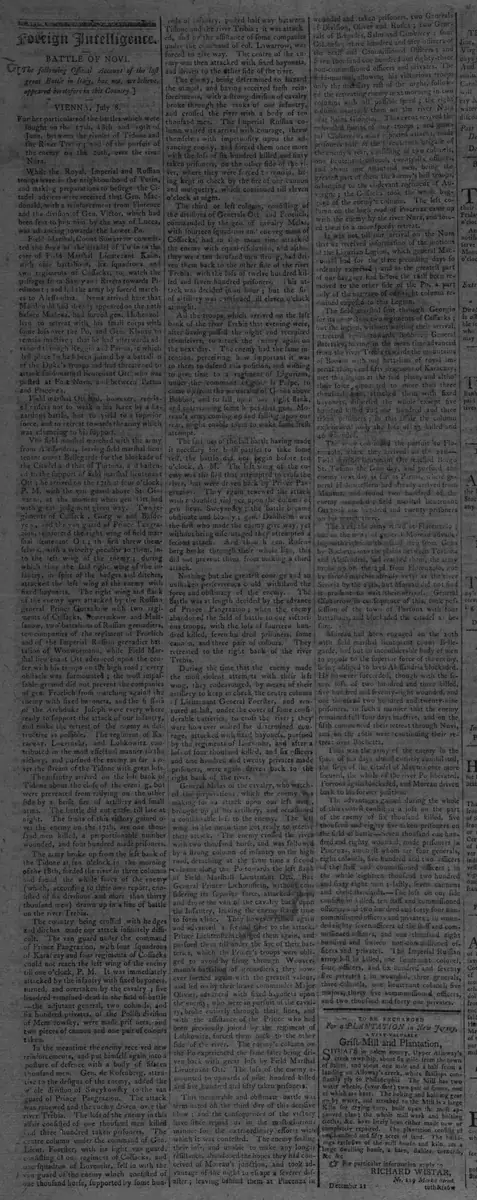
BATTLE OF NOVI.
The following Official Account of the last great Battle in Italy, has not, we believe, appeared heretofore in this Country.
VIENNA, July 8.
Further particulars of the battles which were fought on the 17th, 18th and 19th of June, between the rivulet of Tidone and the River Trebbia; and of the pursuit of the enemy on the 20th, over the river Nura.
While the Royal, Imperial and Russian troops were in the neighbourhood of Turin, and making preparations to besiege the Citadel, advices were received that Gen. Macdonald, with a reinforcement from Florence and that division of Gen. Victor, which had been sent to join him by the way of Lucca, was advancing towards the Lower Po. Field Marshal, Count Suwarrow committed the siege of the citadel of Turin to the care of Field Marshal Lieutenant Kaim, with nine battalions, six squadrons, and two regiments of Cossacks, to watch the passes from Savoy and Riviera towards Piedmont; and led the army by forced marches to Alexandria. News arrived here that Macdonald had already appeared on the 12th before Modena, had forced gen. Hohenzollern to retreat with his small corps with some loss over the Po, and Gen. Klenau to remain inactive; that he had afterwards advanced through Reggio and Parma, in which last place he had been joined by a battalion of the Duke's troops and had threatened to attack field marshal lieutenant Ott, who was posted at Fort Novo, and between Parma and Piacenza.
Field marshal Ott had, however, received orders not to weaken his force by a hazardous battle, but to yield to a superior force, and to retreat towards the army which was advancing to his support.
The field marshal marched with the army from Alexandria, leaving field marshal lieutenant count Bellegarde for the blockade of the Citadel and that of Tortona, and hastened to the support of field marshal lieutenant Ott; he arrived on the 17th at four o'clock P. M. with the van guard above St. Giovanni, at the moment when gen. Ott, had with great judgment given way. Two regiments of Cossacks, Gorgy and Badejeu, and the van guard of Prince Pangrazion, reinforced the right wing of field marshal lieutenant Ott: the first threw themselves, with a velocity peculiar to them, into the left wing of the enemy; during which time the said right wing of the infantry, in spite of the hedges and ditches, attacked the left wing of the enemy with fixed bayonets. The right wing and flank of the enemy were attacked by the Russian general Prince Gortzakow with two regiments of Cossacks, Semernkow and Moltanow, two battalions of Russian grenadiers, ten companies of the regiment of Froelich and of the Imperial Russian grenadier battalion of Wollowmann, while Field Marshal lieutenant Ott advanced upon the center with his troops on the high road; every obstacle was surmounted; the most impassable ground did not prevent the companies of gen. Froelich from marching against the enemy with fixed bayonets, and the hussars of the Archduke Joseph were every where ready to support the attack of our infantry, and make the retreat of the enemy as destructive as possible. The regiment of Karraczay, Lovrenehr, and Lobkowitz contributed in the most effectual manner to the victory, and pursued the enemy as far over the stream of the Tidone with great loss.
The infantry arrived on the left bank of Tidone about the close of the evening, but were prevented from rallying on the other side by a brisk fire of artillery and small arms. The battle did not cease till late at night. The fruits of this victory gained over the enemy on the 17th, are one thousand men killed, a proportionable number wounded, and four hundred made prisoners.
The army broke up from the left bank of the Tidone at ten o'clock in the morning of the 18th, forded the river in three columns and found the whole force of the enemy (which, according to their own report, consisted of six divisions and more than thirty thousand men) drawn up in a line of battle on the river Trebbia.
The country being crossed with hedges and ditches made our attack infinitely difficult. The van guard under the command of Prince Pangrazion, with four squadrons of Karraczay and four regiments of Cossacks could not reach the left wing of the enemy till one o'clock, P. M. It was immediately attacked by the infantry with fixed bayonets, turned, and overtaken by the cavalry; five hundred remained dead in the field of battle—the adjutant general, two colonels, and six hundred privates, of the Polish division of Memrowski, were made prisoners, and two pieces of cannon and one pair of colours taken.
In the meantime the enemy received new reinforcements, and put himself again into a posture of defence with a body of fifteen thousand men. Gen. de Rosenberg, attentive to the designs of the enemy, added the whole division of Sweykowsky to the van guard of Prince Pangrazion. The attack was renewed and the enemy driven over the river Trebbia. The loss of the enemy in this affair consisted of one thousand men killed and three hundred taken prisoners. The centre column under the command of Gen. Lieut. Foerster, with its light van guard, consisting of one regiment of Cossacks, and one squadron of Lovenehr, fell in with the van guard of the enemy which consisted of one thousand horse, supported by some hundreds of infantry, posted half way between Tidone and the river Trebbia: it was attacked, and by the assistance of some companies under the command of col. Lawarrow, was forced to give way. The centre of the enemy was then attacked with fixed bayonets, and driven to the other side of the river.
The enemy, being determined to hazard the utmost, and having received fresh reinforcements, with a strong division of cavalry broke through the ranks of our infantry, and crossed the river with a body of ten thousand men. The Imperial Russian column waited its arrival with courage, threw themselves with impetuosity upon the advancing enemy, and forced them once more with the loss of six hundred killed and sixty taken prisoners, on the other side of the river, where they were forced to remain, being kept in check by the fire of our cannon and musquetry, which continued till eleven o'clock at night.
The third or left column, consisting of the divisions of Generals Ott and Froelich, commanded by the gen. of cavalry Melas, with fourteen squadrons and one regiment of Cossacks, had in the mean time attacked the enemy with equal resolution, and altho' they were ten thousand men strong, had driven them back to the other side of the river Trebbia, with the loss of twelve hundred killed and seven hundred prisoners. This attack was decided in an hour: but the fire of artillery was continued till eleven o'clock at night.
All the troops which arrived on the left bank of the river Trebbia that evening were, after having passed the night and recruited themselves, to attack the enemy again on the next day. The enemy had the same intention, perceiving how important it was to them to defend this position, and wishing to give time to a regiment of Ligurians, under the command of gen. la Poinpe, to come up from the mountains of Genoa above Bobbio, and to fall upon our right flank, and entertaining some hopes that gen. Moreau's army coming up and falling upon our rear, might enable them to make some fresh attempt.
The fatigues of the last battle having made it necessary for both parties to take some rest, the battle did not begin before ten o'clock, A. M. The left wing of the enemy was the first that attempted to cross the river, but were driven back by Prince Pangrazion. They again renewed the attack with redoubled violence upon the column of gen lieut. Sweykowsky; the battle became obstinate and bloody; gen. Dahlheim was the first who made the enemy give way, yet without being discouraged they attempted a second attack. And though gen. Rosenberg broke through their whole line, this did not prevent them from making a third attack.
Nothing but the greatest courage and unshaken perseverance could withstand the force and obstinacy of the enemy. The battle was at length decided by the advance of Prince Pangrazion; when the enemy abandoned the field of battle to our victorious troops, with the loss of fourteen hundred killed, seven hundred prisoners, some cannon, and three pair of colours. They retreated to the right bank of the river Trebbia.
During the time that the enemy made the most violent attempts with their left wing, they endeavoured, by means of their artillery to keep in check the centre column of Lieutenant General Foerster, and ventured at last, under the cover of some considerable batteries, to cross the river; they were however waited for with determined courage, attacked with fixed bayonets, pursued by the regiments of Loevenhr, and after a loss of four thousand killed, and six officers and one hundred and twenty privates made prisoners, were again driven back to the right bank of the river.
General Melas of the cavalry, who watched the preparations which the enemy was making for an attack upon our left wing, brought up his artillery, and occasioned a considerable loss to the enemy. The left wing in the mean time got ready to receive their attack. The enemy crossed the river with two thousand horse, and was followed by a strong column of infantry on the high road, detaching at the same time a second column along the Po towards the left flank of Field Marshall Lieutenant Ott. But General Prince-Liechtenstein, without considering its superior force, attacked them, and drove the van of the cavalry back upon the infantry, leaving the enemy scarce time to form a line. They however rallied again and advanced a second time to the attack. Prince Liechtenstein charged them again, and pursued them till under the fire of their batteries, which the Prince's troops were obliged to avoid by filing through Wollowmann's battalion of grenadiers; they however formed again with the greatest valour, and led on by their brave commander Major Olivier, advanced with fixed bayonets upon the enemy, who were in pursuit of the cavalry, broke entirely through their lines, and with the assistance of the Prince who had been previously joined by the regiment of Lobkowitz, forced them back to the other side of the river. The enemy's column on the Po experienced the same fate; being driven back with great loss by Field Marshall Lieutenant Ott. The loss of the enemy amounted to upwards of nine hundred killed and five hundred and fifty taken prisoners.
This memorable and obstinate battle was terminated on the third day of this decisive blow; and the consequences of the victory have since repaid us in the most glorious manner: for the extraordinary efforts with which it was contested. The enemy feeling their loss, and unable to make any longer resistance, abandoned the hopes they had conceived of Moreau's junction, and took advantage of the night to escape a severer disaster; leaving behind them at Piacenza in wounded and taken prisoners, two Generals of Division, Olivier and Ruska; two Generals of Brigades, Salm and Cimbrecy; our eight colonels: three hundred and sixty officers of the Staff and Commissioned Officers; and seven thousand one hundred and eighty-three non-commissioned officers and privates. The field-marshal, allowing his victorious troops only the necessary rest of the night, followed the retreating enemy next morning in two columns with all possible speed; the right column overtook them on the river Nura near Saint Giorgio. This event revived the exhausted spirits of our troops; and general Chubarow, after repeated attacks, made prisoners half of the seventeenth brigade of the enemy's rear, consisting of two colonels, one lieutenant colonel, twenty-six officers, and about one thousand men, being the greatest part of them the enemy's best troops, belonging to the ci-devant regiment of Auvergne; the Cossacks took the whole baggage of the enemy's column. The left column on the high road of Piacenza came up with the enemy by the river Nura, and tore them to a more speedy retreat.
It was not till our arrival on the Nura that we received information of the motions of the Ligurian Legion, which general Macdonald had for the three preceding days so ardently expected; and as the greatest part of our baggage had before the 15th been removed to the other side of the Po, a part only of the baggage of our right column remained exposed to this Legion. The field marshal sent through Giorgio for its protection two regiments of Cossacks; but the legion, without waiting their arrival, retreated again towards Bobbio. General Bettensky, having in the mean time advanced from the river Trebbia towards the mountains of Bobbio with one battalion of royal imperial troops and fifty dragoons of Karraczay, met this legion at the said place, and altho their force amounted to more than three thousand men, attacked them with fixed bayonets, dispersed the whole except five hundred killed and one hundred and three taken prisoners; in this affair the column experienced only the loss of 23 killed and 46 wounded.
The army continued the pursuit to Florence, where they arrived on the 21st. Field marshal lieutenant Ott reached Borgo St. Donino the same day, and pursued the enemy next day as far as Parma, where general Hohenzollern had already arrived from Mantua, and found two hundred of the enemy wounded; Field marshal lieutenant Ott took one hundred and twenty prisoners on his march there.
The 22d, the army rested at Florenzolo: but as the news of general Moreau advancing with eight thousand men from Genoa by Bochetta into the plains between Tortona and Alexandria, had reached them, the army broke up on the 23d from Florenzolo, got by forced marches already as far as the river Scrivia by the 25th, but Moreau did not find it prudent to wait their arrival. General Chubarow in consequence of this, took possession of the town of Tortona with four battalions, and blockaded the citadel as before.
Moreau had been engaged on the 20th with field marshal lieutenant count Bellegarde, had but an inconsiderable body of men to oppose to the superior force of the enemy, being obliged to keep Alexandria blockaded. He however succeeded, though with the severe loss of two hundred and three killed, five hundred and seventy-eight wounded, and one thousand two hundred and twenty-nine prisoners, in such a manner that the enemy remained full four days inactive, and on the fifth commenced their retreat through Novi, and on the 25th were continuing their retreat over Bochetta.
Thus was the army of the enemy in the space of ten days almost entirely annihilated, the siege of the citadel of Mantua once more secured, the whole of the river Po liberated. Tortona again blockaded, and Moreau driven back to his former position.
The advantages gained during the whole of this contest consist in a loss on the part of the enemy of six thousand killed, five thousand and eighty five taken prisoners on the field of battle—Seven thousand one hundred and eighty wounded, made prisoners in Piacenza, amongst whom are four generals, eight colonels, five hundred and two officers of the staff and commissioned officers; in the whole eighteen thousand two hundred and sixty eight men;—lastly, seven cannons and eight standards.—The loss on our side consists in killed, ten staff and commissioned officers, and two hundred and forty four non-commissioned officers and privates; in wounded eighty seven officers of the staff and commissioned officers, and one thousand eight hundred and sixteen non-commissioned officers and privates. The Imperial Russian army lost in killed, one lieutenant colonel, four officers, and six hundred and seventy five privates; in wounded, three generals, three colonels, one lieutenant colonel, five majors, thirty five commissioned officers, and two thousand and forty one privates.
What sub-type of article is it?
What keywords are associated?
What entities or persons were involved?
Where did it happen?
Foreign News Details
Primary Location
Italy
Event Date
17th, 18th And 19th Of June
Key Persons
Outcome
enemy losses: 6,000 killed, 5,085 prisoners on field, 7,180 wounded prisoners (including 4 generals, 8 colonels, 502 officers), total 18,268 men, 7 cannons, 8 standards. allied losses: 10 officers + 244 killed, 87 officers + 1,816 wounded. russian: 1 lt. col. + 4 officers + 675 killed, 3 generals + 3 colonels + 1 lt. col. + 5 majors + 35 officers + 2,041 wounded.
Event Details
Allied forces under Suwarrow engaged French army under Macdonald in battles on June 17-19 along Tidone and Trebbia rivers near Piacenza, Italy. After initial clashes on 17th, intense fighting over three days in three columns repelled French attacks, forcing retreat with heavy losses. Pursuit on 20th over Nura river captured more prisoners and baggage. Ligurian Legion defeated near Bobbio. French army nearly annihilated, Po river liberated, Moreau retreated through Novi.