Thank you for visiting SNEWPapers!
Sign up free
Story
June 26, 1807
Berkeley And Jefferson Intelligencer
Martinsburg, Berkeley County, Virginia
What is this article about?
News updates from Washington and Martinsburg on General Wilkinson's arrival for Aaron Burr's treason trial in Richmond, including court proceedings on subpoenas to President Jefferson, witness examinations, and legal arguments in June 1807.
Clipping
OCR Quality
92%
Excellent
Full Text
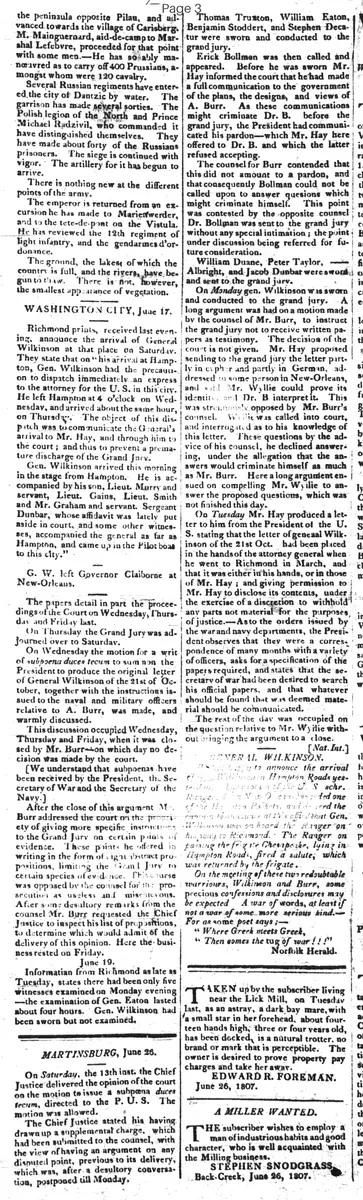
WASHINGTON CITY, June 17.
Richmond papers, received last evening, announce the arrival of General Wilkinson at that place on Saturday. They state that on his arrival at Hampton, Gen. Wilkinson had the precaution to dispatch immediately an express to the attorney for the U. S. in this city. He left Hampton at 4 o'clock on Wednesday, and arrived about the same hour, on Thursday. The object of this dispatch was to communicate the General's arrival to Mr. Hay, and through him to the court; and thus to prevent a premature discharge of the Grand Jury. Gen. Wilkinson arrived this morning in the stage from Hampton. He is accompanied by his son, Lieut. Murray and servant, Lieut. Gaines, Lieut. Smith and Mr. Graham and servant. Sergeant Dunbar, whose affidavit was lately put aside in court, and some other witnesses, accompanied the general as far as Hampton, and came up in the Pilot boat to this city. Gen. W. left Governor Claiborne at New-Orleans. The papers detail in part the proceedings of the Court on Wednesday, Thursday and Friday last. On Thursday the Grand Jury was adjourned over to Saturday. On Wednesday the motion for a writ of subpoena duces tecum to summon the President to produce the original letter of General Wilkinson of the 21st of October, together with the instructions issued to the naval and military officers relative to A. Burr, was made, and warmly discussed. This discussion occupied Wednesday, Thursday and Friday, when it was closed by Mr. Burr on which day no decision was made by the court. We understand that subpoenas have been received by the President, the Secretary of War and the Secretary of the Navy. After the close of this argument Mr. Burr addressed the court on the propriety of giving more specific instructions to the Grand Jury on certain points of evidence. These points he offered in writing in the form of eight abstract propositions, limiting the Grand Jury to certain species of evidence. This course was opposed by the counsel for the prosecution as useless and mischievous. After some desultory remarks from the counsel Mr. Burr requested the Chief Justice to inspect his list of propositions, to determine which would admit of the delivery of this opinion. Here the business rested on Friday.
June 19.
Information from Richmond as late as Tuesday, states there had been only five witnesses examined on Monday evening—the examination of Gen. Eaton lasted about four hours. Gen. Wilkinson had been sworn but not examined.
MARTINSBURG, June 26.
On Saturday, the 13th inst. the Chief Justice delivered the opinion of the court on the motion to issue a subpoena duces tecum, directed to the P. U. S. The motion was allowed. The Chief Justice stated his having drawn up a supplemental charge, which had been submitted to the counsel, with the view of having an argument on any disputed point, previous to its delivery, which was, after a desultory conversation, postponed till Monday. Thomas Truxton, William Eaton, Benjamin Stoddert, and Stephen Decatur were sworn and conducted to the grand jury. Erick Bollman was then called and appeared. Before he was sworn Mr. Hay informed the court that he had made a full communication to the government of the plans, the designs, and views of A. Burr. As these communications might criminate Dr. B. before the grand jury, the President had communicated his pardon—which Mr. Hay here offered to Dr. B. and which the latter refused accepting. The counsel for Burr contended that this did not amount to a pardon, and that consequently Bollman could not be called upon to answer questions which might criminate himself. This point was contested by the opposite counsel. Dr. Bollman was sent to the grand jury without any special intimation: the point under discussion being referred for future consideration. William Duane, Peter Taylor, Albright, and Jacob Dunbar were sworn and sent to the grand jury. On Monday gen. Wilkinson was sworn and conducted to the grand jury. A long argument was had on a motion made by the counsel of Mr. Burr, to instruct the grand jury not to receive written papers as testimony. The decision of the court is not given. Mr. Hay proposed sending to the grand jury the letter partly in cipher and partly in German, addressed to some person in New-Orleans, and said Mr. W. if he could prove its identity, and Dr. B. interpret it. This was strenuously opposed by Mr. Burr's counsel. Willie was called into court, and interrogated as to his knowledge of this letter. These questions by the advice of his counsel, he declined answering, under the allegation that the answers would criminate himself as much as Mr. Burr. Here a long argument ensued on compelling Mr. Willie to answer the proposed questions, which was not finished this day. On Tuesday Mr. Hay produced a letter to him from the President of the U. S. stating that the letter of general Wilkinson of the 21st Oct. had been placed in the hands of the attorney general when he went to Richmond in March, and that it was either in his hands, or in those of Mr. Hay: and giving permission to Mr. Hay to disclose its contents, under the exercise of a discretion to withhold any parts not material for the purposes of justice. As to the orders issued by the war and navy departments, the President observes that they were a correspondence of many months with a variety of officers, asks for a specification of the papers required, and states that the secretary of war had been desired to search his official papers, and that whatever should be found that was deemed material should be communicated. The rest of the day was occupied on the question relative to Mr. Wyilie without bringing the argument to a close.
[Nat. Int.]
GENERAL WILKINSON.
News to announce the arrival of Gen. Wilkinson at Hampton Roads yesterday—from on board the U. S. schr. Revenue, which arrived one of the fleet packets, and addressed the master thus of the hut Gen. Wilkinson came on board the Revenue on his way to Richmond. The Ranger on passing the frigate Chesapeake, lying in Hampton Roads, fired a salute; which was returned by the frigate. On the meeting of these two redoubtable warriors, Wilkinson and Burr, some precious confessions and disclosures may be expected. A war of words, at least if not a war of some more serious kind. For as some poet says:
"Where Greek meets Greek,
Then comes the tug of war!!!"
Norfolk Herald.
Richmond papers, received last evening, announce the arrival of General Wilkinson at that place on Saturday. They state that on his arrival at Hampton, Gen. Wilkinson had the precaution to dispatch immediately an express to the attorney for the U. S. in this city. He left Hampton at 4 o'clock on Wednesday, and arrived about the same hour, on Thursday. The object of this dispatch was to communicate the General's arrival to Mr. Hay, and through him to the court; and thus to prevent a premature discharge of the Grand Jury. Gen. Wilkinson arrived this morning in the stage from Hampton. He is accompanied by his son, Lieut. Murray and servant, Lieut. Gaines, Lieut. Smith and Mr. Graham and servant. Sergeant Dunbar, whose affidavit was lately put aside in court, and some other witnesses, accompanied the general as far as Hampton, and came up in the Pilot boat to this city. Gen. W. left Governor Claiborne at New-Orleans. The papers detail in part the proceedings of the Court on Wednesday, Thursday and Friday last. On Thursday the Grand Jury was adjourned over to Saturday. On Wednesday the motion for a writ of subpoena duces tecum to summon the President to produce the original letter of General Wilkinson of the 21st of October, together with the instructions issued to the naval and military officers relative to A. Burr, was made, and warmly discussed. This discussion occupied Wednesday, Thursday and Friday, when it was closed by Mr. Burr on which day no decision was made by the court. We understand that subpoenas have been received by the President, the Secretary of War and the Secretary of the Navy. After the close of this argument Mr. Burr addressed the court on the propriety of giving more specific instructions to the Grand Jury on certain points of evidence. These points he offered in writing in the form of eight abstract propositions, limiting the Grand Jury to certain species of evidence. This course was opposed by the counsel for the prosecution as useless and mischievous. After some desultory remarks from the counsel Mr. Burr requested the Chief Justice to inspect his list of propositions, to determine which would admit of the delivery of this opinion. Here the business rested on Friday.
June 19.
Information from Richmond as late as Tuesday, states there had been only five witnesses examined on Monday evening—the examination of Gen. Eaton lasted about four hours. Gen. Wilkinson had been sworn but not examined.
MARTINSBURG, June 26.
On Saturday, the 13th inst. the Chief Justice delivered the opinion of the court on the motion to issue a subpoena duces tecum, directed to the P. U. S. The motion was allowed. The Chief Justice stated his having drawn up a supplemental charge, which had been submitted to the counsel, with the view of having an argument on any disputed point, previous to its delivery, which was, after a desultory conversation, postponed till Monday. Thomas Truxton, William Eaton, Benjamin Stoddert, and Stephen Decatur were sworn and conducted to the grand jury. Erick Bollman was then called and appeared. Before he was sworn Mr. Hay informed the court that he had made a full communication to the government of the plans, the designs, and views of A. Burr. As these communications might criminate Dr. B. before the grand jury, the President had communicated his pardon—which Mr. Hay here offered to Dr. B. and which the latter refused accepting. The counsel for Burr contended that this did not amount to a pardon, and that consequently Bollman could not be called upon to answer questions which might criminate himself. This point was contested by the opposite counsel. Dr. Bollman was sent to the grand jury without any special intimation: the point under discussion being referred for future consideration. William Duane, Peter Taylor, Albright, and Jacob Dunbar were sworn and sent to the grand jury. On Monday gen. Wilkinson was sworn and conducted to the grand jury. A long argument was had on a motion made by the counsel of Mr. Burr, to instruct the grand jury not to receive written papers as testimony. The decision of the court is not given. Mr. Hay proposed sending to the grand jury the letter partly in cipher and partly in German, addressed to some person in New-Orleans, and said Mr. W. if he could prove its identity, and Dr. B. interpret it. This was strenuously opposed by Mr. Burr's counsel. Willie was called into court, and interrogated as to his knowledge of this letter. These questions by the advice of his counsel, he declined answering, under the allegation that the answers would criminate himself as much as Mr. Burr. Here a long argument ensued on compelling Mr. Willie to answer the proposed questions, which was not finished this day. On Tuesday Mr. Hay produced a letter to him from the President of the U. S. stating that the letter of general Wilkinson of the 21st Oct. had been placed in the hands of the attorney general when he went to Richmond in March, and that it was either in his hands, or in those of Mr. Hay: and giving permission to Mr. Hay to disclose its contents, under the exercise of a discretion to withhold any parts not material for the purposes of justice. As to the orders issued by the war and navy departments, the President observes that they were a correspondence of many months with a variety of officers, asks for a specification of the papers required, and states that the secretary of war had been desired to search his official papers, and that whatever should be found that was deemed material should be communicated. The rest of the day was occupied on the question relative to Mr. Wyilie without bringing the argument to a close.
[Nat. Int.]
GENERAL WILKINSON.
News to announce the arrival of Gen. Wilkinson at Hampton Roads yesterday—from on board the U. S. schr. Revenue, which arrived one of the fleet packets, and addressed the master thus of the hut Gen. Wilkinson came on board the Revenue on his way to Richmond. The Ranger on passing the frigate Chesapeake, lying in Hampton Roads, fired a salute; which was returned by the frigate. On the meeting of these two redoubtable warriors, Wilkinson and Burr, some precious confessions and disclosures may be expected. A war of words, at least if not a war of some more serious kind. For as some poet says:
"Where Greek meets Greek,
Then comes the tug of war!!!"
Norfolk Herald.
What sub-type of article is it?
Historical Event
Crime Story
What themes does it cover?
Crime Punishment
Justice
What keywords are associated?
Burr Trial
Wilkinson Arrival
Grand Jury
Subpoena Duces Tecum
Witness Examination
Treason Proceedings
What entities or persons were involved?
General Wilkinson
A. Burr
Mr. Hay
Chief Justice
President Of The U. S.
Gen. Eaton
Erick Bollman
Governor Claiborne
Where did it happen?
Richmond
Story Details
Key Persons
General Wilkinson
A. Burr
Mr. Hay
Chief Justice
President Of The U. S.
Gen. Eaton
Erick Bollman
Governor Claiborne
Location
Richmond
Event Date
June 1807
Story Details
General Wilkinson arrives in Richmond as a key witness in Aaron Burr's treason trial; court debates subpoenas to President Jefferson for documents, witness testimonies including Eaton and Bollman, and legal arguments on evidence and pardons.