Thank you for visiting SNEWPapers!
Sign up free
Letter to Editor
August 22, 1771
The Massachusetts Spy
Boston, Suffolk County, Massachusetts
What is this article about?
A member of a Harvard class defends their committee's choice of a cheaper printer over R. Draper for commencement theses, citing cost negotiations and refuting Draper's claims of faction and political bias in the Massachusetts Spy.
Clipping
OCR Quality
85%
Good
Full Text
For the MASSACHUSETTS SPY.
To Mr. R. Draper.
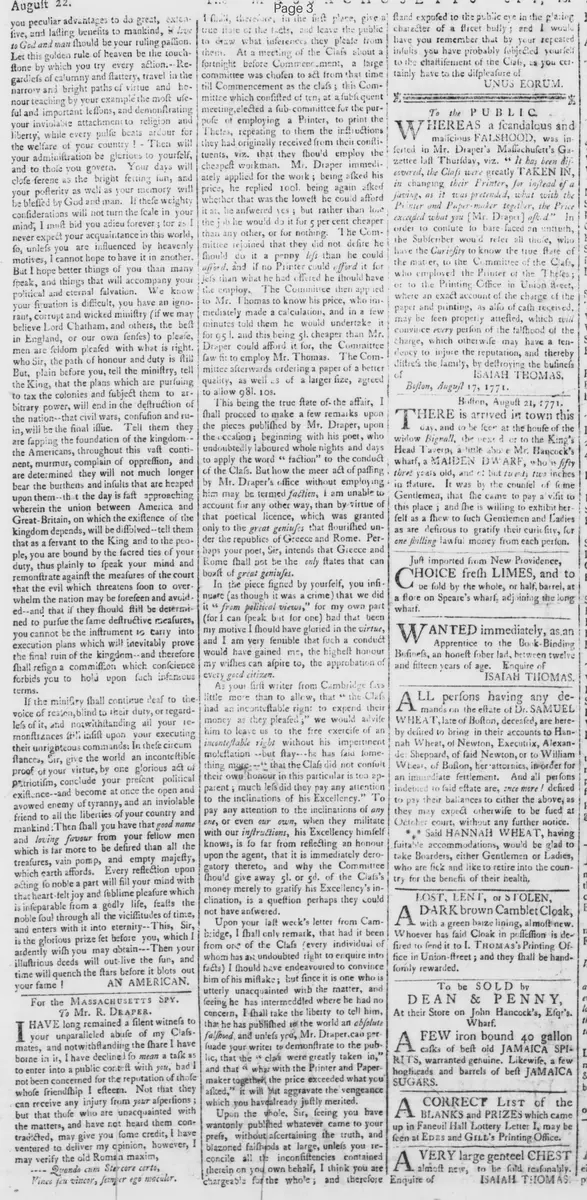
I have long remained a silent witness to your unparalleled abuse of my Classmates, and notwithstanding the share I have borne in it, I have declined so mean a task as to enter into a public contest with you, had I not been concerned for the reputation of those whose friendship I esteem. Not that they can receive any injury from your aspersions; but that those who are unacquainted with the matters, and have not heard them contracted, may give you some credit, I have ventured to deliver my opinion, however, I may verify the old Roman maxim,
— Quando cum Stizcori certs,
Pince fix rincor, ferper ego maculer.
I shall, therefore, in the first place, give a true state of the facts, and leave the public to draw what inferences they please from them. At a meeting of the Class about a fortnight before Commencement, a large committee was chosen to act from that time til Commencement as the class; this Committee which consisted of ten, at a subsequent meeting, elected a sub-committee for the purpose of employing a Printer, to print the Theses, repeating to them the instructions they had originally received from their constituents, viz. that they should employ the cheapest workman. Mr. Draper immediately applied for the work; being asked his price, he replied 100l. being again asked whether that was the lowest he could afford it at, he answered yes; but rather than lose the job he would do it for 5 per cent cheaper than any other, or for nothing. The Committee rejoined that they did not desire he should do it a penny less than he could afford, and if no Printer could afford it for less than what he had stated he should have the employ. The Committee then applied to Mr. Thomas to know his price, who immediately made a calculation, and in a few minutes told them he would undertake it for 95l. and this being 5l. cheaper than Mr. Draper could afford it for, the Committee saw fit to employ Mr. Thomas. The Committee afterwards ordering a paper of a better quality, as well as of a larger size, agreed to allow 98l. 10s.
This being the true state of the affair, I shall proceed to make a few remarks upon the pieces published by Mr. Draper, upon the occasion; beginning with his poet, who undoubtedly laboured whole nights and days to apply the word "faction" to the conduct of the Class. But how the meer act of passing by Mr. Draper's office without employing him may be termed faction, I am unable to account for any other way, than by virtue of that poetical licence, which was granted only to the great geniuses that flourished under the republics of Greece and Rome. Perhaps your poet, Sir, intends that Greece and Rome shall not be the only states that can boast of great geniuses.
In the piece signed by yourself, you insinuate (as though it was a crime) that we did it "from political views," for my own part (for I can speak but for one) had that been my motive I should have gloried in the virtue. and I am very sensible that such a conduct would have gained me, the highest honour my wishes can aspire to, the approbation of every good citizen.
As your first writer from Cambridge says little more than to allow, that "the Class had an incontestable right to expend their money as they pleased;" we would advise him to leave us to the free exercise of an incontestable right without his impertinent molestation—but stay—he has said something more.—"that the Class did not consult their own honour in this particular is too apparent; much less did they pay any attention to the inclinations of his Excellency." To pay any attention to the inclinations of any one, or even our own, when they militate with our instructions, his Excellency himself knows, is so far from reflecting an honour upon the agent, that it is immediately derogatory thereto, and why the Committee should give away 5l. or 5d. of the Class's money merely to gratify his Excellency's inclination, is a question perhaps they could not have answered.
Upon your last week's letter from Cambridge, I shall only remark, that had it been from one of the Class (every individual of whom has an undoubted right to enquire into facts) I should have endeavoured to convince him of his mistake; but since it is one who is utterly unacquainted with the matter, and seeing he has intermeddled where he had no concern, I shall take the liberty to tell him, that he has published to the world an absolute falsehood, and unless you, Mr. Draper, can persuade your writer to demonstrate to the public, that the "class were greatly taken in," and that "what with the Printer and Paper-maker together, the price exceeded what you asked," it will but aggravate the vengeance which you have already justly merited.
Upon the whole, Sir, seeing you have wantonly published whatever came to your press, without ascertaining the truth, and blazoned falsehoods at large, unless you reconcile all the inconsistencies contained therein on your own behalf, I think you are chargeable for the whole; and therefore shall stand exposed to the public eye in the glaring character of a street bully: and I would have you remember that by your repeated insults you have probably subjected yourself to the chastisement of the Class, as you certainly have to the displeasure of
UNUS EORUM.
To Mr. R. Draper.
I have long remained a silent witness to your unparalleled abuse of my Classmates, and notwithstanding the share I have borne in it, I have declined so mean a task as to enter into a public contest with you, had I not been concerned for the reputation of those whose friendship I esteem. Not that they can receive any injury from your aspersions; but that those who are unacquainted with the matters, and have not heard them contracted, may give you some credit, I have ventured to deliver my opinion, however, I may verify the old Roman maxim,
— Quando cum Stizcori certs,
Pince fix rincor, ferper ego maculer.
I shall, therefore, in the first place, give a true state of the facts, and leave the public to draw what inferences they please from them. At a meeting of the Class about a fortnight before Commencement, a large committee was chosen to act from that time til Commencement as the class; this Committee which consisted of ten, at a subsequent meeting, elected a sub-committee for the purpose of employing a Printer, to print the Theses, repeating to them the instructions they had originally received from their constituents, viz. that they should employ the cheapest workman. Mr. Draper immediately applied for the work; being asked his price, he replied 100l. being again asked whether that was the lowest he could afford it at, he answered yes; but rather than lose the job he would do it for 5 per cent cheaper than any other, or for nothing. The Committee rejoined that they did not desire he should do it a penny less than he could afford, and if no Printer could afford it for less than what he had stated he should have the employ. The Committee then applied to Mr. Thomas to know his price, who immediately made a calculation, and in a few minutes told them he would undertake it for 95l. and this being 5l. cheaper than Mr. Draper could afford it for, the Committee saw fit to employ Mr. Thomas. The Committee afterwards ordering a paper of a better quality, as well as of a larger size, agreed to allow 98l. 10s.
This being the true state of the affair, I shall proceed to make a few remarks upon the pieces published by Mr. Draper, upon the occasion; beginning with his poet, who undoubtedly laboured whole nights and days to apply the word "faction" to the conduct of the Class. But how the meer act of passing by Mr. Draper's office without employing him may be termed faction, I am unable to account for any other way, than by virtue of that poetical licence, which was granted only to the great geniuses that flourished under the republics of Greece and Rome. Perhaps your poet, Sir, intends that Greece and Rome shall not be the only states that can boast of great geniuses.
In the piece signed by yourself, you insinuate (as though it was a crime) that we did it "from political views," for my own part (for I can speak but for one) had that been my motive I should have gloried in the virtue. and I am very sensible that such a conduct would have gained me, the highest honour my wishes can aspire to, the approbation of every good citizen.
As your first writer from Cambridge says little more than to allow, that "the Class had an incontestable right to expend their money as they pleased;" we would advise him to leave us to the free exercise of an incontestable right without his impertinent molestation—but stay—he has said something more.—"that the Class did not consult their own honour in this particular is too apparent; much less did they pay any attention to the inclinations of his Excellency." To pay any attention to the inclinations of any one, or even our own, when they militate with our instructions, his Excellency himself knows, is so far from reflecting an honour upon the agent, that it is immediately derogatory thereto, and why the Committee should give away 5l. or 5d. of the Class's money merely to gratify his Excellency's inclination, is a question perhaps they could not have answered.
Upon your last week's letter from Cambridge, I shall only remark, that had it been from one of the Class (every individual of whom has an undoubted right to enquire into facts) I should have endeavoured to convince him of his mistake; but since it is one who is utterly unacquainted with the matter, and seeing he has intermeddled where he had no concern, I shall take the liberty to tell him, that he has published to the world an absolute falsehood, and unless you, Mr. Draper, can persuade your writer to demonstrate to the public, that the "class were greatly taken in," and that "what with the Printer and Paper-maker together, the price exceeded what you asked," it will but aggravate the vengeance which you have already justly merited.
Upon the whole, Sir, seeing you have wantonly published whatever came to your press, without ascertaining the truth, and blazoned falsehoods at large, unless you reconcile all the inconsistencies contained therein on your own behalf, I think you are chargeable for the whole; and therefore shall stand exposed to the public eye in the glaring character of a street bully: and I would have you remember that by your repeated insults you have probably subjected yourself to the chastisement of the Class, as you certainly have to the displeasure of
UNUS EORUM.
What sub-type of article is it?
Persuasive
Informative
Political
What themes does it cover?
Commerce Trade
Politics
What keywords are associated?
Printing Contract
Class Committee
Draper Dispute
Cheaper Printer
Political Views
Theses Printing
Committee Negotiation
What entities or persons were involved?
Unus Eorum
Mr. R. Draper
Letter to Editor Details
Author
Unus Eorum
Recipient
Mr. R. Draper
Main Argument
the letter defends the class committee's decision to hire a cheaper printer (mr. thomas at 95l. instead of mr. draper's 100l.) for printing theses, refuting accusations of factionalism and political motives, and providing the true facts of the negotiation.
Notable Details
Mangled Latin Quote: 'Quando Cum Stizcori Certs, Pince Fix Rincor, Ferper Ego Maculer.'
References To 'His Excellency' Implying The Governor's Inclinations.
Accusations Of Draper's Publications Containing Falsehoods And Inconsistencies.