Thank you for visiting SNEWPapers!
Sign up free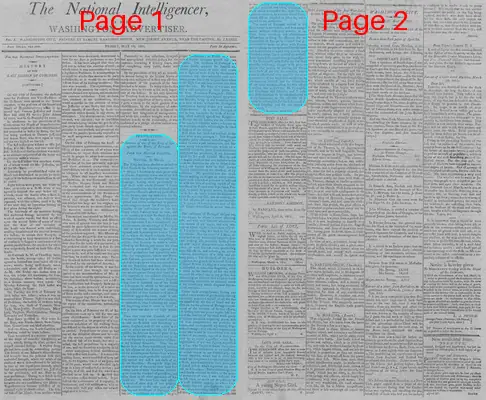
The National Intelligencer And Washington Advertiser
Washington, District Of Columbia
What is this article about?
King of Spain declares war on Portugal on February 27, 1801, after failed mediation for peace with France, citing Portugal's alliance with England, aid to enemies, and insults to Spanish dignity. Reported in Madrid Gazette on March 3.
Merged-components note: This is a direct continuation of the Declaration of War by the King of Spain against Portugal, split across pages 1 and 2 with sequential reading orders.
Clippings
1 of 2
OCR Quality
Full Text
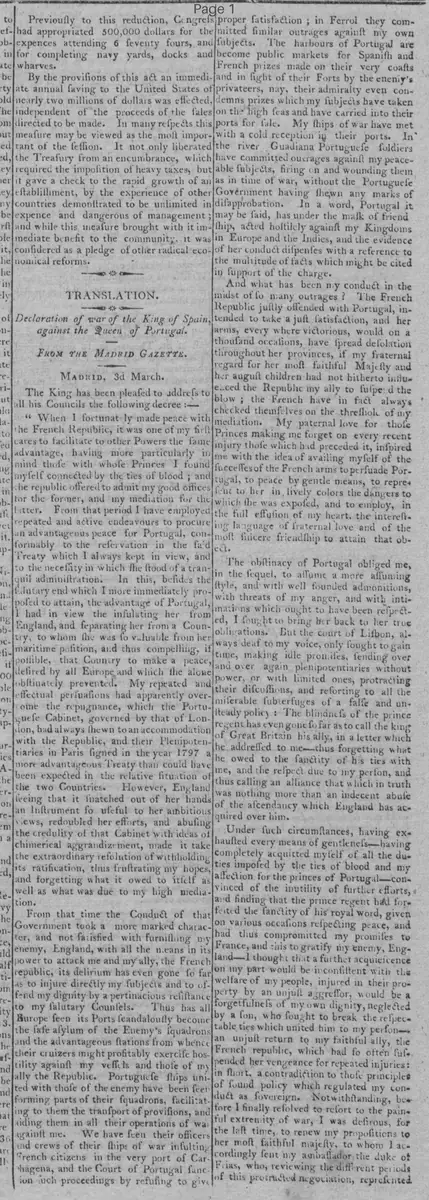
Declaration of war of the King of Spain, against the Queen of Portugal.
FROM THE MADRID GAZETTE.
MADRID, 3d March.
The King has been pleased to address to all his Councils the following decree: -
"When I fortunately made peace with the French Republic, it was one of my first cares to facilitate to other Powers the same advantage, having more particularly in mind those with whose Princes I found myself connected by the ties of blood; and the republic offered to admit my good offices for the former, and my mediation for the latter. From that period I have employed repeated and active endeavours to procure an advantageous peace for Portugal, conformably to the reservation in the said Treaty which I always kept in view, and to the necessity in which he stood of a tranquil administration. In this, besides the salutary end which I more immediately proposed to attain, the advantage of Portugal, I had in view the insulating her from England, and separating her from a Country, to whom she was so valuable from her maritime position, and thus compelling, if possible, that Country to make a peace, desired by all Europe and which she alone obstinately prevented. My repeated and effectual persuasions had apparently overcome the repugnance, which the Portuguese Cabinet, governed by that of London, had always shown to an accommodation with the Republic, and their Plenipotentiaries in Paris signed in the year 1797 a more advantageous Treaty than could have been expected in the relative situation of the two Countries. However, England seeing that it snatched out of her hands an Instrument so useful to her ambitious views, redoubled her efforts, and abusing the credulity of that Cabinet with ideas of chimerical aggrandizement, made it take the extraordinary resolution of withholding its ratification, thus frustrating my hopes and forgetting what it owed to itself as well as what was due to my high mediation.
From that time the Conduct of that Government took a more marked character, and not satisfied with furnishing my enemy, England, with all the means in its power to attack me and my ally, the French republic, its delirium has even gone so far as to injure directly my subjects and to offend my dignity by a pertinacious resistance to my salutary Counsels. Thus has all Europe seen its Ports scandalously become the safe asylum of the Enemy's squadrons and the advantageous stations from whence their cruizers might profitably exercise hostility against my vessels and those of my ally the Republic. Portuguese ships united with those of the enemy have been seen forming parts of their squadrons, facilitating to them the transport of provisions, and aiding them in all their operations of war against me. We have seen their officers and crews of their ships of war insulting French citizens in the very port of Carthagena, and the Court of Portugal sanctioning such proceedings by refusing to give proper satisfaction; in Ferrol they committed similar outrages against my own subjects. The harbours of Portugal are become public markets for Spanish and French prizes made on their very coasts and in sight of their Forts by the enemy's privateers, nay, their admiralty even condemns prizes which my subjects have taken on the high seas and have carried into their ports for sale. My ships of war have met with a cold reception in their ports. In the river Guadiana Portuguese soldiers have committed outrages against my peaceable subjects, firing on and wounding them as in time of war, without the Portuguese Government having shown any marks of disapprobation. In a word, Portugal it may be said, has under the mask of friendship, acted hostilely against my Kingdoms in Europe and the Indies, and the evidence of her conduct dispenses with a reference to the multitude of facts which might be cited in support of the charge.
And what has been my conduct in the midst of so many outrages? The French Republic justly offended with Portugal, intended to take a just satisfaction, and her arms, every where victorious, would on a thousand occasions, have spread desolation throughout her provinces, if my fraternal regard for her most faithful Majesty and her august children had not hitherto influenced the Republic my ally to suspend the blow: the French have in fact always checked themselves on the threshold of my mediation. My paternal love for those Princes making me forget on every recent injury those which had preceded it, inspired me with the idea of availing myself of the successes of the French arms to persuade Portugal, to peace by gentle means, to represent to her in lively colors the dangers to which she was exposed, and to employ, in the full effusion of my heart, the interesting language of fraternal love and of the most sincere friendship to attain that object.
The obstinacy of Portugal obliged me, in the sequel, to assume a more assuming style, and with well founded admonitions, with threats of my anger, and with intimations which ought to have been respected, I sought to bring her back to her true obligations. But the court of Lisbon, always deaf to my voice, only sought to gain time, making idle promises, sending over and over again plenipotentiaries without power, or with limited ones, protracting their discussions, and resorting to all the miserable subterfuges of a false and unsteady policy: The blindness of the prince regent has even gone so far as to call the king of Great Britain his ally, in a letter which he addressed to me--thus forgetting what he owed to the sanctity of his ties with me, and the respect due to my person, and thus calling an alliance that which in truth was nothing more than an indecent abuse of the ascendancy which England has acquired over him.
Under such circumstances, having exhausted every means of gentleness--having completely acquitted myself of all the duties imposed by the ties of blood and my affection for the princes of Portugal--convinced of the inutility of further efforts, and finding that the prince regent had forfeited the sanctity of his royal word, given on various occasions respecting peace, and had thus compromised my promises to France, and this to gratify my enemy, England--I thought that a further acquiescence on my part would be inconsistent with the welfare of my people, injured in their property by an unjust aggressor, would be a forgetfulness of my own dignity, neglected by a son, who ought to break the respectable ties which united him to my person-- an unjust return to my faithful ally, the French republic, which had so often suspended her vengeance for repeated injuries: in short, a contradiction to those principles of sound policy which regulated my conduct as sovereign. Notwithstanding, before I finally resolved to resort to the painful extremity of war, I was desirous, for the last time, to renew my propositions to her most faithful majesty, to whom I accordingly sent my ambassador the duke of Frias, who, reviewing the different periods of this protracted negociation, represented
To her majesty how disrespectful and unjust her conduct had been, displayed the abyss which threatened her, with the only means to avoid it, by a treaty which France would still be disposed to listen to, out of regard to my mediation.
The court of Portugal replied in the same terms as heretofore, and sent a negotiator without sufficient powers, at the same time rejecting my ultimatum.
Wherefore it being of essential for the tranquility of Europe to compel that government to make its peace with France, and to obtain for my beloved subjects those indemnifications to which they have so well founded a claim, I have ordered my ambassador to leave Lisbon, and have given passports to the Portuguese ambassador for the same purpose, resolving, though with pain, to attack that power, by uniting my forces with those of my ally the republic, whose cause is assimilated with mine by the compromise of my neglected mediation, by our common interest, and for satisfaction of my own wrongs— And for this effect.
I declare war against her M. F. majesty, her Kingdoms and subjects, and I order this determination to be communicated to all my dominions, to the end that all fit means be resorted to for the defence of my beloved subjects, and for the attack of the enemy.
Given at Aranjuez, 27th Feb. 1801."
What sub-type of article is it?
What keywords are associated?
What entities or persons were involved?
Where did it happen?
Foreign News Details
Primary Location
Spain
Event Date
27th Feb. 1801
Key Persons
Outcome
declaration of war against portugal, ordering unification of spanish and french forces to attack and defend against portuguese subjects.
Event Details
The King of Spain, after failed mediations and repeated Portuguese refusals to ratify peace with France, alliance with England, and various outrages against Spanish and French interests, declares war on Portugal to compel peace with France and seek indemnification for wrongs.