Thank you for visiting SNEWPapers!
Sign up free
Herald Of The United States
Warren, Bristol County, Rhode Island
What is this article about?
Mutiny by Froberg's Regiment at Fort Ricasoli, Malta, on April 4, 1806. Mutineers overpowered officers, killed three, and threatened to bombard Valletta. After standoff, most surrendered; ringleaders blew up a gunpowder magazine, killing three sentinels. 24 executed on April 16.
Clipping
OCR Quality
Full Text
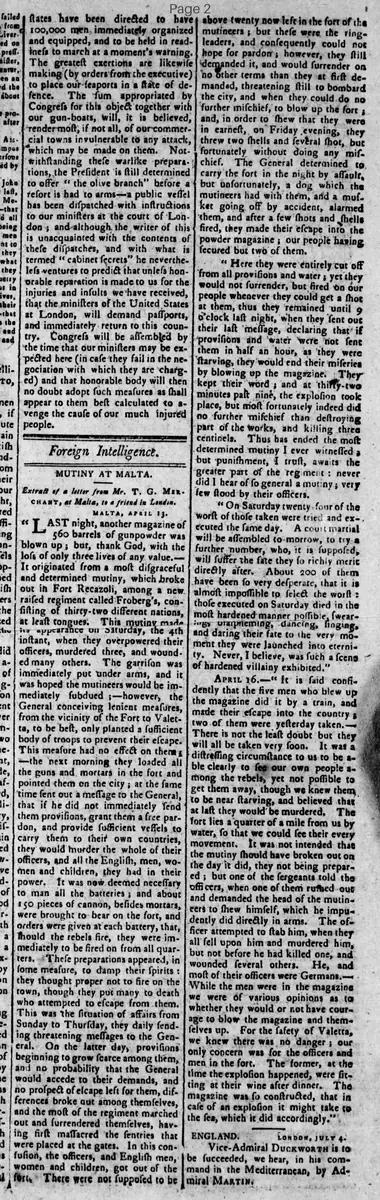
MUTINY AT MALTA.
Extract of a letter from Mr. T. G. Merchant, at Malta, to a friend in London.
MALTA, APRIL 13.
"Last night, another magazine of 560 barrels of gunpowder was blown up; but, thank God, with the loss of only three lives of any value.—It originated from a most disgraceful and determined mutiny, which broke out in Fort Ricasoli, among a new raised regiment called Froberg's, consisting of thirty-two different nations, at least tongues. This mutiny made its appearance on Saturday, the 4th instant, when they overpowered their officers, murdered three, and wounded many others. The garrison was immediately put under arms, and it was hoped the mutineers would be immediately subdued;—however, the General conceiving lenient measures, from the vicinity of the Fort to Valetta, to be best, only planted a sufficient body of troops to prevent their escape. This measure had no effect on them—the next morning they loaded all the guns and mortars in the fort and pointed them on the city; at the same time sent out a message to the General, that if he did not immediately send them provisions, grant them a free pardon, and provide sufficient vessels to carry them to their own countries, they would murder the whole of their officers, and all the English, men, women and children, they had in their power. It was now deemed necessary to man all the batteries; and about 150 pieces of cannon, besides mortars, were brought to bear on the fort, and orders were given at each battery, that, should the rebels fire, they were immediately to be fired on from all quarters. These preparations appeared, in some measure, to damp their spirits: they thought proper not to fire on the town, though they put many to death who attempted to escape from them. This was the situation of affairs from Sunday to Thursday, they daily sending threatening messages to the General. On the latter day provisions beginning to grow scarce among them, and no probability that the General would accede to their demands, and no prospect of escape left for them, differences broke out among themselves, and the most of the regiment marched out and surrendered themselves, having first massacred the sentries that were placed at the gates. In this confusion, the officers, and English men, women and children, got out of the fort. There were not supposed to be above twenty now left in the fort of the mutineers; but these were the ring-leaders, and consequently could not hope for pardon; however, they still demanded it, and would surrender on no other terms than they at first demanded, threatening still to bombard the city, and when they could do no further mischief, to blow up the fort: and, in order to show that they were in earnest, on Friday evening, they threw two shells and several shot, but fortunately without doing any mischief. The General determined to carry the fort in the night by assault, but unfortunately, a dog which the mutineers had with them, and a musket going off by accident, alarmed them, and after a few shots and shells fired, they made their escape into the powder magazine; our people having secured but two of them.
Here they were entirely cut off from all provisions and water; yet they would not surrender, but fired on our people whenever they could get a shot at them, thus they remained until 9 o'clock last night, when they sent out their last message, declaring that if provisions and water were not sent them in half an hour, as they were starving, they would end their miseries by blowing up the magazine. They kept their word; and at thirty-two minutes past nine, the explosion took place, but most fortunately indeed did no further mischief than destroying part of the works, and killing three sentinels. Thus has ended the most determined mutiny I ever witnessed but punishment, I trust, awaits the greater part of the regiment: never did I hear of so general a mutiny; very few stood by their officers.
"On Saturday twenty four of the worst of those taken were tried and executed the same day. A court martial will be assembled to-morrow, to try a further number, who, it is supposed, will suffer the fate they so richly merit directly after. About 200 of them have been so very desperate, that it is almost impossible to exact the work: those executed on Saturday died in the most hardened manner possible, wearing surprizing, dancing, singing, and daring their fate to the very moment they were launched into eternity. Never, I believe, was such a scene of hardened villainy exhibited."
April 16. —"It is said confidently that the five men who blew up the magazine did it by a train, and made their escape into the country; two of them were yesterday taken.—There is not the least doubt but they will all be taken very soon. It was a distressing circumstance to us to be able to clearly to see our own people among the rebels, yet not possible to get them away, though we knew them to be near starving, and believed that at last they would be murdered. The fort lies a quarter of a mile from us by water, so that we could see their every movement. It was not intended that the mutiny should have broken out on the day it did, they not being prepared; but one of the sergeants told the officers, when one of them rushed out and demanded the head of the mutineers to show himself, which he impudently did directly in arms. The officer attempted to stab him, when they all fell upon him and murdered him, but not before he had killed one, and wounded several others. He, and most of their officers were Germans.—While the men were in the magazine we were of various opinions as to whether they would or not have courage to blow the magazine and themselves up. For the safety of Valetta, we knew there was no danger; our only concern was for the officers and men in the fort. The former, at the time the explosion happened, were sitting at their wine after dinner. The magazine was so constructed, that in case of an explosion it might take to the sea, which it did accordingly."
What sub-type of article is it?
What keywords are associated?
What entities or persons were involved?
Where did it happen?
Foreign News Details
Primary Location
Fort Ricasoli, Malta
Event Date
April 4 To April 16, 1806
Key Persons
Outcome
three officers murdered, many wounded; three sentinels killed in explosion; 24 mutineers executed on april 16; five ringleaders escaped after blowing up magazine, two recaptured; most of regiment surrendered and face trials.
Event Details
Froberg's Regiment mutinied at Fort Ricasoli on April 4, overpowering and killing three officers. They threatened Valletta, demanding provisions, pardon, and transport home. After standoff, most surrendered on April 7; ringleaders retreated to magazine, blew it up on April 12, killing three sentinels, and escaped.