Thank you for visiting SNEWPapers!
Sign up free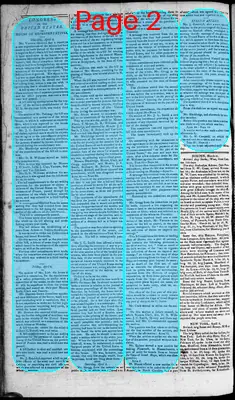
Alexandria Daily Advertiser
Alexandria, Virginia
What is this article about?
Proceedings of the U.S. House of Representatives on April 3-5, 1806, covering debates and passages of bills on militia organization, Indiana territory division, military appropriations, revolutionary war pensions, post roads, session closure, navy yards, merchant vessels, lighthouses, copper duties, public lands, and Spanish affairs, with various motions and amendments.
Clipping
OCR Quality
Full Text
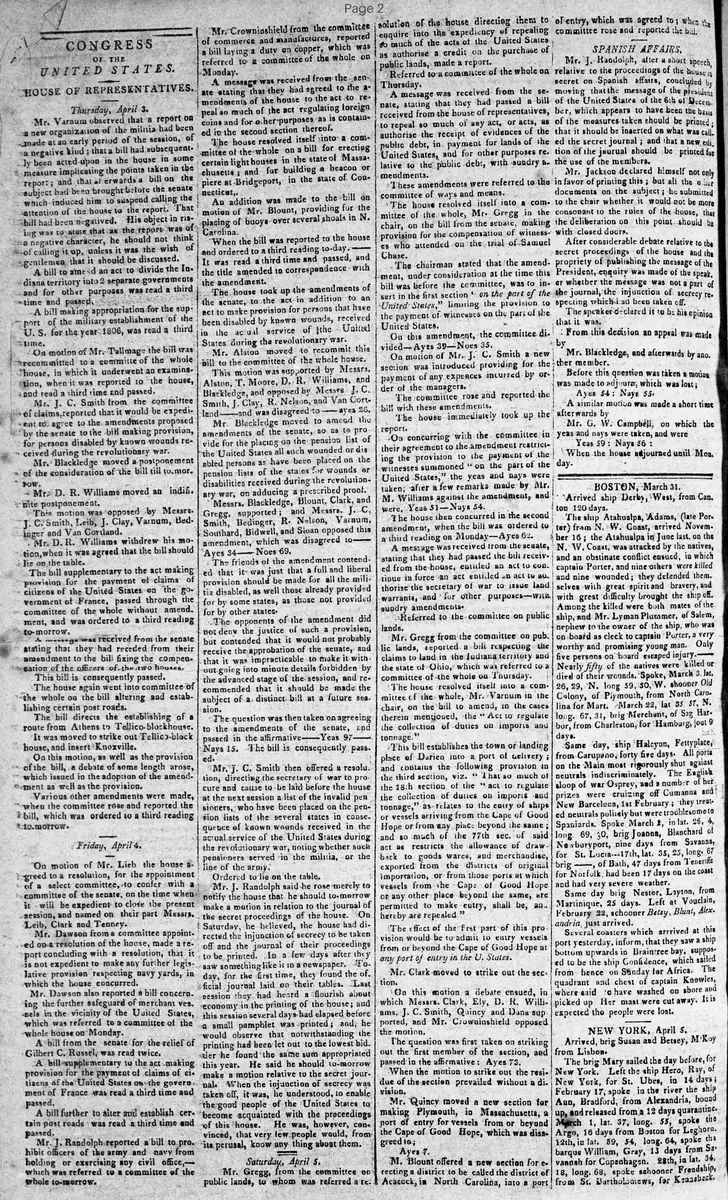
OF THE
UNITED STATES.
HOUSE OF REPRESENTATIVES.
Thursday, April 3.
Mr. Varnum observed that a report on a new organization of the militia had been made at an early period of the session, of a negative kind; that a bill had subsequently been acted upon in the house in some measure implicating the points taken in the report; and that afterwards a bill on the subject had been brought before the senate which had been negatived. His object in rising was to state that as the report was of a negative character, he should not think of calling the attention of the house to the report. That which induced him to suspend calling it up, unless it was the wish of gentlemen that it should be discussed.
A bill to amend an act to divide the Indiana territory into two separate governments and for other purposes was read a third time and passed.
A bill making appropriation for the support of the military establishment of the U. S. for the year 1806, was read a third time.
On motion of Mr. Tallmadge the bill was recommitted to a committee of the whole house, in which it underwent an examination, when it was reported to the house, and read a third time and passed.
Mr. J. C. Smith from the committee of claims reported that it would be expedient to agree to the amendments proposed by the senate to the bill making provision for persons disabled by known wounds received during the revolutionary war.
Mr. Blackledge moved a postponement of the consideration of the bill till to-morrow.
Mr. D. R. Williams moved an indefinite postponement.
This motion was opposed by Messrs. J. C. Smith, Leib, J. Clay, Varnum, Bedinger and Van Cortlandt.
Mr. D. R. Williams withdrew his motion, when it was agreed that the bill should lie on the table.
The bill supplementary to the act making provision for the payment of claims of citizens of the United States on the government of France, passed through the committee of the whole without amendment, and was ordered to a third reading to-morrow.
A message was received from the senate stating that they had receded from their amendment to the bill fixing the compensation of the officers of the two houses.
This bill is consequently passed.
The house again went into committee of the whole on the bill altering and establishing certain post roads.
The bill directs the establishing of a route from Athens to Tellico Blockhouse.
It was moved to strike out Tellico Blockhouse and insert Knoxville.
On this motion, as well as the provision of the bill, a debate of some length arose, which ensued in the adoption of the amendment as well as the provision.
Various other amendments were made, when the committee rose and reported the bill, which was ordered to a third reading to-morrow.
Friday, April 4.
On motion of Mr. Leib the house agreed to a resolution, for the appointment of a select committee, to confer with a committee of the senate, on the time when it will be expedient to close the present session, and named on their part Messrs. Leib, Clark and Tenney.
Mr. Dawson from a committee appointed on a resolution of the house, made a report concluding with a resolution, that it is not expedient to make any further legislative provision respecting navy yards, in which the house concurred.
Mr. Dawson also reported a bill concerning the further safeguard of merchant vessels in the vicinity of the United States, which was referred to a committee of the whole house on Monday.
A bill from the senate for the relief of Gilbert C. Russell, was read twice.
A bill supplementary to the act making provision for the payment of claims of citizens of the United States on the government of France was read a third time and passed.
A bill further to alter and establish certain post roads was read a third time and passed.
Mr. J. Randolph reported a bill to prohibit officers of the army and navy from holding or exercising any civil office, which was referred to a committee of the whole to-morrow.
Mr. Crowninshield from the committee of commerce and manufactures, reported a bill laying a duty on copper, which was referred to a committee of the whole on Monday.
A message was received from the senate stating that they had agreed to the amendments of the house to the act to repeal so much of the act regulating foreign coins and for other purposes as is contained in the second section thereof.
The house resolved itself into a committee of the whole on a bill for erecting certain light houses in the state of Massachusetts; and for building a beacon or pier at Bridgeport, in the state of Connecticut.
An addition was made to the bill on motion of Mr. Blount, providing for the placing of buoys over several shoals in N. Carolina.
When the bill was reported to the house and ordered to a third reading to-day.
It was read a third time and passed, and the title amended in correspondence with the amendment.
The house took up the amendments of the senate, to the act in addition to an act to make provision for persons that have been disabled by known wounds, received in the actual service of the United States during the revolutionary war.
Mr. Alston moved to recommit this bill to the committee of the whole house.
This motion was supported by Messrs. Alston, T. Moore, D. R. Williams, and Blackledge, and opposed by Messrs. J. C. Smith, J. Clay, R. Nelson, and Van Cortlandt—and was disagreed to—ayes 26.
Mr. Blackledge moved to amend the amendments of the senate, so as to provide for the placing on the pension list of the United States all such wounded or disabled persons as have been placed on the pension lists of the states for wounds or disabilities received during the revolutionary war, on adducing a prescribed proof.
Messrs. Blackledge, Blount, Clark, and Gregg, supported; and Messrs. J. C. Smith, Bedinger, R. Nelson, Varnum, Southard, Bidwell, and Sloan opposed this amendment, which was disagreed to— Ayes 34—Noes 69.
The friends of the amendment contended that it was just that a full and liberal provision should be made for all the militia disabled, as well those already provided for by some states, as those not provided for by other states.
The opponents of the amendment did not deny the justice of such a provision, but contended that it would not probably receive the approbation of the senate, and that it was impracticable to make it without going into minute details forbidden by the advanced stage of the session, and recommended that it should be made the subject of a distinct bill at a future session.
The question was then taken on agreeing to the amendments of the senate, and passed in the affirmative—Yeas 97— Nays 15. The bill is consequently passed.
Mr. J. C. Smith then offered a resolution, directing the secretary of war to procure and cause to be laid before the house at the next session a list of the invalid pensioners, who have been placed on the pension lists of the several states in consequence of known wounds received in the actual service of the United States during the revolutionary war, noting whether such pensioners served in the militia, or the line of the army.
Ordered to lie on the table.
Mr. J. Randolph said—he rose merely to notify the house that he should to-morrow make a motion in relation to the journal of the secret proceedings of the house. On Saturday, he believed, the house had directed the injunction of secrecy to be taken off and the journal of their proceedings to be printed. In a few days after they saw something like it in a newspaper. To-day, for the first time, they found the official journal laid on their tables. Last session they had heard a flourish about economy in the printing of the house; and this session several days had elapsed before a small pamphlet was printed; and he would observe that notwithstanding the printing had been let out to the lowest bidder he found the same sum appropriated this year. He said he should to-morrow make a motion relative to the secret journal. When the injunction of secrecy was taken off, it was, he understood, to enable the good people of the United States to become acquainted with the proceedings of this house. He was, however, convinced, that very few people would, from its perusal, know any thing about them.
Saturday, April 5.
Mr. Gregg, from the committee on public lands, to whom was referred a resolution of the house directing them to enquire into the expediency of repealing so much of the acts of the United States as authorise a credit on the purchase of public lands, made a report.
Referred to a committee of the whole on Thursday.
A message was received from the senate, stating that they had passed a bill received from the house of representatives, to repeal so much of any act, or acts, as authorise the receipt of evidences of the public debt, in payment for lands of the United States, and for other purposes relative to the public debt, with sundry amendments.
These amendments were referred to the committee of ways and means.
The house resolved itself into a committee of the whole, Mr. Gregg in the chair, on the bill from the senate, making provision for the compensation of witnesses who attended on the trial of Samuel Chase.
The chairman stated that the amendment, under consideration at the time this bill was before the committee, was to insert in the first section "on the part of the United States," limiting the provision to the payment of witnesses on the part of the United States.
On this amendment, the committee divided— Ayes 39 — Noes 35.
On motion of Mr. J. C. Smith a new section was introduced providing for the payment of any expenses incurred by order of the managers.
The committee rose and reported the bill with these amendments.
The house immediately took up the report.
On concurring with the committee in their agreement to the amendment restricting the provision to the payment of the witnesses summoned " on the part of the United States," the yeas and nays were taken; after a few remarks made by Mr. M. Williams against the amendment, and were, Yeas 51—Nays 54.
The house then concurred in the second amendment, when the bill was ordered to a third reading on Monday—Ayes 62.
A message was received from the senate, stating that they had passed the bill received from the house, entitled an act to continue in force an act entitled an act to authorise the secretary of war to issue land warrants, and for other purposes—with sundry amendments—
Referred to the committee on public lands.
Mr. Gregg from the committee on public lands, reported a bill respecting the claims to land in the Indiana territory and the state of Ohio, which was referred to a committee of the whole on Thursday.
The house resolved itself into a committee of the whole, Mr. Varnum in the chair, on the bill to amend, in the cases therein mentioned, the " Act to regulate the collection of duties on imports and tonnage."
This bill establishes the town or landing place of Darien into a port of delivery; and contains the following provision in the third section, viz. " That so much of the 18th section of the " act to regulate the collection of duties on imports and tonnage," as relates to the entry of ships or vessels arriving from the Cape of Good Hope or from any place beyond the same ; and so much of the 77th sec. of said act as restricts the allowance of drawback to goods wares, and merchandise, exported from the districts of original importation, or from those ports at which vessels from the Cape of Good Hope or any other place beyond the same, are permitted to make entry, shall be, and hereby are repealed."
The effect of the first part of this provision would be to admit to entry vessels from or beyond the Cape of Good Hope at any port of entry in the U. States.
Mr. Clark moved to strike out the section.
On this motion a debate ensued, in which Messrs. Clark, Ely, D. R. Williams, J. C. Smith, Quincy and Dana supported, and Mr. Crowninshield opposed the motion.
The question was first taken on striking out the first member of the section, and passed in the affirmative: Ayes 73.
When the motion to strike out the residue of the section prevailed without a division.
Mr. Quincy moved a new section for making Plymouth, in Massachusetts, a port of entry for vessels from or beyond the Cape of Good Hope, which was disagreed to; Ayes 7.
Mr. Blount offered a new section for erecting a district to be called the district of Albemarle, in North Carolina, into a port of entry, which was agreed to; when the committee rose and reported the bill.
SPANISH AFFAIRS.
Mr. J. Randolph, after a short speech relative to the proceedings of the house in secret on Spanish affairs, concluded by moving that the message of the president of the United States of the 6th of December, which appears to have been the basis of the measures taken should be printed ; that it should be inserted on what was called the secret journal ; and that a new edition of the journal should be printed for the use of the members.
Mr. Jackson declared himself not only in favor of printing this ; but all the other documents on the subject; he submitted to the chair whether it would not be more consonant to the rules of the house, that the deliberation on this point should be with closed doors.
After considerable debate relative to the secret proceedings of the house and the propriety of publishing the message of the President, enquiry was made of the speaker whether the message was not a part of the journal, the injunction of secrecy respecting which had been taken off.
The speaker declared it to be his opinion that it was.
From this decision an appeal was made by Mr. Blackledge, and afterwards by another member.
Before this question was taken a motion was made to adjourn, which was lost; Ayes 54: Nays 55.
A similar motion was made a short time afterwards by Mr. G. W. Campbell, on which the yeas and nays were taken, and were Yeas 59: Nays 56 :
When the house adjourned until Monday.
What sub-type of article is it?
What keywords are associated?
What entities or persons were involved?
Domestic News Details
Event Date
April 3 5, 1806
Key Persons
Outcome
multiple bills passed including amendments to indiana territory division, military appropriations for 1806, revolutionary war pension provisions, post roads alterations, french claims payments, lighthouse constructions, and port entries; various motions defeated or tabled; debates on session closure, navy yards, copper duties, public lands, and secret proceedings on spanish affairs.
Event Details
The House of Representatives conducted sessions on April 3, 4, and 5, 1806, discussing and acting on reports, bills, and resolutions related to militia organization, territorial divisions, military funding, veteran pensions, post roads, session timing, navy provisions, merchant vessel safeguards, lighthouses, import duties, public lands, and secret journals concerning Spanish affairs, with debates, amendments, and votes recorded.