Thank you for visiting SNEWPapers!
Sign up free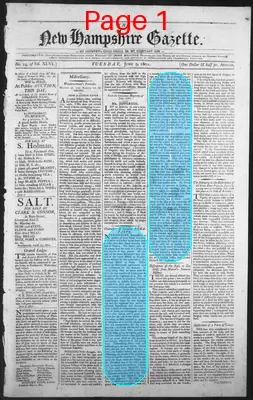
The New Hampshire Gazette
Portsmouth, Rockingham County, New Hampshire
What is this article about?
Biographical sketch of Napoleon Bonaparte's early life, education, character, revolutionary involvement, and successful command of the Italian army in 1796, highlighting his rise from Corsican origins to key French general.
Clipping
OCR Quality
Full Text
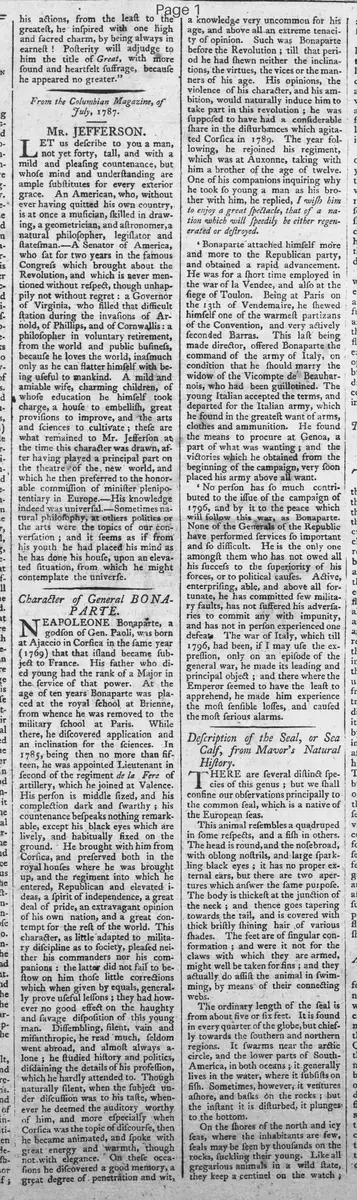
Napoleon Bonaparte, was born at Ajaccio in Corsica in the same year (1769) that that island became subject to France. His father who died young had the rank of a Major in the service of that power. At the age of ten years Bonaparte was placed at the royal school at Brienne, from whence he was removed to the military school at Paris. While there, he discovered application and an inclination for the sciences. In 1785, being then no more than fifteen, he was appointed Lieutenant in second of the regiment de la Fere of artillery, which he joined at Valence. His person is middle sized, and his complexion dark and swarthy ; his countenance bespeaks nothing remarkable, except his black eyes which are lively, and habitually fixed on the ground.
He brought with him from Corsica, and preserved both in the royal houses where he was brought up, and the regiment into which he entered, Republican and elevated ideas, a spirit of independence, a great deal of pride, an extravagant opinion of his own nation, and a great contempt for the rest of the world. This character, as little adapted to military discipline as to society, pleased neither his commanders nor his companions : the latter did not fail to bestow on him those little corrections which when given by equals, generally prove useful lessons ; they had however no good effect on the haughty and savage disposition of this young man. Dissembling, silent, vain and misanthropic, he read much, seldom went abroad, and almost always alone ; he studied history and politics, disdaining the details of his profession, which he hardly attended to. Though naturally silent, when the subject under discussion was to his taste, whenever he deemed the auditory worthy of him, and more especially when Corsica was the topic of discourse, then he became animated, and spoke with great energy and warmth, though not with elegance. On these occasions he discovered a good memory, a great degree of penetration and wit, a knowledge very uncommon for his age, and above all an extreme tenacity of opinion.
Such was Bonaparte before the Revolution ; till that period he had shewn neither the inclinations, the virtues, the vices or the manners of his age. His opinions, the violence of his character, and his ambition, would naturally induce him to take part in this revolution ; he was supposed to have had a considerable share in the disturbances which agitated Corsica in 1789. The year following, he rejoined his regiment, which was at Auxonne, taking with him a brother of the age of twelve. One of his companions inquiring why he took so young a man as his brother with him, he replied, I wish him to enjoy a great spectacle, that of a nation which will speedily be either regenerated or destroyed.
Bonaparte attached himself more and more to the Republican party, and obtained a rapid advancement. He was for a short time employed in the war of la Vendee, and also at the Siege of Toulon. Being at Paris on the 13th of Vendemiaire, he shewed himself one of the warmest partizans of the Convention, and very actively seconded Barras. This last being made director, offered Bonaparte the command of the army of Italy, on condition that he should marry the widow of the Vicompte de Beauharnais, who had been guillotined. The young Italian accepted the terms, and departed for the Italian army, which he found in the greatest want of arms, clothes and ammunition. He found the means to procure at Genoa, a part of what was wanting; and the victories which he obtained from the beginning of the campaign, very soon placed his army above all want.
No person has so much contributed to the issue of the campaign of 1796, and by it to the peace which will follow this war, as Bonaparte. None of the Generals of the Republic have performed services so important and so difficult. He is the only one amongst them who has not owed all his success to the superiority of his forces, or to political causes. Active, enterprising, able, and above all fortunate, he has committed few military faults, has not suffered his adversaries to commit any with impunity, and has not in person experienced one defeat The war of Italy, which till 1796, had been, if I may use the expression, only on an episode of the general war, he made its leading and principal object ; and there where the Emperor seemed to have the least to apprehend, he made him experience the most sensible loss, . and caused the most serious alarms.
What sub-type of article is it?
What themes does it cover?
What keywords are associated?
What entities or persons were involved?
Where did it happen?
Story Details
Key Persons
Location
Ajaccio In Corsica, Brienne, Paris, Valence, Auxonne, La Vendee, Toulon, Italy, Genoa
Event Date
1769 1796
Story Details
Napoleon Bonaparte, born in Corsica in 1769, educated in France, became a lieutenant in 1785. Known for republican ideas, pride, and independence, he advanced during the Revolution, served in Vendee and Toulon, aided the Convention in 1795, married and commanded the Army of Italy in 1796, achieving victories that turned the war's course.