Thank you for visiting SNEWPapers!
Sign up free
Story
August 23, 1855
The Richmond Indiana Palladium
Richmond, Wayne County, Indiana
What is this article about?
Detailed account of the manufacturing process of stamped envelopes for the U.S. Post Office Department at a factory on Pearl Street, involving cutting, stamping, self-sealing, and folding by ingenious machines operated by young women, under Mr. Nesbitt's direction.
Clipping
OCR Quality
95%
Excellent
Full Text
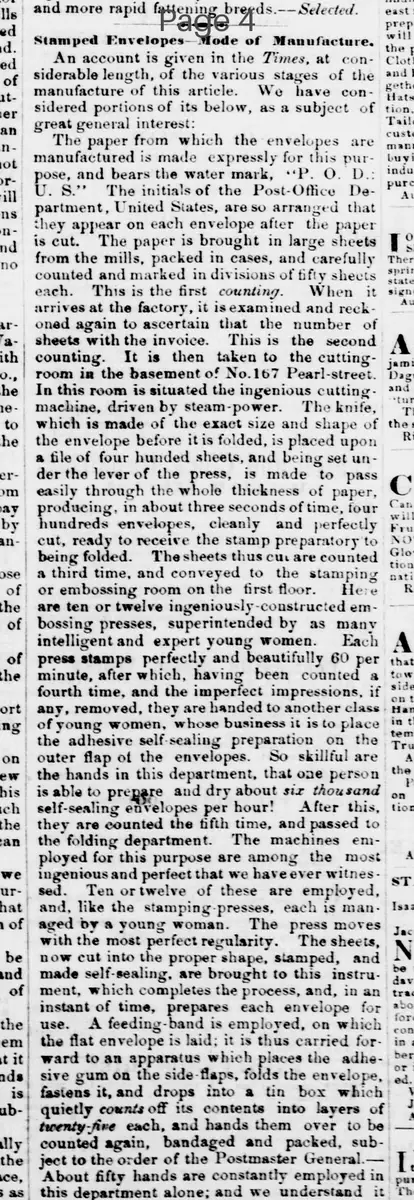
Stamped Envelopes--Mode of Manufacture.
An account is given in the Times, at considerable length, of the various stages of the manufacture of this article. We have considered portions of it below, as a subject of great general interest:
The paper from which the envelopes are manufactured is made expressly for this purpose, and bears the water mark, "P. O. D.: U. S." The initials of the Post-Office Department, United States, are so arranged that they appear on each envelope after the paper is cut. The paper is brought in large sheets from the mills, packed in cases, and carefully counted and marked in divisions of fifty sheets each. This is the first counting. When it arrives at the factory, it is examined and reckoned again to ascertain that the number of sheets agrees with the invoice. This is the second counting. It is then taken to the cutting-room in the basement of No. 167 Pearl-street.
In this room is situated the ingenious cutting machine, driven by steam-power. The knife, which is made of the exact size and shape of the envelope before it is folded, is placed upon a pile of four hundred sheets, and being set under the lever of the press, is made to pass easily through the whole thickness of paper, producing, in about three seconds of time, four hundred envelopes, cleanly and perfectly cut, ready to receive the stamp preparatory to being folded. The sheets thus cut are counted a third time, and conveyed to the stamping or embossing room on the first floor.
Here are ten or twelve ingeniously-constructed embossing presses, superintended by as many intelligent and expert young women. Each press stamps perfectly and beautifully 60 per minute, after which, having been counted a fourth time, and the imperfect impressions, if any, removed, they are handed to another class of young women, whose business it is to place the adhesive self-sealing preparation on the outer flap of the envelopes. So skillful are the hands in this department, that one person is able to prepare and dry about six thousand self-sealing envelopes per hour! After this, they are counted the fifth time, and passed to the folding department. The machines employed for this purpose are among the most ingenious and perfect that we have ever witnessed. Ten or twelve of these are employed, and, like the stamping-presses, each is managed by a young woman. The press moves with the most perfect regularity. The sheets, now cut into the proper shape, stamped, and made self-sealing, are brought to this instrument, which completes the process, and, in an instant of time, prepares each envelope for use. A feeding-band is employed, on which the flat envelope is laid; it is thus carried forward to an apparatus which places the adhesive gum on the side-flaps, folds the envelope, fastens it, and drops it into a tin box which quietly counts off its contents into layers of twenty-five each, and hands them over to be counted again, bandaged and packed, subject to the order of the Postmaster General.
About fifty hands are constantly employed in this department alone; and we understand it is Mr. Nesbitt's intention to manufacture, in addition to those for the Government, a supply of this beautiful article, unstamped, for the trade.
An account is given in the Times, at considerable length, of the various stages of the manufacture of this article. We have considered portions of it below, as a subject of great general interest:
The paper from which the envelopes are manufactured is made expressly for this purpose, and bears the water mark, "P. O. D.: U. S." The initials of the Post-Office Department, United States, are so arranged that they appear on each envelope after the paper is cut. The paper is brought in large sheets from the mills, packed in cases, and carefully counted and marked in divisions of fifty sheets each. This is the first counting. When it arrives at the factory, it is examined and reckoned again to ascertain that the number of sheets agrees with the invoice. This is the second counting. It is then taken to the cutting-room in the basement of No. 167 Pearl-street.
In this room is situated the ingenious cutting machine, driven by steam-power. The knife, which is made of the exact size and shape of the envelope before it is folded, is placed upon a pile of four hundred sheets, and being set under the lever of the press, is made to pass easily through the whole thickness of paper, producing, in about three seconds of time, four hundred envelopes, cleanly and perfectly cut, ready to receive the stamp preparatory to being folded. The sheets thus cut are counted a third time, and conveyed to the stamping or embossing room on the first floor.
Here are ten or twelve ingeniously-constructed embossing presses, superintended by as many intelligent and expert young women. Each press stamps perfectly and beautifully 60 per minute, after which, having been counted a fourth time, and the imperfect impressions, if any, removed, they are handed to another class of young women, whose business it is to place the adhesive self-sealing preparation on the outer flap of the envelopes. So skillful are the hands in this department, that one person is able to prepare and dry about six thousand self-sealing envelopes per hour! After this, they are counted the fifth time, and passed to the folding department. The machines employed for this purpose are among the most ingenious and perfect that we have ever witnessed. Ten or twelve of these are employed, and, like the stamping-presses, each is managed by a young woman. The press moves with the most perfect regularity. The sheets, now cut into the proper shape, stamped, and made self-sealing, are brought to this instrument, which completes the process, and, in an instant of time, prepares each envelope for use. A feeding-band is employed, on which the flat envelope is laid; it is thus carried forward to an apparatus which places the adhesive gum on the side-flaps, folds the envelope, fastens it, and drops it into a tin box which quietly counts off its contents into layers of twenty-five each, and hands them over to be counted again, bandaged and packed, subject to the order of the Postmaster General.
About fifty hands are constantly employed in this department alone; and we understand it is Mr. Nesbitt's intention to manufacture, in addition to those for the Government, a supply of this beautiful article, unstamped, for the trade.
What sub-type of article is it?
Curiosity
What keywords are associated?
Stamped Envelopes
Manufacturing Process
Cutting Machine
Embossing Presses
Self Sealing
Folding Machines
Post Office
Pearl Street
What entities or persons were involved?
Mr. Nesbitt
Where did it happen?
No. 167 Pearl Street
Story Details
Key Persons
Mr. Nesbitt
Location
No. 167 Pearl Street
Story Details
Description of the step-by-step manufacturing process of stamped envelopes, from paper arrival and cutting by steam-powered machine, to embossing by presses operated by young women, applying self-sealing adhesive, and folding by ingenious machines, with multiple countings for accuracy, employing about fifty hands.