Thank you for visiting SNEWPapers!
Sign up free
Editorial
October 13, 1792
National Gazette
Philadelphia, Philadelphia County, Pennsylvania
What is this article about?
This continued editorial from the American Daily Advertiser defends Thomas Jefferson's political character against attacks in the Gazette of the United States. It analyzes his letters on the U.S. Constitution, portraying his views as balanced and patriotic, and criticizes demands for unquestioning executive loyalty as subversive to republican principles.
Clipping
OCR Quality
95%
Excellent
Full Text
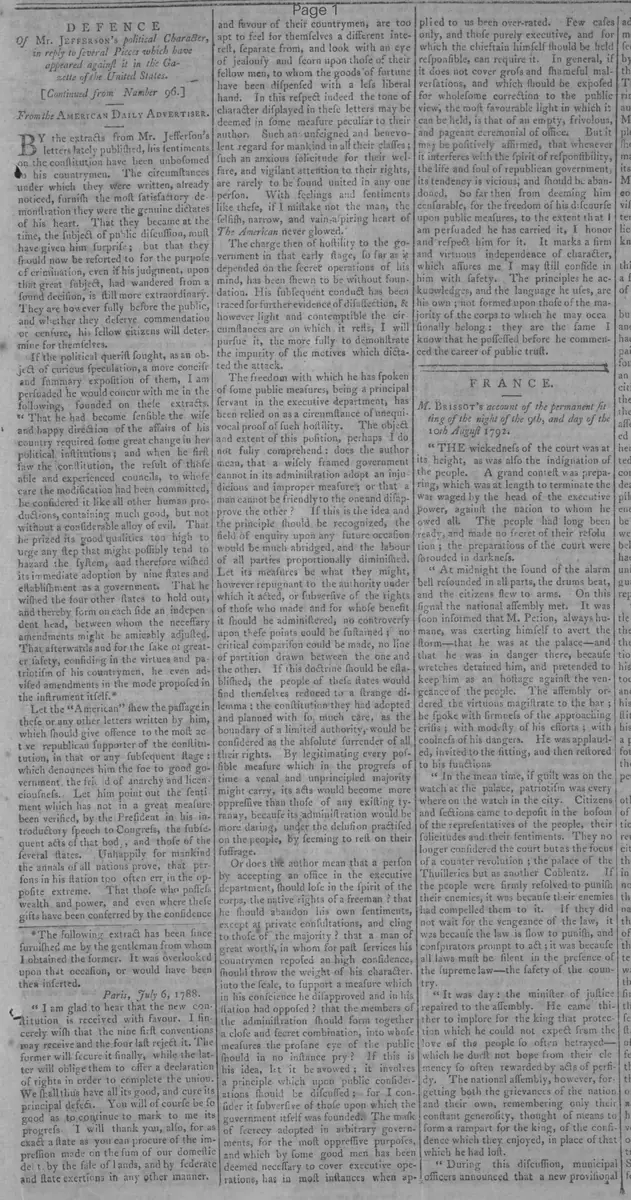
DEFENCE
Of Mr. Jefferson's political Character,
in reply to several Pieces which have
appeared against it in the Gazette
of the United States.
[Continued from Number 96.]
From the American Daily Advertiser.
By the extracts from Mr. Jefferson's
letters lately published, his sentiments
on the constitution have been unbosomed
to his countrymen. The circumstances
under which they were written, already
noticed, furnish the most satisfactory
demonstration they were the genuine dictates
of his heart. That they became at the
time, the subject of public discussion, must
have given him surprise; but that they
should now be resorted to for the purpose
of crimination, even if his judgment, upon
that great subject, had wandered from a
sound decision, is still more extraordinary.
They are however fully before the public,
and whether they deserve commendation
or censure, his fellow citizens will determine
for themselves.
If the political querist ought, as an object
of curious speculation, a more concise
and summary exposition of them, I am
persuaded he would concur with me in the
following, founded on these extracts.
That he had become sensible the wise
and happy direction of the affairs of his
country required some great change in her
political institutions; and when he first
saw the constitution, the result of those
able and experienced councils, to whose
care the modification had been committed,
he considered it like all other human productions,
containing much good, but not
without a considerable alloy of evil. That
he prized its good qualities too high to
urge any step that might possibly tend to
hazard the system, and therefore wished
its immediate adoption by nine states and
establishment as a government. That he
wished the four other states to hold out,
and thereby form on each side an independent
head, between whom the necessary
amendments might be amicably adjusted.
That afterwards and for the sake of greater
safety, consisting in the virtues and patriotism
of his countrymen, he even advised
amendments in the mode proposed in
the instrument itself.*
Let the "American" shew the passage in
these or any other letters written by him,
which should give offence to the most active
republican supporter of the constitution,
in that or any subsequent stage:
which denounces him the foe to good government,
the friend of anarchy and licentiousness.
Let him point out the sentiments
which have not in a great measure
been verified, by the President in his introductory
speech to Congress, the subsequent
acts of that body, and those of the
several states. Unhappily for mankind
the annals of all nations prove, that persons
in his situation too often err in the opposite
extreme. That those who possess
wealth and power, and even where these
gifts have been conferred by the confidence
and favour of their countrymen, are too
apt to feel for themselves a different interest,
separate from, and look with an eye
of jealousy and scorn upon those of their
fellow men, to whom the goods of fortune
have been dispensed with a less liberal
hand. In this respect indeed the tone of
character displayed in these letters may be
considered in some measure peculiar to their
author Such an unfeigned and benevolent
regard for mankind in all their classes;
such an anxious solicitude for their welfare,
and vigilant attention to their rights,
are rarely to be found united in any one
person. With feelings and sentiments
like these, if I mistake not the man, the
selfish, narrow, and vain-aspiring heart of
The American never glowed.
The charge then of hostility to the government
in that early stage, so far as it
depended on the secret operations of his
mind, has been shewn to be without foundation.
His subsequent conduct has been
traced for further evidence of disaffection, &
however light and contemptible the circumstances
are on which it rests, I will
pursue it, the more fully to demonstrate
the impurity of the motives which dictated
the attack.
The freedom with which he has spoken
of some public measures, being a principal
servant in the executive department, has
been relied on as a circumstance of unequivocal
proof of such hostility. The object
and extent of this position, perhaps I do
not fully comprehend: does the author
mean, that a wisely framed government
cannot in its administration adopt an injudicious
and improper measure; or that a
man cannot be friendly to the one and disapprove
the other? If this is the idea and
the principle should be recognized, the
field of enquiry upon any future occasion
would be much abridged, and the labour
of all parties proportionally diminished.
Let its measures be what they might,
however repugnant to the authority under
which it acted, or subversive of the rights
of those who made and for whose benefit
it should be administered, no controversy
upon these points could be sustained; no
critical comparison could be made, no line
of partition drawn between the one and
the other. If this doctrine should be established,
the people of these states would
find themselves reduced to a strange dilemma:
the constitution they had adopted
and planned with so much care, as the
boundary of a limited authority, would be
considered as the absolute surrender of all
their rights. By legitimating every possible
measure which in the progress of
time a venal and unprincipled majority
might carry, its acts would become more
oppressive than those of any existing tyranny,
because its administration would be
more daring, under the delusion practiced
on the people, by seeming to rest on their
suffrage.
Or does the author mean that a person
by accepting an office in the executive
department, should lose in the spirit of the
corps, the native rights of a freeman? that
he should abandon his own sentiments,
except at private consultations, and cling
to those of the majority? that a man of
great worth, in whom for past services his
countrymen reposed a high confidence.
should throw the weight of his character.
into the scale, to support a measure which
in his conscience he disapproved and in his
situation had opposed? that the members of
the administration should form together
a close and secret combination, into whose
measures the profane eye of the public
should in no instance pry? If this is
his idea, let it be avowed; it involves
a principle which upon public considerations
should be discussed: for I consider
it subversive of those upon which the
government itself was founded. The mask
of secrecy adopted in arbitrary governments,
for the most oppressive purposes,
and which by some good men has been
deemed necessary to cover executive operations,
has in most instances when ap-
Of Mr. Jefferson's political Character,
in reply to several Pieces which have
appeared against it in the Gazette
of the United States.
[Continued from Number 96.]
From the American Daily Advertiser.
By the extracts from Mr. Jefferson's
letters lately published, his sentiments
on the constitution have been unbosomed
to his countrymen. The circumstances
under which they were written, already
noticed, furnish the most satisfactory
demonstration they were the genuine dictates
of his heart. That they became at the
time, the subject of public discussion, must
have given him surprise; but that they
should now be resorted to for the purpose
of crimination, even if his judgment, upon
that great subject, had wandered from a
sound decision, is still more extraordinary.
They are however fully before the public,
and whether they deserve commendation
or censure, his fellow citizens will determine
for themselves.
If the political querist ought, as an object
of curious speculation, a more concise
and summary exposition of them, I am
persuaded he would concur with me in the
following, founded on these extracts.
That he had become sensible the wise
and happy direction of the affairs of his
country required some great change in her
political institutions; and when he first
saw the constitution, the result of those
able and experienced councils, to whose
care the modification had been committed,
he considered it like all other human productions,
containing much good, but not
without a considerable alloy of evil. That
he prized its good qualities too high to
urge any step that might possibly tend to
hazard the system, and therefore wished
its immediate adoption by nine states and
establishment as a government. That he
wished the four other states to hold out,
and thereby form on each side an independent
head, between whom the necessary
amendments might be amicably adjusted.
That afterwards and for the sake of greater
safety, consisting in the virtues and patriotism
of his countrymen, he even advised
amendments in the mode proposed in
the instrument itself.*
Let the "American" shew the passage in
these or any other letters written by him,
which should give offence to the most active
republican supporter of the constitution,
in that or any subsequent stage:
which denounces him the foe to good government,
the friend of anarchy and licentiousness.
Let him point out the sentiments
which have not in a great measure
been verified, by the President in his introductory
speech to Congress, the subsequent
acts of that body, and those of the
several states. Unhappily for mankind
the annals of all nations prove, that persons
in his situation too often err in the opposite
extreme. That those who possess
wealth and power, and even where these
gifts have been conferred by the confidence
and favour of their countrymen, are too
apt to feel for themselves a different interest,
separate from, and look with an eye
of jealousy and scorn upon those of their
fellow men, to whom the goods of fortune
have been dispensed with a less liberal
hand. In this respect indeed the tone of
character displayed in these letters may be
considered in some measure peculiar to their
author Such an unfeigned and benevolent
regard for mankind in all their classes;
such an anxious solicitude for their welfare,
and vigilant attention to their rights,
are rarely to be found united in any one
person. With feelings and sentiments
like these, if I mistake not the man, the
selfish, narrow, and vain-aspiring heart of
The American never glowed.
The charge then of hostility to the government
in that early stage, so far as it
depended on the secret operations of his
mind, has been shewn to be without foundation.
His subsequent conduct has been
traced for further evidence of disaffection, &
however light and contemptible the circumstances
are on which it rests, I will
pursue it, the more fully to demonstrate
the impurity of the motives which dictated
the attack.
The freedom with which he has spoken
of some public measures, being a principal
servant in the executive department, has
been relied on as a circumstance of unequivocal
proof of such hostility. The object
and extent of this position, perhaps I do
not fully comprehend: does the author
mean, that a wisely framed government
cannot in its administration adopt an injudicious
and improper measure; or that a
man cannot be friendly to the one and disapprove
the other? If this is the idea and
the principle should be recognized, the
field of enquiry upon any future occasion
would be much abridged, and the labour
of all parties proportionally diminished.
Let its measures be what they might,
however repugnant to the authority under
which it acted, or subversive of the rights
of those who made and for whose benefit
it should be administered, no controversy
upon these points could be sustained; no
critical comparison could be made, no line
of partition drawn between the one and
the other. If this doctrine should be established,
the people of these states would
find themselves reduced to a strange dilemma:
the constitution they had adopted
and planned with so much care, as the
boundary of a limited authority, would be
considered as the absolute surrender of all
their rights. By legitimating every possible
measure which in the progress of
time a venal and unprincipled majority
might carry, its acts would become more
oppressive than those of any existing tyranny,
because its administration would be
more daring, under the delusion practiced
on the people, by seeming to rest on their
suffrage.
Or does the author mean that a person
by accepting an office in the executive
department, should lose in the spirit of the
corps, the native rights of a freeman? that
he should abandon his own sentiments,
except at private consultations, and cling
to those of the majority? that a man of
great worth, in whom for past services his
countrymen reposed a high confidence.
should throw the weight of his character.
into the scale, to support a measure which
in his conscience he disapproved and in his
situation had opposed? that the members of
the administration should form together
a close and secret combination, into whose
measures the profane eye of the public
should in no instance pry? If this is
his idea, let it be avowed; it involves
a principle which upon public considerations
should be discussed: for I consider
it subversive of those upon which the
government itself was founded. The mask
of secrecy adopted in arbitrary governments,
for the most oppressive purposes,
and which by some good men has been
deemed necessary to cover executive operations,
has in most instances when ap-
What sub-type of article is it?
Constitutional
Partisan Politics
What keywords are associated?
Jefferson Defense
Constitution Sentiments
Political Character
Executive Loyalty
Republican Principles
Government Secrecy
What entities or persons were involved?
Mr. Jefferson
The American
President
Congress
Editorial Details
Primary Topic
Defense Of Jefferson's Political Character And Constitutional Views
Stance / Tone
Strongly Supportive Of Jefferson, Critical Of His Attackers
Key Figures
Mr. Jefferson
The American
President
Congress
Key Arguments
Jefferson's Letters Reflect Genuine, Balanced Sentiments On The Constitution
His Views Advocated Adoption With Amendments For Safety
Critics Fail To Show Offensive Passages In His Writings
Demanding Unquestioning Loyalty In Executive Undermines Republican Principles
Jefferson's Character Shows Benevolent Regard For All Classes
Secrecy In Government Is Subversive To Its Foundations