Thank you for visiting SNEWPapers!
Sign up free
Editorial
March 31, 1813
Alexandria Gazette, Commercial And Political
Alexandria, Virginia
What is this article about?
The editorial critiques the notion that a war declaration obligates unconditional funding, citing British history where Parliament checked the king's war powers, including Lord Chatham's opposition to the Revolutionary War. It urges the next US Congress to withhold supplies if the current war harms national interests.
Clipping
OCR Quality
98%
Excellent
Full Text
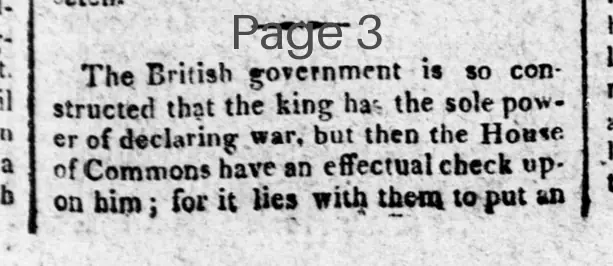
The British government is so constructed that the king has the sole power of declaring war, but then the House of Commons have an effectual check upon him; or it lies with them to put an end to a war declared by their king, by withholding the supplies necessary for carrying it on. This they have done in many instances; nor is it usual for a king of England to venture upon the important step of declaring war, until he finds that a large and substantial majority are in favor of it. Upon this principle, as it would seem, the Prince Regent delayed the issuing of his war manifesto against America, till some considerable time after the meeting of the parliament, that he might sound the sentiments and feelings of the nation on the subject.
That great statesman and orator, Lord Chatham, being decidedly against the American war, with us called the war of the revolution, did strenuously oppose the granting of supplies for carrying it on. In 1777, a grant of money was asked of the parliament, by the British minister for the further prosecution of the war with America, which had begun about two years before. On that subject Lord Chatham said- "The time demands the language of truth. We must not now apply the flattering unction of servile compliance, or blind complaisance. In a just and necessary war, to maintain the rights and honor of my country, I would strip the shirt from my back to support it: but in such a war as this is, unjust in its principle, impracticable in its means and ruinous in its consequences, I would not contribute a single effort nor a single shilling"
This noble independence of Chatham was highly applauded in America; and so far was he from falling into contempt or under reproach at home, on this account, that the parliament, at last, followed his counsel and example, and the king was compelled, much against his own inclination, to desist from prosecuting the war
Yet a doctrine has been broached, purporting that a declaration of war with us binds the whole nation, as it were, hand and foot; and that even the people's representatives in Congress are under political obligations to furnish supplies for the war, so long as the executive shall please to carry it on, how much soever they may disapprove it themselves.
But this slavish doctrine cannot prevail. No, it is impossible; unless the U. States be ripe for slavery. Indeed while the money lasts, which Congress has authorised to be got on loan, it will be in the power of the executive to effect the continuance of the war, provided that sum be actually borrowed. But it will be in the power of the next House of Representatives to withhold all further appropriations; and it will be even their bounden duty so to do, if in their judgments, the continuance of the war will be destructive rather than beneficial to the interests of the country -- In a great measure it will depend on the next congress, either to save or sink the nation. If a majority of them shall turn out to be men of the right stamp, the snare of the Corsican fox will be broken.--Connecticut Courant.
That great statesman and orator, Lord Chatham, being decidedly against the American war, with us called the war of the revolution, did strenuously oppose the granting of supplies for carrying it on. In 1777, a grant of money was asked of the parliament, by the British minister for the further prosecution of the war with America, which had begun about two years before. On that subject Lord Chatham said- "The time demands the language of truth. We must not now apply the flattering unction of servile compliance, or blind complaisance. In a just and necessary war, to maintain the rights and honor of my country, I would strip the shirt from my back to support it: but in such a war as this is, unjust in its principle, impracticable in its means and ruinous in its consequences, I would not contribute a single effort nor a single shilling"
This noble independence of Chatham was highly applauded in America; and so far was he from falling into contempt or under reproach at home, on this account, that the parliament, at last, followed his counsel and example, and the king was compelled, much against his own inclination, to desist from prosecuting the war
Yet a doctrine has been broached, purporting that a declaration of war with us binds the whole nation, as it were, hand and foot; and that even the people's representatives in Congress are under political obligations to furnish supplies for the war, so long as the executive shall please to carry it on, how much soever they may disapprove it themselves.
But this slavish doctrine cannot prevail. No, it is impossible; unless the U. States be ripe for slavery. Indeed while the money lasts, which Congress has authorised to be got on loan, it will be in the power of the executive to effect the continuance of the war, provided that sum be actually borrowed. But it will be in the power of the next House of Representatives to withhold all further appropriations; and it will be even their bounden duty so to do, if in their judgments, the continuance of the war will be destructive rather than beneficial to the interests of the country -- In a great measure it will depend on the next congress, either to save or sink the nation. If a majority of them shall turn out to be men of the right stamp, the snare of the Corsican fox will be broken.--Connecticut Courant.
What sub-type of article is it?
War Or Peace
Constitutional
What keywords are associated?
War Declaration
Withholding Supplies
Lord Chatham
American War
Congress Duty
British Parliament
Prince Regent
What entities or persons were involved?
Prince Regent
Lord Chatham
House Of Commons
King Of England
Congress
British Minister
Editorial Details
Primary Topic
Opposition To Unconditional Funding Of Declared Wars
Stance / Tone
Strongly Against Slavish Doctrine Of Binding Support For Unjust Wars
Key Figures
Prince Regent
Lord Chatham
House Of Commons
King Of England
Congress
British Minister
Key Arguments
King Declares War But House Of Commons Can Withhold Supplies To End It
Lord Chatham Opposed Supplies For The American Revolutionary War In 1777
Parliament Followed Chatham's Lead And Compelled The King To End The War
Declaration Of War Does Not Bind The Nation Or Congress To Fund It Unconditionally
Next Congress Has Duty To Withhold Appropriations If War Is Destructive To The Country