Thank you for visiting SNEWPapers!
Sign up free
The Providence Journal, And Town And Country Advertiser
Providence, Providence County, Rhode Island
What is this article about?
Merchants of New-Haven remonstrate against the appointment of 78-year-old Samuel Bishop as Collector of Revenue, replacing Elizur Goodrich, citing Bishop's infirmities and incompetence. President Jefferson replies on July 12, 1801, defending the appointment based on Bishop's reputation and offices, and explaining the necessity of changes in administration.
Clipping
OCR Quality
Full Text
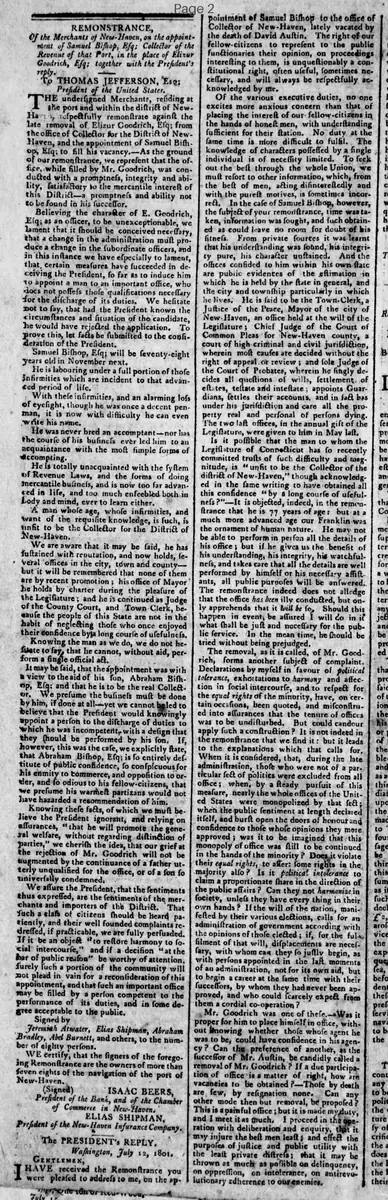
Of the Merchants of New-Haven, on the appointment of Samuel Bishop, Esq. Collector of the Revenue of that Port, in the place of Elizur Goodrich, Esq. together with the President's reply.
To THOMAS JEFFERSON, Esq.
President of the United States.
THE Merchants respectfully remonstrate against the late removal of Elizur Goodrich, Esq. from the office of Collector for the District of New-Haven, and the appointment of Samuel Bishop, Esq. to fill his vacancy.--As the ground of our remonstrance, we represent that the office, while filled by Mr. Goodrich, was conducted with a promptness, integrity and ability, satisfactory to the mercantile interest of this District--a promptness and ability not to be found in his successor.
Believing the character of E. Goodrich, Esq. as an officer, to be unexceptionable, we lament that it should be conceived necessary, that a change in the administration must produce a change in the subordinate officers, and in this instance we have especially to lament, that certain measures have succeeded in deceiving the President, so far as to induce him to appoint a man to an important office, who does not possess those qualifications necessary for the discharge of its duties. We hesitate not to say, that had the President known the circumstances and situation of the candidate, he would have rejected the application. To prove this, let facts be submitted to the consideration of the President.
Samuel Bishop, Esq. will be seventy-eight years old in November next. He is labouring under a full portion of those infirmities which are incident to that advanced period of life.
With these infirmities, and an alarming loss of eyesight, though he was once a decent penman, it is now with difficulty he can even write his name.
He was never bred an accountant--nor has the course of his business ever led him to an acquaintance with the most simple forms of accounting.
He is totally unacquainted with the system of Revenue Laws, and the forms of doing mercantile business. and is now too far advanced in life, and too much enfeebled both in body and mind, ever to learn either.
A man whose age, whose infirmities, and want of the requisite knowledge, is such, is unfit to be the Collector for the District of New-Haven.
We are aware that it may be said, he has obtained with reputation, and now holds, several offices in the city, town and county-- but it will be remembered that none of them are by recent promotion ; his office of Mayor he holds by charter during the pleasure of the Legislature; and he is continued as Judge of the County Court, and Town-Clerk, because the people of this State are not in the habit of neglecting those who once enjoyed their confidence by a long course of usefulness.
Knowing the man as we do, we do not hesitate to say, that he cannot, without aid, perform a single official act.
It may be said, that the appointment was with a view to the aid of his son, Abraham Bishop, Esq: and that he is to be the real Collector. We presume the business must be done by him, if done at all--yet we cannot be led to believe that the President would knowingly appoint a person to the discharge of duties to which he was incompetent. with a design that they should be performed by his son. If, however, this was the case, we explicitly state, that Abraham Bishop, Esq; is so entirely destitute of public confidence, so conspicuous for his enmity to commerce, and opposition to order, and so odious to his fellow-citizens, that we presume his warmest partizans would not have hazarded a recommendation of him.
Knowing these facts. of which we must believe the President ignorant, and relying on his assurances, "that he will promote the general welfare, without regarding distinction of parties," we cherish the idea, that our grief at the rejection of Mr. Goodrich will not be augmented by the continuance of a father utterly unqualified for the office, or of a son so universally condemned,
We assure the President, that the sentiments thus expressed, are the sentiments of the merchants and importers of the District. That such a class of citizens should be heard patiently. and their well founded complaints redressed, if practicable, we are fully persuaded.
If it be an object "to restore harmony to social intercourse." and if a decision "at the bar of public reason" be worthy of attention. surely such a portion of the community will not plead in vain for a reconsideration of this appointment, and that such an important office may be filled by a person competent to the performance of its duties, and in some degree acceptable to the public.
Signed by Jeremiah Atwater, Elias Shipman, Abraham Bradley, Abel Buell, and others, to the number of eighty persons.
WE certify, that the signers of the foregoing Remonstrance are the owners of more than seven eights of the navigation of the port of New-Haven.
(Signed)
ISAAC BEERS.
President of the Bank, and of the Chamber of Commerce in New-Haven.
ELIAS SHIPMAN.
President of the New-Haven Insurance Company.
The PRESIDENT's REPLY.
Washington, July 12, 1801.
Gentlemen;
HAVE received the Remonstrance you were pleased to address to me, on the appointment of Samuel Bishop to the office of Collector of New-Haven, lately vacated by the death of David Austin. The right of our fellow-citizens to represent to the public functionaries their opinion, on proceedings interesting to them, is unquestionably a constitutional right, often useful, sometimes necessary, and will always be respectfully acknowledged by me.
Of the various executive duties, no one excites more anxious concern than that of placing the interest of our fellow-citizens in the hands of honest men, with understanding sufficient for their station. No duty at the same time is more difficult to fulfil., The knowledge of characters possessed by a single individual is of necessity limited. To seek out the best through the whole Union, we must resort to other information, which, from the best of men, acting disinterestedly and with the purest motives, is sometimes incorrect. In the case of Samuel Bishop, however, the subject of your remonstrance, time was taken, information was sought, and such obtained as could leave no room for doubt of his fitness. From private sources it was learnt that his understanding was sound, his integrity pure, his character unstained. And the offices confided to him within his own state are public evidences of the estimation -in which he is held by the state in general, and the city and township particularly in which he lives. He is said to be the Town-Clerk, a Justice of the Peace, Mayor of the city of New-Haven, an office held at the will of the Legislature: Chief Judge of the Court of Common Pleas for New-Haven county, a court of high criminal and civil jurisdiction, wherein most causes are decided without the right of appeal.or review ; and sole Judge of the Court of Probates, wherein he singly decides all questions of wills, settlement. of estates, testate and intestate; appoints Guardians, settles their accounts. and in fact has under his jurisdiction and care all the property real and personal of persons dying.
The two last offices, in the annual gift of the Legislature, were given to him in May last.
Is it possible that the man to whom the Legislature of Connecticut has so recently committed trusts of such difficulty and magnitude, is "unfit to be the Collector of the district of New-Haven," though acknowledged in the same writing to have obtained all this confidence" by a long course of usefulness ?". -It is objected, indeed, in the remontrance that he is 77 years of age: but at a much more advanced age our Franklin was the ornament of human nature. He may not be able to perform in person all the details of his office; but if.he gives us the benefit of his understanding, his integrity, his watchfulness. and takes care that all the details are well performed by himself or his necessary assistants, all public purposes will be answered.
The remonstrance indeed does not allege that the office has been illy conducted. but only apprehends that it will be so, Should this happen in event, be assured I will correct it what shall be just and necessary for the public service. In the mean time, he should be tried without being prejudged.
The removal, as it is called, of Mr. Good. rich, forms another subject of complaint.
Declarations by myself in favour of political tolerance, exhortations to harmony and affection in social intercourse. and to respect for the equal rights of the minority, have, on 'certain occasions, been quoted, and misconstrued into assurances that the tenure of offices was to be undisturbed. But could candour apply such a construction ? It is not indeed in the remonstrance that we find it : but it leads to the explanations which that calls for.
When it is considered, that, during the late administration, those who were not of a particular set of politics were excluded from all offices. when. by a steady pursuit of this measure, nearly the whole offices of the United States were monopolized. by that set: when the public sentiment at length declared itself, and burst open the doors of honor and confidence to those whose opinions they more approved ; was it to be imagined that this monopoly of office was still to be continued in the hands of the minority ? Does it violate their equal rights, to assert some rights in the majority also? Is it political intolerance to claim a proportionate share in the direction of the public affairs ? Can they not harmonize in society, unless they have every thing in their own hands ? If the will of the nation, manifested by their various elections, calls for an administration of government according with the opinions of those elected: if. for the fulfilment of that will, displacements are necessary, with whom can they so justly begin, as with persons appointed in the last moments of an administration, not for its own aid, but to begin a career at the same time with their successors, by whom they had never been approved, and who could scarcely expect from thein a cordial co-operation ?
Mr. Goodrich was one of these.--Was it proper for him to place himself in office, without knowing whether those whose agent he was.to be, could have confidence in his agency? Can the preference of another, as the successor of Mr. Austin, be candidly called a removal of Mr. Goodrich ? If a due participation of office is a matter of right, how are vacancies to be obtained ?-Those by death are few, by resignation none. Can any other mode then but removal, be proposed?
This is a painful office ; but it is made my duty. and I meet it as such. I proceed in the operation with deliberation and enquiry, that it may injure the best men least ; and effect the purposes of justice and public utility with the least private distress; that it may be thrown as much as possible on delinquency, on oppression, onintolerance, on antirevolutionary adherence to our enemies.
What sub-type of article is it?
What keywords are associated?
What entities or persons were involved?
Where did it happen?
Domestic News Details
Primary Location
New Haven
Event Date
July 12, 1801
Key Persons
Outcome
president jefferson defends the appointment of samuel bishop, citing his integrity and prior offices, and explains the political necessity of removing holdover appointees like goodrich; appointment upheld.
Event Details
Merchants of New-Haven submit a remonstrance to President Jefferson protesting the removal of Collector Elizur Goodrich and appointment of elderly and infirm Samuel Bishop, arguing Bishop's unfitness and lack of qualifications. Jefferson responds, affirming Bishop's suitability based on information received and justifying administrative changes to reflect the new majority's will.