Thank you for visiting SNEWPapers!
Sign up free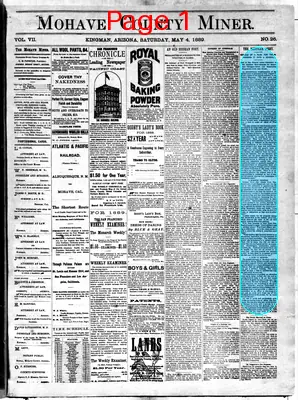
Mohave County Miner
Mineral Park, Mohave County, Arizona
What is this article about?
Gen. August V. Kautz proposes transforming the U.S. regular army into an educational institution by recruiting youth from each congressional district for five-year terms to learn military duties, trades, and leadership, arguing it would be cheaper than the current $30-40 million annual cost and better prepare the nation for war.
Clipping

OCR Quality
Full Text
DETAILS OF A PLAN FOR TRANSFORMING IT INTO A SCHOOL.
Cost of Our Present Army-Character of the Enlisted Men-Reasons for Important Changes--Novel and Noteworthy Suggestions from Gen. Kautz.
An extraordinary transformation of the regular army is proposed by Gen. August V. Kautz, colonel of the Eighth infantry, in the Century Magazine, "The ideal army that we have in view." he says, "is an educational institution, the fundamental principle being to recruit its material from the youth of the land, who will be able to learn the duties of the service and to impart them to others; and in order to give the whole country a share in this school, he would have the recruit selected according to locality, a fixed number from each Congress district, to which, on completing their education, they would return. In short, he would substitute a method of making officers for the one of maintaining enlisted men;" and he declares that this would be cheaper, besides keeping the country better prepared for a great war.
COST OF KEEPING.
The cost of keeping up our present army according to Gen. Kautz, has always exceeded $30,000,000 a year, and has often amounted to $40,000,000, so that he considers the annual cost per man of maintaining our military establishment to be about $1,200. Hence "it costs more to maintain a private than it does to make an officer at West Point."
"The men enlisted for this force are mostly recruited in the large cities, and consist of class who in the main have selected to enlist from other than patriotic motives or love of the military profession. A large proportion are foreigners who are not sufficiently acquainted with the country to find other employment. Many have found out their incapacity to make headway in civil life, the causes being as different as the characters and circumstances of the individuals. Too many belong to that large and unfortunate class known under the generic name of 'tramps,' who are wanderers by nature, and who become the deserters from the army. Many are illiterate, few are educated and capable, and the great majority lack the necessary talents and capacity to take care of themselves and to advance in life. The smart and apparently capable man, when found in the ranks, is generally suspected of some moral taint or intemperate habit not tolerated among his friends, and the number who attain distinction in the army, or after leaving it, are few indeed. There is no opportunity afforded the enlisted man to become qualified to command in case of war and the number who rise to a commission remarkably small."
A HUMDRUM CONDITION.
Perhaps those who dissent from Gen. Kautz's plan would dispute not only the figures of cost attributed to maintaining the enlisted man, but his view of the real average character of the present recruits. Gen. Kautz proceeds to say that the duties of the troops mostly consist of the simplest routine of garrison life, and that since even the outbreaks of the Indians are becoming less frequent, they have little opportunity to learn field service. This humdrum condition is not quite so marked in the cavalry, because the trooper has at least his horse to take care of; but in general the soldiers are forever practicing elementary duties and drills,"doing them as well, if not better, after the first few weeks of instruction as they ever do afterward."
Another reason for his proposed change Gen. Kautz finds in the modern art of war, which destroys the value of the old drill tactics, making them even perilous.
With these premises to start from, Gen. Kautz proposes to make "every military post a military school," West Point officers serving as instructors. As to the exact duties of such a school the article is somewhat more vague:
"While holding that the army should be an educational institution. it is not intended to limit it to book knowledge. The instruction should also be technical to a certain extent. There will be many who will not take to books who can be of great service as carpenters, wheelwrights, blacksmiths, masons, painters, etc. These are all trades which can be taught, for they are all carried on at every post. All these pursuits are essential in war; in fact, there is no pursuit in civil life that may not be of service in war."
A RUSH OF RECRUITS.
The present strength of the army could be obtained by taking fifteen recruits annually from each congress district, and the prevailing rule should be a single enlistment of five years, so that the greatest number possible may get a military training. The result would be such a rush of recruits that only the best could be received:
"The opportunity of getting an education while one is being clothed and fed, and receiving from 50 cents to $1 per day, would be availed of gladly by any young man who had not been favored by fortune. It would be his chance to see something of the great world. After five years he could return to his home and relatives with a diploma and discharge that would give him a claim to a commission as an officer in the event of a war, and he could have from one to two thousand dollars in his pocket; for he could save all his pay."
All this is novel and particularly noteworthy as coming from an officer like Gen. Kautz, who has seen long and varied service. A German by birth, and a private in the Ohio infantry during the Mexican war, he was also a graduate of the Military Academy and a distinguished soldier during the civil war, and now has been forty years in the service.-New York Sun.
What sub-type of article is it?
What themes does it cover?
What keywords are associated?
What entities or persons were involved?
Where did it happen?
Story Details
Key Persons
Location
United States
Story Details
Gen. Kautz proposes converting the regular army into an educational institution by recruiting young men from each congressional district for five-year enlistments to learn military skills, trades, and leadership, criticizing the current system's high cost, poor recruit quality, and routine duties, and arguing the reform would be more economical and enhance national war preparedness.