Thank you for visiting SNEWPapers!
Sign up free
The Tri County News
Grand Rapids, Wood County, Ohio
What is this article about?
C. E. Dennis, following his father's experiments in New Jersey, perfected scientific watercress farming in suitable streams, becoming America's 'king of cress' with year-round supplies from farms in Martinsburg, W. Va., and Huntsville, Ala., producing 5 million bunches annually.
Merged-components note: Merged split components of the article 'How Man With New Idea Became U. S. King of Cress' including the accompanying image due to sequential reading order and content continuation.
Clipping
OCR Quality
Full Text
Became U. S. King of Cress
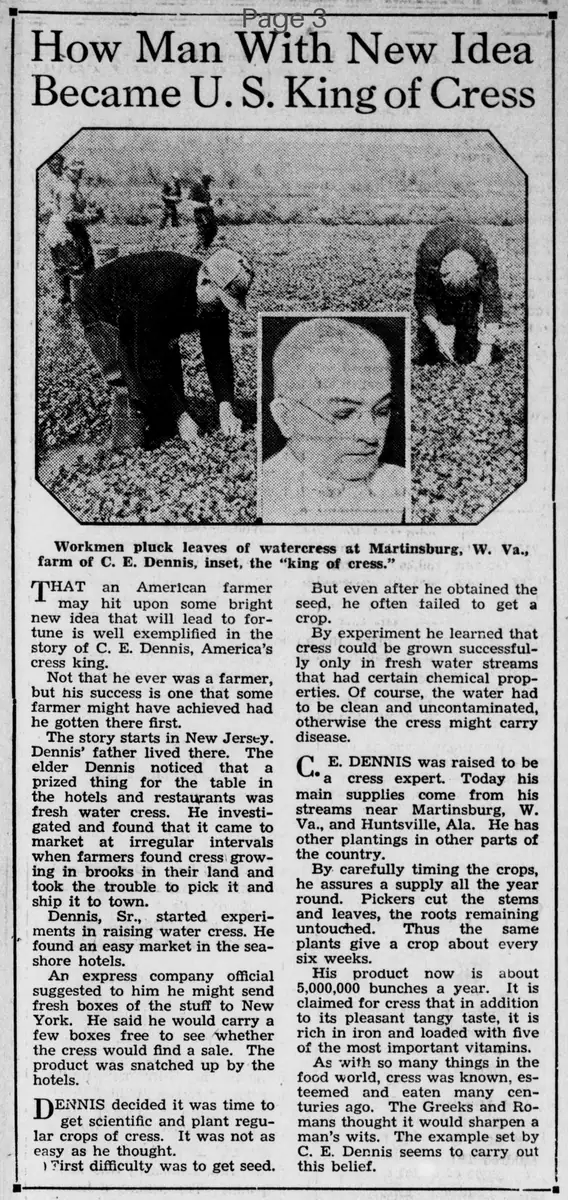
Workmen pluck leaves of watercress at Martinsburg, W. Va.,
farm of C. E. Dennis, inset, the "king of cress."
That an American farmer may hit upon some bright
new idea that will lead to fortune is well exemplified in the
story of C. E. Dennis, America's cress king.
Not that he ever was a farmer,
but his success is one that some
farmer might have achieved had
he gotten there first.
The story starts in New Jersey.
Dennis' father lived there. The
elder Dennis noticed that a
prized thing for the table in
the hotels and restaurants was
fresh water cress. He investi-
gated and found that it came to
market at irregular intervals
when farmers found cress growing
in brooks in their land and
took the trouble to pick it and
ship it to town.
Dennis, Sr., started experiments
in raising water cress. He
found an easy market in the sea-
shore hotels.
An express company official
suggested to him he might send
fresh boxes of the stuff to New
York. He said he would carry a
few boxes free to see whether
the cress would find a sale. The
product was snatched up by the
hotels.
Dennis decided it was time to
get scientific and plant regu-
lar crops of cress. It was not as
easy as he thought.
First difficulty was to get seed.
But even after he obtained the
seed, he often failed to get a
crop.
By experiment he learned that
cress could be grown successful-
ly only in fresh water streams
that had certain chemical prop-
erties. Of course, the water had
to be clean and uncontaminated,
otherwise the cress might carry
disease.
C. E. DENNIS was raised to be
a cress expert. Today his
main supplies come from his
streams near Martinsburg, W.
Va., and Huntsville, Ala. He has
other plantings in other parts of
the country.
By carefully timing the crops,
he assures a supply all the year
round. Pickers cut the stems
and leaves, the roots remaining
untouched.
Thus the same
plants give a crop about every
six weeks.
His product now
is about
5,000,000 bunches a year. It is
claimed for cress that in addition
to its pleasant tangy taste, it is
rich in iron and loaded with five
of the most important vitamins.
As with so many things in the
food world, cress was known, es-
teemed and eaten many cen-
turies ago. The Greeks and Ro-
mans thought it would sharpen a
man's wits. The example set by
C. E. Dennis seems to carry out
this belief.
What sub-type of article is it?
What themes does it cover?
What keywords are associated?
What entities or persons were involved?
Where did it happen?
Story Details
Key Persons
Location
New Jersey; Martinsburg, W. Va.; Huntsville, Ala.
Story Details
C. E. Dennis, son of an experimenter in watercress, learned to cultivate it scientifically in specific fresh streams, overcoming seed and growth challenges to supply hotels year-round from multiple farms, producing 5,000,000 bunches annually and proving its nutritional value.