Thank you for visiting SNEWPapers!
Sign up free
Alexandria Gazette
Alexandria, Alexandria County, District Of Columbia
What is this article about?
Translation of a French Royal Agricultural Society report praising farmer Jean Joseph Lecerf's innovative small-scale beet sugar manufactory in Onnaing, France, using simple machinery to produce high-quality sugar and cattle feed residue. He receives a silver medal for his achievement. Samples of his sugar and poppy seeds for oil are available in Philadelphia via Mr. Snider.
Clipping
OCR Quality
Full Text
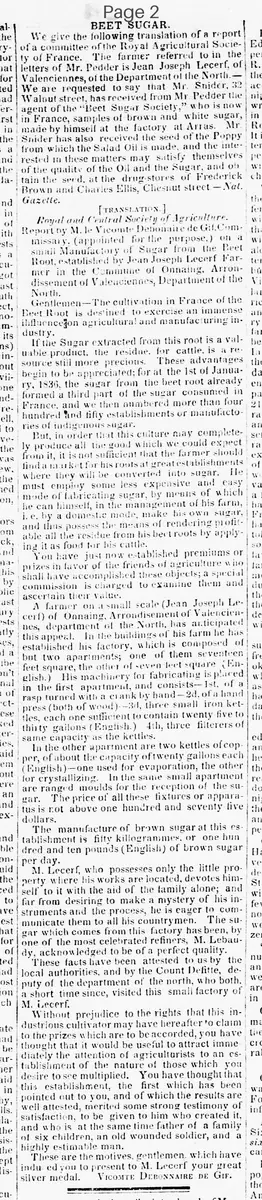
We give the following translation of a report of a committee of the Royal Agricultural Society of France. The farmer referred to in the letters of Mr. Pedder is Jean Joseph Lecerf, of Valenciennes, of the Department of the North.
We are requested to say that Mr. Snider, 32 Walnut street, has received from Mr Pedder the agent of the "Beet Sugar Society," who is now in France, samples of brown and white sugar, made by himself at the factory at Arras. Mr Snider has also received the seed of the Poppy from which the Salad Oil is made, and the interested in these matters may satisfy themselves of the quality of the Oil and the Sugar, and obtain the seed, at the drug-stores of Frederick Brown and Charles Ellis, Chestnut street - Nat. Gazette.
[TRANSLATION.]
Royal and Central Society of Agriculture,
Report by M. le Vicomte Debonaire de Gif, Commissioner (appointed for the purpose) on a small Manufactory of Sugar from the Beet Root, established by Jean Joseph Lecerf Farmer in the Commune of Onnaing, Arrondissement of Valenciennes, Department of the North.
Gentlemen - The cultivation in France of the Beet Root is destined to exercise an immense influence on agricultural and manufacturing industry.
If the Sugar extracted from this root is a valuable product, the residue, for cattle, is a resource still more precious. These advantages begin to be appreciated; for at the 1st of January, 1836, the sugar from the beet root already formed a third part of the sugar consumed in France, and we then numbered more than four hundred and fifty establishments or manufactories of indigenous sugar.
But, in order that this culture may completely produce all the good which we could expect from it, it is not sufficient that the farmer should find a market for his roots at great establishments where they will be converted into sugar. He must employ some less expensive and easy mode of fabricating sugar, by means of which he can himself, in the management of his farm, i. e. by a domestic mode, make his own sugar, and thus possess the means of rendering profitable all the residue from his beet roots by applying it as food for his cattle.
You have just now established premiums or prizes in favor of the friends of agriculture who shall have accomplished these objects; a special commission is charged to examine them and ascertain their value.
A farmer on a small scale (Jean Joseph Lecerf) of Onnaing, Arrondissement of Valenciennes, department of the North, has anticipated this appeal. In the buildings of his farm he has established his factory, which is composed of but two apartments; one of them seventeen feet square, the other of seven feet square (English.) His machinery for fabricating is placed in the first apartment, and consists - 1st. of a rasp turned with a crank by hand - 2d, of a hand press (both of wood) - 3d, three small iron kettles, each one sufficient to contain twenty five to thirty gallons (English.) 4th, three filterers of same capacity as the kettles.
In the other apartment are two kettles of copper, of about the capacity of twenty gallons each (English) - one used for evaporation, the other for crystallizing. In the same small apartment are ranged moulds for the reception of the sugar. The price of all these fixtures or apparatus is not above one hundred and seventy five dollars.
The manufacture of brown sugar at this establishment is fifty kilogrammes, or one hundred and ten pounds (English) of brown sugar per day.
M. Lecerf, who possesses only the little property where his works are located, devotes himself to it with the aid of the family alone; and far from desiring to make a mystery of his instruments and the process, he is eager to communicate them to all his countrymen. The sugar which comes from this factory has been, by one of the most celebrated refiners, M. Lebaudy, acknowledged to be of a perfect quality.
These facts have been attested to us by the local authorities, and by the Count Defitte, deputy of the department of the north, who both, a short time since, visited this small factory of M. Lecerf.
Without prejudice to the rights that this industrious cultivator may have hereafter to claim to the prizes which are to be accorded, you have thought that it would be useful to attract immediately the attention of agriculturists to an establishment of the nature of those which you desire to see multiplied. You have thought that this establishment, the first which has been pointed out to you, and of which the results are well attested, merited some strong testimony of satisfaction, to be given to him who created it, and who is at the same time father of a family of six children, an old wounded soldier, and a highly estimable man.
These are the motives, gentlemen, which have induced you to present to M. Lecerf your great silver medal.
VICOMTE DEBONNAIRE DE GIF.
What sub-type of article is it?
What themes does it cover?
What keywords are associated?
What entities or persons were involved?
Where did it happen?
Story Details
Key Persons
Location
Onnaing, Arrondissement Of Valenciennes, Department Of The North, France
Event Date
1836
Story Details
Jean Joseph Lecerf establishes a small domestic beet sugar factory on his farm in Onnaing, using simple hand-operated machinery to produce 110 pounds of brown sugar daily, with residue for cattle feed. The Royal Agricultural Society recognizes his innovation and quality, awarding him a great silver medal. Samples of his sugar and poppy seeds are distributed in Philadelphia.