Thank you for visiting SNEWPapers!
Sign up free
Literary
April 18, 1804
Alexandria Daily Advertiser
Alexandria, Virginia
What is this article about?
Extracts from the French book 'The Agronome, or the Farmer's Pocket Dictionary' provide practical recipes for enhancing corn and wheat yields, preventing smut, and preparing seeds for poor soils, claiming prepared seeds produce more stalks and resist diseases.
Clipping
OCR Quality
98%
Excellent
Full Text
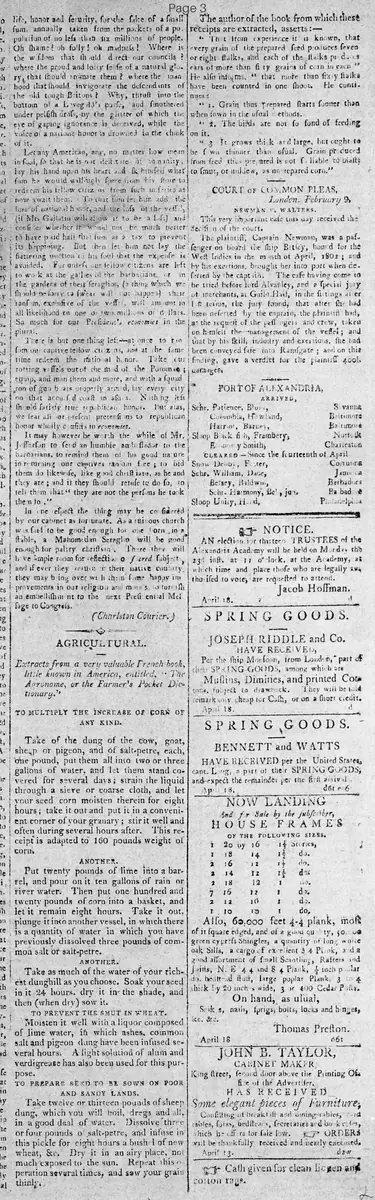
(Charleston Courier.)
AGRICULTURAL.
Extracts from a very valuable French book, little known in America, entitled, 'The Agronome, or the Farmer's Pocket Dictionary."
TO MULTIPLY THE INCREASE OF CORN OF ANY KIND.
Take of the dung of the cow, goat, sheep or pigeon, and of salt-petre, each, one pound, put them all into two or three gallons of water, and let them stand covered for several days; strain the liquid through a sieve or coarse cloth, and let your seed corn moisten therein for eight hours; take it out and put it in a convenient corner of your granary; stir it well and often during several hours after. This receipt is adapted to 160 pounds weight of corn.
ANOTHER.
Put twenty pounds of lime into a barrel, and pour on it ten gallons of rain or river water. Then put one hundred and twenty pounds of corn into a basket, and let it remain eight hours. Take it out. plunge it into another vessel, in which there is a quantity of water in which you have previously dissolved three pounds of common salt or salt-petre.
ANOTHER.
Take as much of the water of your richest dunghill as you choose. Soak your seed in it 24 hours. dry it in the shade, and then (when dry) sow it.
TO PREVENT THE SMUT IN WHEAT.
Moisten it well with a liquor composed of lime water, in which ashes, common salt and pigeon dung have been infused several hours. A light solution of alum and verdigrease has also been used for this purpose.
TO PREPARE SEED TO BE SOWN ON POOR AND SANDY LANDS.
Take twelve or thirteen pounds of sheep dung, which you will boil, dregs and all, in a good deal of water. Dissolve three or four pounds of salt-petre, and infuse in this pickle for eight hours a bushel of new wheat, &c. Dry it in an airy place, not much exposed to the sun. Repeat this operation several times, and sow your grain thinly.
The author of the book from which these receipts are extracted, asserts:--
'Ihat from experience it is known, that every grain of the prepared seed produces seven or eight stalks, and each of the stalks produces ears of more than fifty grains of corn in each.' He also affirms, that more than sixty stalks have been counted in one root. He continues:
'1. Grain thus prepared starts sooner than when sown in the usual methods.
2. The birds are not so fond of feeding on it.
3. It grows thick and large, but ought to be sown thinner than usual. Grain produced from seed thus prepared is not liable to blast: to smut, or mildew, as unprepared corn.'
AGRICULTURAL.
Extracts from a very valuable French book, little known in America, entitled, 'The Agronome, or the Farmer's Pocket Dictionary."
TO MULTIPLY THE INCREASE OF CORN OF ANY KIND.
Take of the dung of the cow, goat, sheep or pigeon, and of salt-petre, each, one pound, put them all into two or three gallons of water, and let them stand covered for several days; strain the liquid through a sieve or coarse cloth, and let your seed corn moisten therein for eight hours; take it out and put it in a convenient corner of your granary; stir it well and often during several hours after. This receipt is adapted to 160 pounds weight of corn.
ANOTHER.
Put twenty pounds of lime into a barrel, and pour on it ten gallons of rain or river water. Then put one hundred and twenty pounds of corn into a basket, and let it remain eight hours. Take it out. plunge it into another vessel, in which there is a quantity of water in which you have previously dissolved three pounds of common salt or salt-petre.
ANOTHER.
Take as much of the water of your richest dunghill as you choose. Soak your seed in it 24 hours. dry it in the shade, and then (when dry) sow it.
TO PREVENT THE SMUT IN WHEAT.
Moisten it well with a liquor composed of lime water, in which ashes, common salt and pigeon dung have been infused several hours. A light solution of alum and verdigrease has also been used for this purpose.
TO PREPARE SEED TO BE SOWN ON POOR AND SANDY LANDS.
Take twelve or thirteen pounds of sheep dung, which you will boil, dregs and all, in a good deal of water. Dissolve three or four pounds of salt-petre, and infuse in this pickle for eight hours a bushel of new wheat, &c. Dry it in an airy place, not much exposed to the sun. Repeat this operation several times, and sow your grain thinly.
The author of the book from which these receipts are extracted, asserts:--
'Ihat from experience it is known, that every grain of the prepared seed produces seven or eight stalks, and each of the stalks produces ears of more than fifty grains of corn in each.' He also affirms, that more than sixty stalks have been counted in one root. He continues:
'1. Grain thus prepared starts sooner than when sown in the usual methods.
2. The birds are not so fond of feeding on it.
3. It grows thick and large, but ought to be sown thinner than usual. Grain produced from seed thus prepared is not liable to blast: to smut, or mildew, as unprepared corn.'
What sub-type of article is it?
Essay
What themes does it cover?
Agriculture Rural
What keywords are associated?
Agriculture
Seed Preparation
Corn Yield
Wheat Smut
Dung Fertilizer
Salt Petre
Lime Soak
Literary Details
Title
Extracts From 'The Agronome, Or The Farmer's Pocket Dictionary'
Subject
Agricultural Seed Preparation And Improvement
Form / Style
Practical Instructional Prose
Key Lines
Take Of The Dung Of The Cow, Goat, Sheep Or Pigeon, And Of Salt Petre, Each, One Pound...
'Ihat From Experience It Is Known, That Every Grain Of The Prepared Seed Produces Seven Or Eight Stalks...'
Grain Produced From Seed Thus Prepared Is Not Liable To Blast: To Smut, Or Mildew, As Unprepared Corn.