Thank you for visiting SNEWPapers!
Sign up free
Story
May 23, 1911
The North Platte Semi Weekly Tribune
North Platte, Lincoln County, Nebraska
What is this article about?
Dr. Franklin White lectures at Harvard on digestion, criticizing Boston baked beans, oysters, and beef extracts as hard to digest or low-value, advocating less food and better habits to combat dyspepsia. Prof. John H. Woods claims a 12-cent meal suffices for his daily work.
Clipping
OCR Quality
95%
Excellent
Full Text
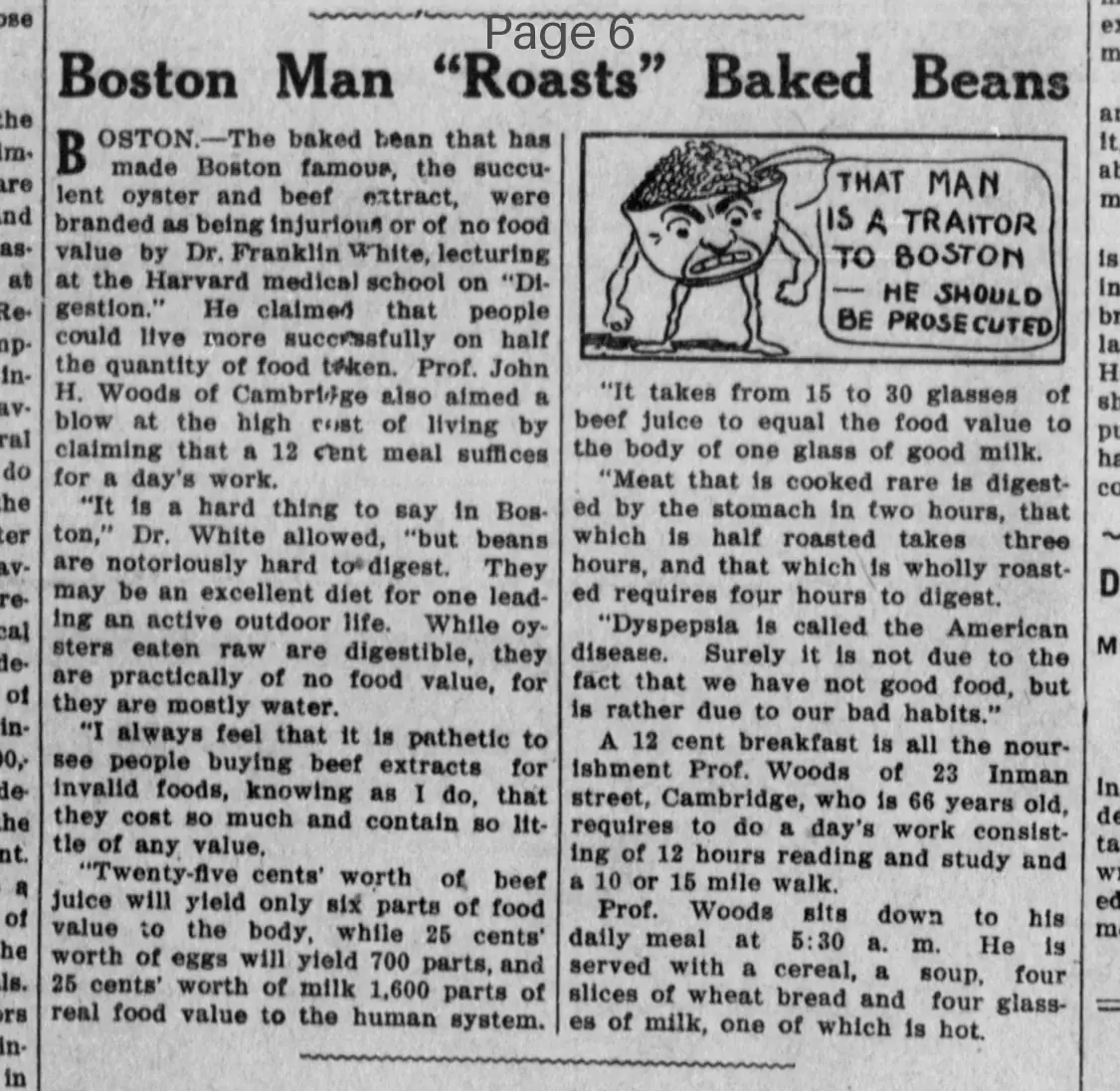
Boston Man "Roasts" Baked Beans
BOSTON.—The baked bean that has made Boston famous, the succulent oyster and beef extract, were branded as being injurious or of no food value by Dr. Franklin White, lecturing at the Harvard medical school on "Digestion." He claimed that people could live more successfully on half the quantity of food taken. Prof. John H. Woods of Cambridge also aimed a blow at the high cost of living by claiming that a 12 cent meal suffices for a day's work.
"It is a hard thing to say in Boston," Dr. White allowed, "but beans are notoriously hard to digest. They may be an excellent diet for one leading an active outdoor life. While oysters eaten raw are digestible, they are practically of no food value, for they are mostly water.
"I always feel that it is pathetic to see people buying beef extracts for invalid foods, knowing as I do, that they cost so much and contain so little of any value.
"Twenty-five cents' worth of beef juice will yield only six parts of food value to the body, while 25 cents' worth of eggs will yield 700 parts, and 25 cents' worth of milk 1,600 parts of real food value to the human system.
That man IS A TRAITOR TO Boston; He Should Be prosecuted.
"It takes from 15 to 30 glasses of beef juice to equal the food value to the body of one glass of good milk.
"Meat that is cooked rare is digested by the stomach in two hours, that which is half roasted takes three hours, and that which is wholly roasted requires four hours to digest.
"Dyspepsia is called the American disease. Surely it is not due to the fact that we have not good food, but is rather due to our bad habits."
A 12 cent breakfast is all the nourishment Prof. Woods of 23 Inman street, Cambridge, who is 66 years old, requires to do a day's work consisting of 12 hours reading and study and a 10 or 15 mile walk.
Prof. Woods sits down to his daily meal at 5:30 a. m. He is served with a cereal, a soup, four slices of wheat bread and four glasses of milk, one of which is hot.
BOSTON.—The baked bean that has made Boston famous, the succulent oyster and beef extract, were branded as being injurious or of no food value by Dr. Franklin White, lecturing at the Harvard medical school on "Digestion." He claimed that people could live more successfully on half the quantity of food taken. Prof. John H. Woods of Cambridge also aimed a blow at the high cost of living by claiming that a 12 cent meal suffices for a day's work.
"It is a hard thing to say in Boston," Dr. White allowed, "but beans are notoriously hard to digest. They may be an excellent diet for one leading an active outdoor life. While oysters eaten raw are digestible, they are practically of no food value, for they are mostly water.
"I always feel that it is pathetic to see people buying beef extracts for invalid foods, knowing as I do, that they cost so much and contain so little of any value.
"Twenty-five cents' worth of beef juice will yield only six parts of food value to the body, while 25 cents' worth of eggs will yield 700 parts, and 25 cents' worth of milk 1,600 parts of real food value to the human system.
That man IS A TRAITOR TO Boston; He Should Be prosecuted.
"It takes from 15 to 30 glasses of beef juice to equal the food value to the body of one glass of good milk.
"Meat that is cooked rare is digested by the stomach in two hours, that which is half roasted takes three hours, and that which is wholly roasted requires four hours to digest.
"Dyspepsia is called the American disease. Surely it is not due to the fact that we have not good food, but is rather due to our bad habits."
A 12 cent breakfast is all the nourishment Prof. Woods of 23 Inman street, Cambridge, who is 66 years old, requires to do a day's work consisting of 12 hours reading and study and a 10 or 15 mile walk.
Prof. Woods sits down to his daily meal at 5:30 a. m. He is served with a cereal, a soup, four slices of wheat bread and four glasses of milk, one of which is hot.
What sub-type of article is it?
Medical Curiosity
Curiosity
What themes does it cover?
Moral Virtue
Misfortune
What keywords are associated?
Baked Beans
Digestion
Food Value
Dyspepsia
Cheap Meals
Beef Extracts
What entities or persons were involved?
Dr. Franklin White
Prof. John H. Woods
Where did it happen?
Boston, Harvard Medical School, Cambridge
Story Details
Key Persons
Dr. Franklin White
Prof. John H. Woods
Location
Boston, Harvard Medical School, Cambridge
Story Details
Dr. White criticizes baked beans, oysters, and beef extracts for poor digestibility and low nutritional value, promotes eating less and better habits to avoid dyspepsia. Prof. Woods demonstrates sufficiency of a simple 12-cent breakfast for his active routine.