Thank you for visiting SNEWPapers!
Sign up free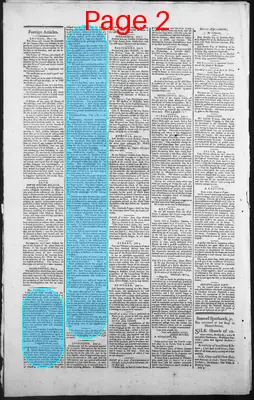
Letter to Editor
July 23, 1796
The New Hampshire Gazette
Portsmouth, Rockingham County, New Hampshire
What is this article about?
A correspondent encloses extracts from Montesquieu's 'The Spirit of Laws' discussing the true meaning of liberty in democracies, warning against its abuse through extreme equality and opposition to government, which could corrupt republican virtue and lead to tyranny. Applies to current political situation.
Clipping
OCR Quality
95%
Excellent
Full Text
Mr. PRINTER,
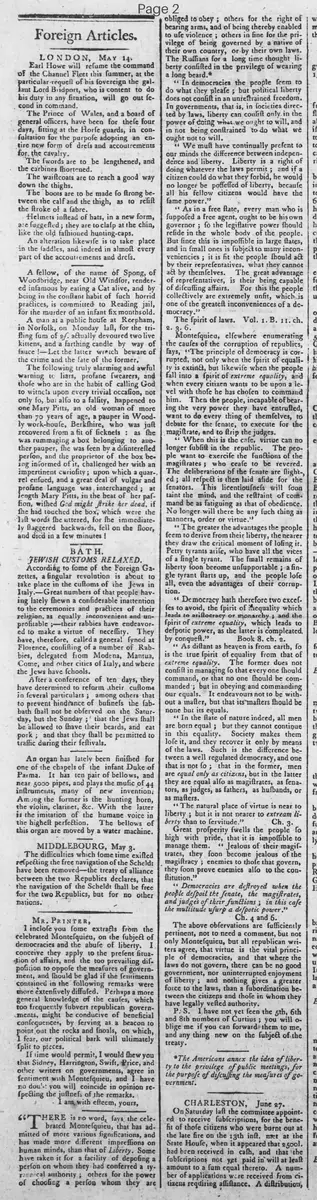
I enclose you some extracts from the celebrated Montesquieu, on the subject of democracies and the abuse of liberty. I conceive they apply to the present situation of affairs, and the too prevailing disposition to oppose the measures of government, and should be glad if the sentiments contained in the following remarks were more extensively diffused. "Perhaps a more general knowledge of the causes, which too frequently subvert republican governments, might be conducive of beneficial consequences, by serving as a beacon to point out the rocks and shoals, on which, I fear, our political bark will ultimately split to pieces."
If time would permit, I would shew you that Sidney, Harrington, Swift, Price, and other writers on governments, agree in sentiment with Montesquieu, and I have no doubt: you will coincide in opinion respecting the justice of the remarks.
I am with esteem, yours,
There is no word, says the celebrated Montesquieu, that has admitted of more various significations, and has made more different impressions on human minds, than that of Liberty. Some have taken it for a facility of deposing a person on whom they had conferred a tyrannical authority; others for the power of choosing a person whom they are obliged to obey: others for the right of bearing arms, and of being thereby enabled to use violence; others in fine for the privilege of being governed by a native of their own country, or by their own laws.
The Russians for a long time thought liberty consisted in the privilege of wearing a long beard.*
"In democracies the people seem to do what they please; but political liberty does not consist in an unrestrained freedom. In governments, that is, in societies directed by laws, liberty can consist only in the power of doing what we ought to will, and in not being constrained to do what we ought not to will."
"We must have continually present to our minds the difference between independence and liberty. Liberty is a right of doing whatever the laws permit; and if a citizen could do what they forbid, he would no longer be possessed of liberty, because all his fellow citizens would have the same power."*
"As in a free state, every man who is supposed a free agent, ought to be his own governor; so the legislative power should reside in the whole body of the people. But since this is impossible in large states, and in small ones is subject to many inconveniencies; it is fit the people should act by their representatives, what they cannot act by themselves. The great advantage of representatives, is their being capable of discussing affairs. For this the people collectively are extremely unfit, which is one of the greatest inconveniencies of a democracy."
The spirit of laws. Vol. 1. B. 11. ch. 2. 3.6.
Montesquieu, elsewhere enumerating the causes of the corruption of republics, says, "The principle of democracy is corrupted, not only when the spirit of equality is extinct, but likewise when the people fall into a spirit of extreme equality, and when every citizen wants to be upon a level with those he has chosen to command him. Then the people, incapable of bearing the very power they have entrusted, want to do every thing of themselves, to debate for the senate, to execute for the magistrate, and to try the judges."
"When this is the case, virtue can no longer subsist in the republic. The people want to exercise the functions of the magistrates; who cease to be revered. The deliberations of the senate are slighted; all respect is then laid aside for the senators. This licentiousness will contaminate the mind, and the restraint of command be as fatiguing as that of obedience.
No longer will there be any such thing as manners, order or virtue."
"The greater the advantages the people seem to derive from their liberty, the nearer they draw the critical moment of losing it. Petty tyrants arise, who have all the vices of a single tyrant. The small remains of liberty soon become unsupportable; a single tyrant starts up, and the people lose all, even the advantages of their corruption."
"Democracy hath therefore two excesses to avoid, the spirit of inequality which leads to aristocracy or monarchy; and the spirit of extreme equality, which leads to despotic power, as the latter is completed by conquest."
Book 8. ch. 2.
"As distant as heaven is from earth, so is the true spirit of equality from that of extreme equality. The former does not consist in managing so that every one should command, or that no one should be commanded; but in obeying and commanding our equals. It endeavours not to be without a master, but that its masters should be none but its equals."
"In the state of nature indeed, all men are born equal; but they cannot continue in this equality. Society makes them lose it, and they recover it only by means of the laws. Such is the difference between a well regulated democracy, and one that is not so; that in the former, men are equal only as citizens, but in the latter they are equal also as magistrates, as senators, as judges, as fathers, as husbands, or as masters."
"The natural place of virtue is near to liberty; but it is not nearer to extreme liberty than to servitude."
Ch. 3.
Great prosperity swells the people so high with pride, that it is impossible to manage them. "Jealous of their magistrates, they soon become jealous of the magistracy; enemies to those that govern, they soon prove enemies also to the constitution."
"Democracies are destroyed when the people depose the senate, the magistrates, and judges of their functions; in this case the multitude usurp a despotic power."
Ch. 4 and 6.
The above observations are sufficiently pertinent, not to need a comment, but not only Montesquieu, but all republican writers agree, that virtue is the vital principle of democracies, and that where the laws do not govern, there can be no good government, nor uninterrupted enjoyment of liberty; and nothing gives a greater force to the laws, than a subordination between the citizens and those in whom they have legally vested authority.
P. S. I have not yet seen the 5th, 6th and 8th numbers of Curtius; you will oblige me if you can forward them to me, and any thing new on the subject of the treaty.
*The Americans annex the idea of liberty to the privilege of public meetings, for the purpose of discussing the measures of government.
I enclose you some extracts from the celebrated Montesquieu, on the subject of democracies and the abuse of liberty. I conceive they apply to the present situation of affairs, and the too prevailing disposition to oppose the measures of government, and should be glad if the sentiments contained in the following remarks were more extensively diffused. "Perhaps a more general knowledge of the causes, which too frequently subvert republican governments, might be conducive of beneficial consequences, by serving as a beacon to point out the rocks and shoals, on which, I fear, our political bark will ultimately split to pieces."
If time would permit, I would shew you that Sidney, Harrington, Swift, Price, and other writers on governments, agree in sentiment with Montesquieu, and I have no doubt: you will coincide in opinion respecting the justice of the remarks.
I am with esteem, yours,
There is no word, says the celebrated Montesquieu, that has admitted of more various significations, and has made more different impressions on human minds, than that of Liberty. Some have taken it for a facility of deposing a person on whom they had conferred a tyrannical authority; others for the power of choosing a person whom they are obliged to obey: others for the right of bearing arms, and of being thereby enabled to use violence; others in fine for the privilege of being governed by a native of their own country, or by their own laws.
The Russians for a long time thought liberty consisted in the privilege of wearing a long beard.*
"In democracies the people seem to do what they please; but political liberty does not consist in an unrestrained freedom. In governments, that is, in societies directed by laws, liberty can consist only in the power of doing what we ought to will, and in not being constrained to do what we ought not to will."
"We must have continually present to our minds the difference between independence and liberty. Liberty is a right of doing whatever the laws permit; and if a citizen could do what they forbid, he would no longer be possessed of liberty, because all his fellow citizens would have the same power."*
"As in a free state, every man who is supposed a free agent, ought to be his own governor; so the legislative power should reside in the whole body of the people. But since this is impossible in large states, and in small ones is subject to many inconveniencies; it is fit the people should act by their representatives, what they cannot act by themselves. The great advantage of representatives, is their being capable of discussing affairs. For this the people collectively are extremely unfit, which is one of the greatest inconveniencies of a democracy."
The spirit of laws. Vol. 1. B. 11. ch. 2. 3.6.
Montesquieu, elsewhere enumerating the causes of the corruption of republics, says, "The principle of democracy is corrupted, not only when the spirit of equality is extinct, but likewise when the people fall into a spirit of extreme equality, and when every citizen wants to be upon a level with those he has chosen to command him. Then the people, incapable of bearing the very power they have entrusted, want to do every thing of themselves, to debate for the senate, to execute for the magistrate, and to try the judges."
"When this is the case, virtue can no longer subsist in the republic. The people want to exercise the functions of the magistrates; who cease to be revered. The deliberations of the senate are slighted; all respect is then laid aside for the senators. This licentiousness will contaminate the mind, and the restraint of command be as fatiguing as that of obedience.
No longer will there be any such thing as manners, order or virtue."
"The greater the advantages the people seem to derive from their liberty, the nearer they draw the critical moment of losing it. Petty tyrants arise, who have all the vices of a single tyrant. The small remains of liberty soon become unsupportable; a single tyrant starts up, and the people lose all, even the advantages of their corruption."
"Democracy hath therefore two excesses to avoid, the spirit of inequality which leads to aristocracy or monarchy; and the spirit of extreme equality, which leads to despotic power, as the latter is completed by conquest."
Book 8. ch. 2.
"As distant as heaven is from earth, so is the true spirit of equality from that of extreme equality. The former does not consist in managing so that every one should command, or that no one should be commanded; but in obeying and commanding our equals. It endeavours not to be without a master, but that its masters should be none but its equals."
"In the state of nature indeed, all men are born equal; but they cannot continue in this equality. Society makes them lose it, and they recover it only by means of the laws. Such is the difference between a well regulated democracy, and one that is not so; that in the former, men are equal only as citizens, but in the latter they are equal also as magistrates, as senators, as judges, as fathers, as husbands, or as masters."
"The natural place of virtue is near to liberty; but it is not nearer to extreme liberty than to servitude."
Ch. 3.
Great prosperity swells the people so high with pride, that it is impossible to manage them. "Jealous of their magistrates, they soon become jealous of the magistracy; enemies to those that govern, they soon prove enemies also to the constitution."
"Democracies are destroyed when the people depose the senate, the magistrates, and judges of their functions; in this case the multitude usurp a despotic power."
Ch. 4 and 6.
The above observations are sufficiently pertinent, not to need a comment, but not only Montesquieu, but all republican writers agree, that virtue is the vital principle of democracies, and that where the laws do not govern, there can be no good government, nor uninterrupted enjoyment of liberty; and nothing gives a greater force to the laws, than a subordination between the citizens and those in whom they have legally vested authority.
P. S. I have not yet seen the 5th, 6th and 8th numbers of Curtius; you will oblige me if you can forward them to me, and any thing new on the subject of the treaty.
*The Americans annex the idea of liberty to the privilege of public meetings, for the purpose of discussing the measures of government.
What sub-type of article is it?
Persuasive
Philosophical
Political
What themes does it cover?
Constitutional Rights
Politics
Morality
What keywords are associated?
Montesquieu
Liberty
Democracy
Republican Government
Virtue
Extreme Equality
Political Corruption
What entities or persons were involved?
Mr. Printer
Letter to Editor Details
Recipient
Mr. Printer
Main Argument
extracts from montesquieu illustrate that true liberty in democracies requires adherence to laws and virtue, not unrestrained freedom or extreme equality, which lead to corruption and loss of republican government; these apply to the current excessive opposition to government measures.
Notable Details
Quotes From Montesquieu's 'The Spirit Of Laws' Books 8 And 11
References To Sidney, Harrington, Swift, Price Agreeing With Montesquieu
P.S. Requesting Curtius Numbers 5, 6, 8 And Updates On Treaty