Thank you for visiting SNEWPapers!
Sign up free
Story
November 13, 1868
Clarksville Chronicle
Clarksville, Montgomery County, Tennessee
What is this article about?
Historical agricultural advice on optimal fall planting of vines and fruit trees in October or November, emphasizing shallow holes, root trimming, and frost protection to ensure healthy growth.
Clipping
OCR Quality
98%
Excellent
Full Text
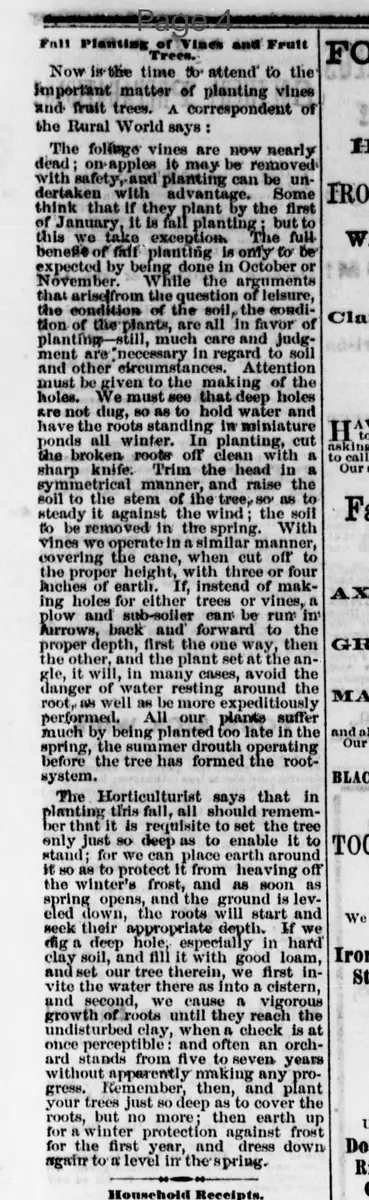
Fall Planting of Vines and Fruit Trees.
Now is the time to attend to the important matter of planting vines and fruit trees. A correspondent of the Rural World says:
The foliage vines are now nearly dead; on apples it may be removed with safety, and planting can be undertaken with advantage. Some think that if they plant by the first of January, it is fall planting; but to this we take exception. The full benefit of fall planting is only to be expected by being done in October or November.
While the arguments that arise from the question of leisure, the condition of the soil, the condition of the plants, are all in favor of planting still, much care and judgment are necessary in regard to soil and other circumstances.
Attention must be given to the making of the holes. We must see that deep holes are not dug, so as to hold water and have the roots standing in miniature ponds all winter. In planting, cut the broken roots off clean with a sharp knife. Trim the head in a symmetrical manner, and raise the soil to the stem of the tree, so as to steady it against the wind; the soil to be removed in the spring. With vines we operate in a similar manner, covering the cane, when cut off to the proper height, with three or four inches of earth. If, instead of making holes for either trees or vines, a plow and sub-soiler can be run in furrows, back and forward to the proper depth, first the one way, then the other, and the plant set at the angle, it will, in many cases, avoid the danger of water resting around the root, as well as be more expeditiously performed. All our plants suffer much by being planted too late in the spring, the summer drouth operating before the tree has formed the root-system.
The Horticulturist says that in planting this fall, all should remember that it is requisite to set the tree only just so deep as to enable it to stand; for we can place earth around it so as to protect it from heaving off the winter's frost, and as soon as spring opens, and the ground is leveled down, the roots will start and seek their appropriate depth. If we dig a deep hole, especially in hard clay soil, and fill it with good loam, and set our tree therein, we first invite the water there as into a cistern, and second, we cause a vigorous growth of roots until they reach the undisturbed clay, when a check is at once perceptible; and often an orchard stands from five to seven years without apparently making any progress. Remember, then, and plant your trees just so deep as to cover the roots, but no more; then earth up for a winter protection against frost for the first year, and dress down again to a level in the spring.
Now is the time to attend to the important matter of planting vines and fruit trees. A correspondent of the Rural World says:
The foliage vines are now nearly dead; on apples it may be removed with safety, and planting can be undertaken with advantage. Some think that if they plant by the first of January, it is fall planting; but to this we take exception. The full benefit of fall planting is only to be expected by being done in October or November.
While the arguments that arise from the question of leisure, the condition of the soil, the condition of the plants, are all in favor of planting still, much care and judgment are necessary in regard to soil and other circumstances.
Attention must be given to the making of the holes. We must see that deep holes are not dug, so as to hold water and have the roots standing in miniature ponds all winter. In planting, cut the broken roots off clean with a sharp knife. Trim the head in a symmetrical manner, and raise the soil to the stem of the tree, so as to steady it against the wind; the soil to be removed in the spring. With vines we operate in a similar manner, covering the cane, when cut off to the proper height, with three or four inches of earth. If, instead of making holes for either trees or vines, a plow and sub-soiler can be run in furrows, back and forward to the proper depth, first the one way, then the other, and the plant set at the angle, it will, in many cases, avoid the danger of water resting around the root, as well as be more expeditiously performed. All our plants suffer much by being planted too late in the spring, the summer drouth operating before the tree has formed the root-system.
The Horticulturist says that in planting this fall, all should remember that it is requisite to set the tree only just so deep as to enable it to stand; for we can place earth around it so as to protect it from heaving off the winter's frost, and as soon as spring opens, and the ground is leveled down, the roots will start and seek their appropriate depth. If we dig a deep hole, especially in hard clay soil, and fill it with good loam, and set our tree therein, we first invite the water there as into a cistern, and second, we cause a vigorous growth of roots until they reach the undisturbed clay, when a check is at once perceptible; and often an orchard stands from five to seven years without apparently making any progress. Remember, then, and plant your trees just so deep as to cover the roots, but no more; then earth up for a winter protection against frost for the first year, and dress down again to a level in the spring.
What sub-type of article is it?
Agricultural Advice
Horticultural Guide
What keywords are associated?
Fall Planting
Vines
Fruit Trees
Soil Preparation
Root Trimming
Frost Protection
Shallow Planting
Story Details
Event Date
October Or November
Story Details
Guidance on timing and techniques for fall planting of vines and fruit trees to maximize benefits, including avoiding deep holes, proper root and head trimming, alternative furrow planting, and shallow depth for frost protection.