Thank you for visiting SNEWPapers!
Sign up free
Alexandria Daily Gazette, Commercial & Political
Alexandria, Virginia
What is this article about?
The court-martial acquits Brigadier General James Wilkinson on all eight charges, including alleged treasonous correspondence with Spanish officials, involvement in Aaron Burr's schemes, and military misconduct. Explanations detail lack of evidence and Wilkinson's loyalty. Approved by James Madison on February 14, 1812.
Clipping
OCR Quality
Full Text
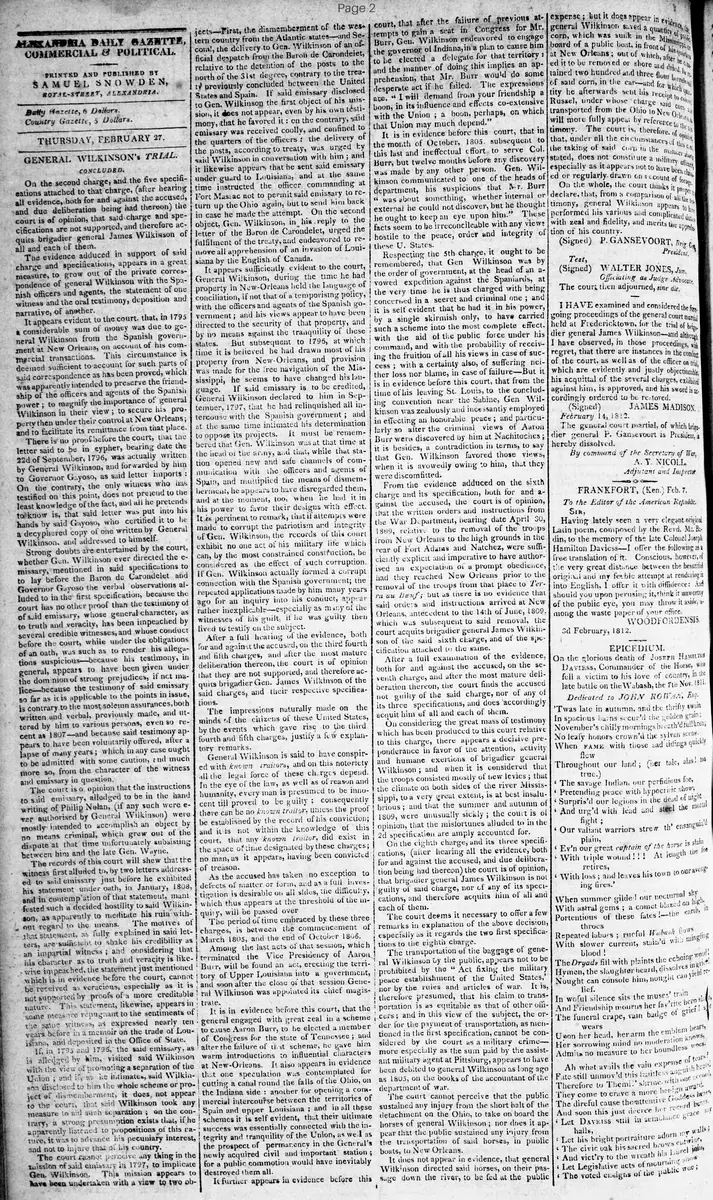
CONCLUDED.
On the second charge, and the five specifications attached to that charge, (after hearing all evidence, both for and against the accused, and due deliberation being had thereon) the court is of opinion, that said charge and specifications are not supported, and therefore acquits brigadier general James Wilkinson of all and each of them.
The evidence adduced in support of said charge and specifications, appears in a great measure, to grow out of the private correspondence of general Wilkinson with the Spanish officers and agents, the statement of one witness and the oral testimony, deposition and narrative, of another.
It appears evident to the court, that, in 1795 a considerable sum of money was due to general Wilkinson from the Spanish government at New Orleans, on account of his commercial transactions. This circumstance is deemed sufficient to account for such parts of said correspondence as has been proved, which was apparently intended to preserve the friendship of the officers and agents of the Spanish power; to magnify the importance of general Wilkinson in their view; to secure his property then under their control at New Orleans: and to facilitate its remittance from that place.
There is no proof before the court, that the letter said to be in cypher, bearing date the 22d of September, 1796, was actually written by General Wilkinson, and forwarded by him to Governor Gayoso, as said letter imports: On the contrary, the only witness who has testified on this point, does not pretend to the least knowledge of the fact, and all he pretends to know is, that said letter was put into his hand by said Gayoso, who certified it to be a decyphered copy of one written by General Wilkinson, and addressed to himself.
Strong doubts are entertained by the court, whether Gen. Wilkinson ever directed the emissary, mentioned in said specifications to lay before the Baron de Carondelet and Governor Gayoso the verbal observations alluded to in the first specification, because the court has no other proof than the testimony of said emissary, whose general character, as to truth and veracity, has been impeached by several credible witnesses, and whose conduct before the court, while under the obligations of an oath, was such as to render his allegations suspicious—because his testimony, in general, appears to have been given under the dominion of strong prejudices, if not malice—because the testimony of said emissary is contrary to the most solemn assurances, both written and verbal, previously made, and uttered by him to various persons, even so recent as 1807—and because said testimony appears to have been voluntarily offered, after a lapse of many years; which in any case ought to be admitted with some caution, and much more so, from the character of the witness and emissary in question.
The court is of opinion that the instructions to said emissary, alleged to be in the hand writing of Philip Nolan, (if any such were ever authorised by General Wilkinson) were mostly intended to accomplish an object by no means criminal, which grew out of the dispute at that time unfortunately subsisting between him and the late Gen. Wayne.
The records of this court will shew that the witness first alluded to, by two letters addressed to said emissary just before he exhibited his statement under oath, in January, 1808, and in contemplation of that statement, manifested such a decided hostility to said Wilkinson, as apparently to meditate his ruin without regard to the means. The motives of that statement, as fully explained in said letters, are sufficient to shake his credibility as an impartial witness; and considering that his character as to truth and veracity is likewise impeached, the statement just mentioned which is in evidence before the court, cannot be received as veracious, especially as it is not supported by proofs of a more creditable nature. This statement, likewise, appears in some measure repugnant to the sentiments of the same witness, as expressed nearly ten years before in a memoir on the trade of Louisiana, and deposited in the Office of State.
If, in 1795 and 1796, the said emissary, as alleged by him, visited said Wilkinson with the view of promoting a separation of the Union; and if, as he intimates, said Wilkinson disclosed to him the whole scheme or project of dismemberment, it does not appear to the court, that said Wilkinson took any measure to aid such separation; on the contrary, a strong presumption exists that, if he apparently listened to propositions of this nature, it was to advance his pecuniary interest, and not to injure that of his country.
The court cannot perceive any thing in the mission of said emissary in 1797, to implicate Gen. Wilkinson. This mission appears to have been undertaken with a view to two objects—First, the dismemberment of the western country from the Atlantic states—and Second, the delivery to Gen. Wilkinson of an official despatch from the Baron de Carondelet, relative to the detention of the posts to the north of the 31st degree, contrary to the treaty previously concluded between the United States and Spain. If said emissary disclosed to Gen. Wilkinson the first object of his mission, it does not appear, even by his own testimony, that he favored it: on the contrary, said emissary was received coolly, and confined to the quarters of the officers: the delivery of the posts, according to treaty, was urged by said Wilkinson in conversation with him; and it likewise appears that he sent said emissary under guard to Louisiana, and at the same time instructed the officer commanding at Fort Massac not to permit said emissary to return up the Ohio again, but to send him back in case he made the attempt. On the second object, Gen. Wilkinson, in his reply to the letter of the Baron de Carondelet, urged the fulfilment of the treaty, and endeavored to remove all apprehension of an invasion of Louisiana by the English of Canada.
It appears sufficiently evident to the court, that General Wilkinson, during the time he had property in New-Orleans held the language of conciliation, if not that of a temporising policy, with the officers and agents of the Spanish government; and his views appear to have been directed to the security of that property, and by no means against the tranquility of these states. But subsequent to 1796, at which time it is believed he had drawn most of his property from New-Orleans, and provision was made for the free navigation of the Mississippi, he seems to have changed his language. If said emissary is to be credited, General Wilkinson declared to him in September, 1797, that he had relinquished all intercourse with the Spanish government; and at the same time intimated his determination to oppose its projects. It must be remembered that Gen. Wilkinson was at that time at the head of the army, and that, while that station opened new and safe channels of communication with the officers and agents of Spain, and multiplied the means of dismemberment, he appears to have disregarded them, and at the moment, too, when he had it in his power to favor their designs with effect.
It is pertinent to remark, that if attempts were made to corrupt the patriotism and integrity of Gen. Wilkinson, the records of this court exhibit no one act of his military life which can, by the most constrained construction, be considered as the effect of such corruption.
If Gen. Wilkinson actually formed a corrupt connection with the Spanish government; the repeated applications made by him many years ago for an inquiry into his conduct, appear rather inexplicable—especially as many of the witnesses of his guilt, if he was guilty then lived to testify on the subject.
After a full hearing of the evidence, both for and against the accused, on the third fourth and fifth charges, and after the most mature deliberation thereon, the court is of opinion that they are not supported, and therefore acquits brigadier Gen. James Wilkinson of the said charges, and their respective specifications.
The impressions naturally made on the minds of the citizens of these United States by the events which gave rise to the third fourth and fifth charges, justify a few explanatory remarks.
General Wilkinson is said to have conspired with known traitors, and on this notoriety all the legal force of these charges depend.
In the eye of the law, as well as of reason and humanity, every man is presumed to be innocent till proved to be guilty; consequently there can be no known traitor, unless the proof be established by the record of his conviction: and it is not within the knowledge of this court, that any known traitor, did exist in the space of time designated by these charges; no man, as it appears, having been convicted of treason.
As the accused has taken no exception to defects of matter or form, and as a full investigation is desirable on all sides, the difficulty, which thus appears at the threshold of the inquiry, will be passed over.
The period of time embraced by these three charges, is between the commencement of March 1805, and the end of October 1806.
Among the last acts of that session, which terminated the Vice Presidency of Aaron Burr, will be found an act, erecting the territory of Upper Louisiana into a government, and soon after the close of that session General Wilkinson was appointed its chief magistrate.
It is in evidence before this court, that the general engaged with great zeal in a scheme to cause Aaron Burr, to be elected a member of Congress for the state of Tennessee; and after the failure of that scheme, he gave him warm introductions to influential characters at New-Orleans. It also appears in evidence that one speculation was contemplated for cutting a canal round the falls of the Ohio, on the Indiana side: another for opening a commercial intercourse between the territories of Spain and upper Louisiana; and in all these schemes it is self evident, that their ultimate success was essentially connected with the integrity and tranquility of the Union, as well as the prospect of permanency in the General's newly acquired civil and important station; for a public commotion would have inevitably destroyed them all.
It further appears in evidence before this court, that after the failure of previous attempts to gain a seat in Congress for Mr. Burr, Gen. Wilkinson endeavored to engage the governor of Indiana, in a plan to cause him to be elected a delegate for that territory: and the manner of doing this implies an apprehension, that Mr. Burr would do some desperate act if he failed. The expressions are. "I will demand from your friendship a boon, in its influence and effects co-extensive with the Union; a boon, perhaps, on which that Union may much depend."
It is in evidence before this court, that in the month of October, 1805. subsequent to this last and ineffectual effort to serve Col. Burr, but twelve months before any discovery was made by any other person. Gen. Wilkinson communicated to one of the heads of department, his suspicions that Mr. Burr "was about something, whether internal or external he could not discover, but he thought he ought to keep an eye upon him." These facts seem to be irreconcileable with any views hostile to the peace, order and integrity of these U. States.
Respecting the 5th charge, it ought to be remembered, that Gen Wilkinson was by the order of government, at the head of an avowed expedition against the Spaniards, at the very time he is thus charged with being concerned in a secret and criminal one; and it is self evident that he had it in his power, by a single skirmish only, to have carried such a scheme into the most complete effect, with the aid of the public force under his command, and with the probability of receiving the fruition of all his views in case of success; with a certainty also, of suffering neither loss nor blame, in case of failure—But it is in evidence before this court, that from the time of his leaving St. Louis, to the concluding convention near the Sabine, Gen. Wilkinson was zealously and incessantly employed in effecting an honorable peace; and particularly so after the criminal views of Aaron Burr were discovered by him at Natchitoches: it is besides, a contradiction in terms, to say that Gen. Wilkinson favored those views, when it is avowedly owing to him, that they were discomfited.
From the evidence adduced on the sixth charge and its specification, both for and against the accused, the court is of opinion, that the written orders and instructions from the War Department, bearing date April 30, 1809, relative to the removal of the troops from New Orleans to the high grounds in the rear of Fort Adams and Natchez, were sufficiently explicit and imperative to have authorised an expectation of a prompt obedience, had they reached New Orleans prior to the removal of the troops from that place to Terra au Boeuf; but as there is no evidence that said orders and instructions arrived at New Orleans, antecedent to the 14th of June, 1809. which was subsequent to said removal, the court acquits brigadier general James Wilkinson of the said sixth charge, and of the specification attached to the same.
After a full examination of the evidence, both for and against the accused, on the seventh charge, and after the most mature deliberation thereon, the court finds the accused not guilty of the said charge, nor of any of its three specifications, and does accordingly acquit him of all and each of them.
On considering the great mass of testimony which has been produced to this court relative to this charge, there appears a decisive preponderance in favor of the attention, activity and humane exertions of brigadier general Wilkinson; and when it is considered that the troops consisted mostly of new levies; that the climate on both sides of the river Mississippi, to a very great extent, is at best insalubrious; and that the summer and autumn of 1809, were unusually sickly; the court is of opinion, that the misfortunes alluded to in the 2d specification are amply accounted for.
On the eighth charge, and its three specifications, (after hearing all the evidence, both for and against the accused, and due deliberation being had thereon) the court is of opinion, that brigadier general James Wilkinson is not guilty of said charge, nor of any of its specifications, and therefore acquits him of all and each of them.
The court deems it necessary to offer a few remarks in explanation of the above decision, especially as it regards the two first specifications to the eighth charge.
The transportation of the baggage of general Wilkinson by the public, appears not to be prohibited by the "Act fixing the military peace establishment of the United States, nor by the rules and articles of war. It is, therefore presumed, that his claim to transportation is as equitable as that of other officers; and in this view of the subject, the order for the payment of transportation, as mentioned in the first specification, cannot be considered by the court as a military crime— more especially as the sum paid by the assistant military agent at Pittsburg, appears to have been debited to general Wilkinson as long ago as 1805, on the books of the accountant of the department of war.
The court cannot perceive that the public sustained any injury from the short halt of the detachment on the Ohio, to take on board the horses of general Wilkinson; nor does it appear that the public sustained any injury from the transportation of said horses, in public boats, to New Orleans.
It does not appear in evidence, that general Wilkinson directed said horses, on their passage down the river, to be fed at the public expense; general Wilkinson saved a quantity of corn at New Orleans: out of which, after he caused it to be removed on shore and dried, he took a part for which he afterwards sent his receipt to Col. Russel, under whose charge said corn was. The court is, therefore, of opinion that, under all the circumstances of this case the taking of said corn in the manner described does not constitute a military offence. On the whole, the court is of opinion that general Wilkinson performed his various and complicated duties with zeal and fidelity, and merits the approbation of his country.
(Signed) P. GANSEVOORT, Brig. Gen.
President.
Test,
(Signed)
WALTER JONES, Jun.
Officiating as Judge Advocate.
The court then adjourned, sine die.
I HAVE examined and considered the foregoing proceedings of the general court martial held at Fredericktown, for the trial of brigadier general James Wilkinson—and although I have observed, in those proceedings, with regret, that there are instances in the conduct of the court, as well as of the officer on trial, which are evidently and justly objectionable; his acquittal of the several charges, exhibited against him, is approved, and his sword is accordingly ordered to be restored.
(Signed)
JAMES MADISON.
February 14, 1812.
The general court martial, of which brigadier general P. Gansevoort is President, is hereby dissolved.
By command of the Secretary of War,
A. Y. NICOLL,
Adjutant and Inspector.
What sub-type of article is it?
What themes does it cover?
What keywords are associated?
What entities or persons were involved?
Where did it happen?
Story Details
Key Persons
Location
Fredericktown
Event Date
February 14, 1812
Story Details
Court-martial acquits General James Wilkinson on charges of treasonous correspondence with Spanish agents, involvement in Aaron Burr's dismemberment schemes, failure to obey orders, neglect of troops, and misuse of public resources, citing insufficient evidence and Wilkinson's loyalty to the United States.