Thank you for visiting SNEWPapers!
Sign up free
Editorial
September 15, 1802
The Recorder, Or, Lady's And Gentleman's Miscellany
Richmond, Virginia
What is this article about?
Federalist editorial from the Gazette of the United States lambasts Democratic-Republicans and President Jefferson for supporting the infamous writer James Callender, whom they knew to be unprincipled, and for Jefferson's alleged endorsement and payment for his libelous attacks on Federalists.
Clipping
OCR Quality
95%
Excellent
Full Text
From the Gazette of the United States
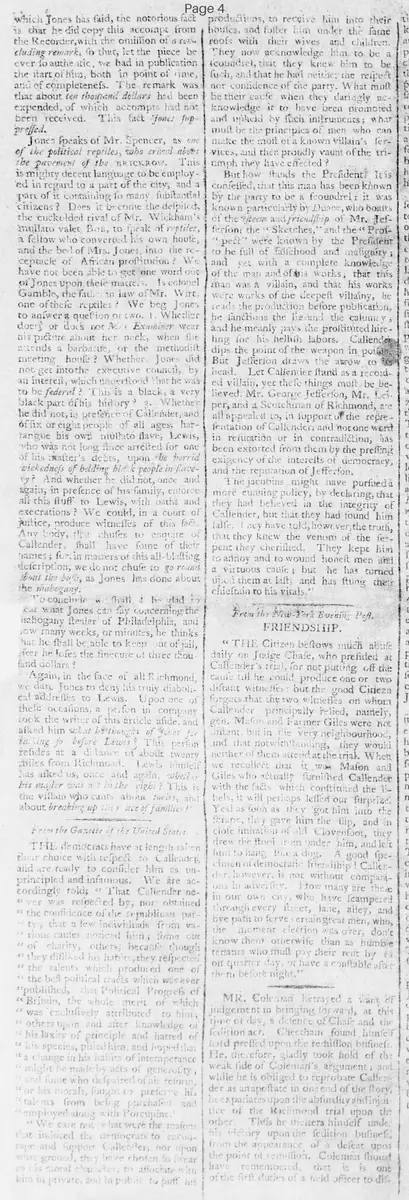
THE democrats have at length taken that choice with respect to Callender and are ready to consider him as unprincipled and infamous. We are accordingly told; "That Callender never was befriended by, nor obtained the confidence of the republican party, that a few individuals from various causes noticed him; some out of charity, others; because though they disliked his habits, they respected the talent, which produced one of the best political tracts which was ever published, that Political Progress of Britain, the whole merit of which was exclusively attributed to him, others upon and after knowledge of his laxity of principle and hatred of his species, pitied him, and hoped that a change in his habits of intemperance might be made by acts of generosity, and some who despaired of his reason, or his morals, sought to preserve his talents from being purchased and employed along with Porcupine.
"We care not what were the reasons that induced the democrats to encourage and support Callender; nor upon what ground, they are now shorten to swear by God he is a moral character, to associate with him in private, and in public to puff his productions, to receive him into their houses, and foster him under the same roofs with their wives and children. They now acknowledge him to be a scoundrel, that they knew him to be such, and that he had neither the respect nor confidence of the party. What must be their cause when they daringly acknowledge it to have been promoted and upheld by such instruments; what must be the principles of men who can make the most of a known villain's services, and then proudly vaunt of the triumph they have effected?
But how stands the President? It is confessed, that this man has been known by the party to be a scoundrel: it was known particularly by Duane, who boasts of the esteem and friendship of Mr. Jefferson: the "Sketches," and the "Prospect" were known by the President to be full of falsehood and malignity; and yet with a complete knowledge of the man and of his works; that this man was a villain, and that his works were works of the deepest villainy, he reads the production before publication he sanctions the lie and the calumny; and he meanly pays the prostituted hireling for his hellish labors. Callender dips the point of the weapon in poison. But Jefferson draws the arrow to its head. Let Callender stand as a recorded villain, yet these things must be believed. Mr. George Jefferson, Mr. Leiper, and a Scotchman of Richmond, are all appealed to, in support of the representation of Callender; and not one word in refutation or in contradiction, has been extorted from them by the pressing exigency of the interests of democracy, and the reputation of Jefferson.
The jacobins might have pursued a more cunning policy, by declaring, that they had believed in the integrity of Callender, but that they had found him false. They have told, however, the truth, that they knew the venom of the serpent they cherished. They kept him to annoy and to wound honest men and a virtuous cause; but he has turned upon them at last; and has stung their chieftain to his vitals."
THE democrats have at length taken that choice with respect to Callender and are ready to consider him as unprincipled and infamous. We are accordingly told; "That Callender never was befriended by, nor obtained the confidence of the republican party, that a few individuals from various causes noticed him; some out of charity, others; because though they disliked his habits, they respected the talent, which produced one of the best political tracts which was ever published, that Political Progress of Britain, the whole merit of which was exclusively attributed to him, others upon and after knowledge of his laxity of principle and hatred of his species, pitied him, and hoped that a change in his habits of intemperance might be made by acts of generosity, and some who despaired of his reason, or his morals, sought to preserve his talents from being purchased and employed along with Porcupine.
"We care not what were the reasons that induced the democrats to encourage and support Callender; nor upon what ground, they are now shorten to swear by God he is a moral character, to associate with him in private, and in public to puff his productions, to receive him into their houses, and foster him under the same roofs with their wives and children. They now acknowledge him to be a scoundrel, that they knew him to be such, and that he had neither the respect nor confidence of the party. What must be their cause when they daringly acknowledge it to have been promoted and upheld by such instruments; what must be the principles of men who can make the most of a known villain's services, and then proudly vaunt of the triumph they have effected?
But how stands the President? It is confessed, that this man has been known by the party to be a scoundrel: it was known particularly by Duane, who boasts of the esteem and friendship of Mr. Jefferson: the "Sketches," and the "Prospect" were known by the President to be full of falsehood and malignity; and yet with a complete knowledge of the man and of his works; that this man was a villain, and that his works were works of the deepest villainy, he reads the production before publication he sanctions the lie and the calumny; and he meanly pays the prostituted hireling for his hellish labors. Callender dips the point of the weapon in poison. But Jefferson draws the arrow to its head. Let Callender stand as a recorded villain, yet these things must be believed. Mr. George Jefferson, Mr. Leiper, and a Scotchman of Richmond, are all appealed to, in support of the representation of Callender; and not one word in refutation or in contradiction, has been extorted from them by the pressing exigency of the interests of democracy, and the reputation of Jefferson.
The jacobins might have pursued a more cunning policy, by declaring, that they had believed in the integrity of Callender, but that they had found him false. They have told, however, the truth, that they knew the venom of the serpent they cherished. They kept him to annoy and to wound honest men and a virtuous cause; but he has turned upon them at last; and has stung their chieftain to his vitals."
What sub-type of article is it?
Partisan Politics
Moral Or Religious
What keywords are associated?
Callender Scandal
Jefferson Criticism
Democrat Hypocrisy
Political Villainy
Federalist Attack
What entities or persons were involved?
Callender
Jefferson
Duane
Mr. George Jefferson
Mr. Leiper
Porcupine
Democrats
Republican Party
Jacobins
Editorial Details
Primary Topic
Criticism Of Democrats And Jefferson For Supporting The Scoundrel Callender
Stance / Tone
Strongly Anti Democratic Republican, Accusatory And Indignant
Key Figures
Callender
Jefferson
Duane
Mr. George Jefferson
Mr. Leiper
Porcupine
Democrats
Republican Party
Jacobins
Key Arguments
Democrats Knew Callender Was Unprincipled But Supported Him For His Talents And To Use Against Opponents
They Now Disavow Him After He Turns Against Them
Jefferson Personally Reviewed And Sanctioned Callender's Libelous Works Despite Knowing Their Falsity
Jefferson Paid Callender For His Attacks
No Refutation From Witnesses Like George Jefferson And Leiper
Democrats Cherished Callender's Venom To Harm Virtuous Causes But He Stung Their Leader