Thank you for visiting SNEWPapers!
Sign up free
Editorial
March 27, 1839
Morning Star
Limerick, York County, Maine
What is this article about?
Editorial reprints John Wesley's sermon excerpt warning Methodists against the spiritual dangers of pursuing riches, urging frugality, generosity, and avoidance of worldly temptations to maintain faith and holiness.
Clipping
OCR Quality
98%
Excellent
Full Text
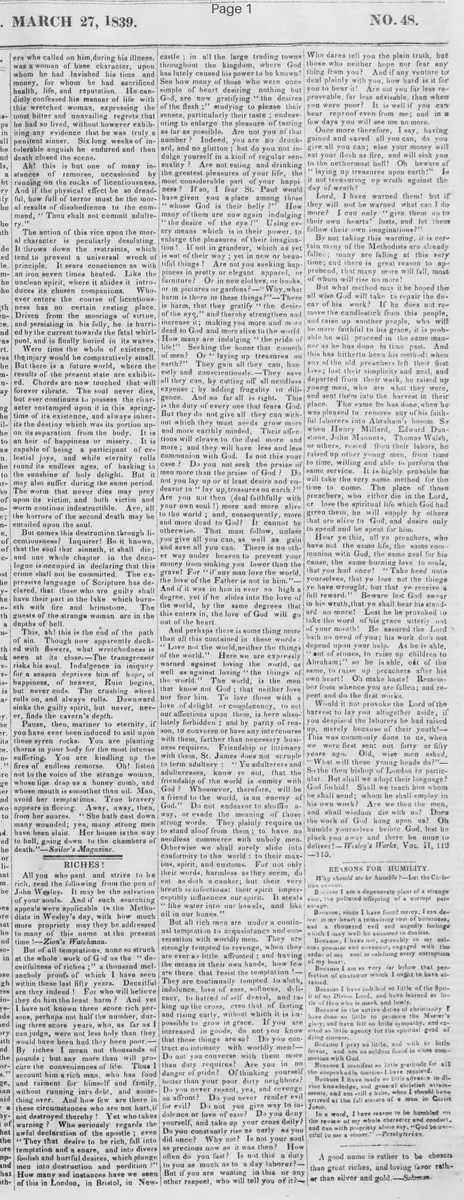
RICHES!
All you who pant and strive to be rich, read the following from the pen of John Wesley. It may be the salvation of your souls. And if such searching appeals were applicable to the Methodists in Wesley's day, with how much more propriety may they be addressed to many of this name at the present time!—Zion's Watchman.
But of all temptations, none so struck at the whole work of God as the "deceitfulness of riches;" a thousand melancholy proofs of which I have seen within these last fifty years. Deceitful are they indeed! For who will believe they do him the least harm? And yet I have not known three score rich persons, perhaps not half the number, during three score years, who, as far as I can judge, were not less holy than they would have been had they been poor.—By riches I mean not thousands of pounds; but any more than will procure the conveniences of life. Thus I account him a rich man, who has food and raiment for himself and family, without running into debt, and something over. And how few are there in these circumstances who are not hurt, if not destroyed thereby! Yet who takes warning? Who seriously regards the awful declaration of the apostle; even "They that desire to be rich, fall into temptation and a snare, and into divers foolish and hurtful desires, which plunge men into destruction and perdition?"
How many sad instances have we seen of this in London, in Bristol, in Newcastle; in all the large trading towns throughout the kingdom, where God has lately caused his power to be known! See how many of those who were once simple of heart desiring nothing but God, are now gratifying "the desires of the flesh;" studying to please their senses, particularly their taste; endeavoring to enlarge the pleasure of tasting as far as possible. Are not you of that number?' Indeed, you are no drunkard, and no glutton; but do you not indulge yourself in a kind of regular sensuality? Are not eating and drinking the greatest pleasures of your life, the most considerable part of your happiness? If so, I fear St. Paul would have given you a place among those "whose God is their belly?" How many of them are now again indulging "the desire of the eye!" Using every means which is in their power, to enlarge the pleasures of their imagination! If not in grandeur, which as yet is out of their way; yet in new or beautiful things! Are not you seeking happiness in pretty or elegant apparel, or furniture? Or in new clothes, or books, or in pictures or gardens?—"Why, what harm is there in these things?"—There is harm, that they gratify "the desire of the eye," and thereby strengthen and increase it; making you more and more dead to God and more alive to the world How many are indulging "the pride of life!" Seeking the honor that cometh of men? Or "laying up treasures on earth?" They gain all they can, honestly and conscientiously.—They save all they can, by cutting off all needless expense; by adding frugality to diligence. And so far all is right. This is the duty of every one that fears God. But they do not give all they can without which they must needs grow more and more earthly minded, Their affections will cleave to the dust more and more; and they will have less and less communion with God. Is not this your case? Do you not seek the praise of men more than the praise of God? Do not you lay up or at least desire and endeavor to "lay up, treasures on earth?" Are you not then (deal faithfully with your own soul!) more and more alive to the world; and, consequently, more and more dead to God? It cannot be otherwise. That must follow, unless you give all you can, as well as gain and save all you can. There is no other way under heaven to prevent your money from sinking you lower than the grave! For "if any man love the world, the love of the Father is not in him." And if it was in him in ever so high a degree, yet if he slides into the love of the world, by the same degrees that this enters in, the love of God will go out of the heart And perhaps there is some thing more than all this contained in these words: "Love not the world, neither the things of the world." Here we are expressly warned against loving the world, as well as against loving "the things of the world." The world, is the men that know not God; that neither love nor fear him. To love those with a love of delight or complacency, to set our affections upon them, is here absolutely forbidden; and by parity of reason, to converse or have any intercourse with them, farther than necessary business requires. Friendship or intimacy with them, St. James does not scruple to term adultery: "Ye adulterers and adulteresses, know ye not, that the friendship of the world is enmity with God? Whosoever, therefore, will be a friend to the world, is an enemy of God." Do not endeavor to shuffle away, or evade the meaning of those strong words. They plainly require us to stand aloof from them; to have no needless commerce with unholy men. Otherwise we shall surely slide into conformity to the world: to their maxims, spirit, and customs. For not only their words, harmless as they seem, do eat as doth a canker; but their very breath is infectious: their spirit imperceptibly influences our spirit. It steals "like water into our bowels, and like oil in our bones."
But all rich men are under a continual temptation to acquaintance and conversation with worldly men. They are strongly tempted to revenge, when they are ever so little affronted; and having the means in their own hands, how few are there that resist the temptation!—They are continually tempted to sloth, indolence, love of ease, softness, delicacy, to hatred of self denial, and taking up the cross, even that of fasting and rising early, without which it is impossible to grow in grace. If you are increased in goods, do not you know that these things are so? Do you contract no intimacy with worldly men?—Do not you converse with them more than duty requires? Are you in no danger of pride? Of thinking yourself better than your poor dirty neighbors? Do you never resent, yea, and revenge an affront? Do you never render evil for evil? Do not you give way to indolence or love of ease? Do you deny yourself, and take up your cross daily? Do you constantly rise as early as you did once? Why not? Is not your soul as precious now as it was then? How often do you fast? Is not this a duty to you as much as to a day laborer?—But if you are wanting in this or any other respect, who will tell you of it?—Who dares tell you the plain truth, but those who neither hope nor fear any thing from you? And if any venture to deal plainly with you, how hard is it for you to bear it! Are not you far less reproveable, far less advisable, than when you were poor? It is well if you can bear reproof even from me: and in a few days you will see me no more.
Once more therefore, I say, having gained and saved all you can, do you give all you can; else your money will eat your flesh as fire, and will sink you to the nethermost hell! Oh beware of "laying up treasures upon earth!" Is it not treasuring up wrath against the day of wrath?
Lord, I have warned them! but if they will not be warned what can I do more? I can only "give them up to their own hearts' lusts, and let them follow their own imaginations?"
By not taking this warning, it is certain many of the Methodists are already fallen; many are falling at this very time; and there is great reason to apprehend, that many more will fall, most of whom will rise no more!
But what method may it be hoped the all wise God will take to repair the decay of his work? If he does not remove the candlestick from this people, and raise up another people, who will be more faithful to his grace, it is probable he will proceed in the same manner as he has done in time past. And this has hitherto been his method: when any of the old preachers left their first love; lost their simplicity and zeal, and departed from their work, he raised up young men, who are what they were, and sent them into the harvest in their place. The same he has done, when he was pleased to remove any of his faithful laborers into Abraham's bosom. So when Henry Millard, Edward Dunstone, John Manners, Thomas Walsh, or others, rested from their labors, he raised up other young men, from time to time, willing and able to perform the same service. It is highly probable he will take the very same method for the time to come. The place of those preachers, who either die in the Lord, or lose the spiritual life which God had given them, he will supply by others that are alive to God, and desire only to spend and be spent for him. Hear ye this, all ye preachers, who have not the same life, the same communion with God, the same zeal for his cause, the same burning love to souls, that you had once! "Take heed unto yourselves, that ye lose not the things ye have wrought, but that ye receive a full reward." Beware lest God swear in his wrath, that ye shall bear his standard no more! Lest he be provoked to take the word of his grace utterly out of your mouth! Be assured the Lord hath no need of you; his work doth not depend upon your help. As he is able, "out of stones, to raise up children to Abraham;" so he is able, out of the same, to raise up preachers after his own heart! Oh make haste! Remember from whence you are fallen; and repent and do the first works.
Would it not provoke the Lord of the harvest to lay you altogether aside, if you despised the laborers he had raised up, merely because of their youth! 'This was commonly done to us, when we were first sent out forty or fifty years ago. Old, wise men asked, "What will these young heads do?"—So the then bishop of London in particular. But shall we adopt their language? God forbid! Shall we teach him whom he shall send; whom he shall employ in his own work? Are we then the men, and shall wisdom die with us? Does the work of God hang upon us? Oh humble yourselves before God. lest he pluck you away and there be none to deliver!—Wesley's Works, Vol. II, 112-115.
All you who pant and strive to be rich, read the following from the pen of John Wesley. It may be the salvation of your souls. And if such searching appeals were applicable to the Methodists in Wesley's day, with how much more propriety may they be addressed to many of this name at the present time!—Zion's Watchman.
But of all temptations, none so struck at the whole work of God as the "deceitfulness of riches;" a thousand melancholy proofs of which I have seen within these last fifty years. Deceitful are they indeed! For who will believe they do him the least harm? And yet I have not known three score rich persons, perhaps not half the number, during three score years, who, as far as I can judge, were not less holy than they would have been had they been poor.—By riches I mean not thousands of pounds; but any more than will procure the conveniences of life. Thus I account him a rich man, who has food and raiment for himself and family, without running into debt, and something over. And how few are there in these circumstances who are not hurt, if not destroyed thereby! Yet who takes warning? Who seriously regards the awful declaration of the apostle; even "They that desire to be rich, fall into temptation and a snare, and into divers foolish and hurtful desires, which plunge men into destruction and perdition?"
How many sad instances have we seen of this in London, in Bristol, in Newcastle; in all the large trading towns throughout the kingdom, where God has lately caused his power to be known! See how many of those who were once simple of heart desiring nothing but God, are now gratifying "the desires of the flesh;" studying to please their senses, particularly their taste; endeavoring to enlarge the pleasure of tasting as far as possible. Are not you of that number?' Indeed, you are no drunkard, and no glutton; but do you not indulge yourself in a kind of regular sensuality? Are not eating and drinking the greatest pleasures of your life, the most considerable part of your happiness? If so, I fear St. Paul would have given you a place among those "whose God is their belly?" How many of them are now again indulging "the desire of the eye!" Using every means which is in their power, to enlarge the pleasures of their imagination! If not in grandeur, which as yet is out of their way; yet in new or beautiful things! Are not you seeking happiness in pretty or elegant apparel, or furniture? Or in new clothes, or books, or in pictures or gardens?—"Why, what harm is there in these things?"—There is harm, that they gratify "the desire of the eye," and thereby strengthen and increase it; making you more and more dead to God and more alive to the world How many are indulging "the pride of life!" Seeking the honor that cometh of men? Or "laying up treasures on earth?" They gain all they can, honestly and conscientiously.—They save all they can, by cutting off all needless expense; by adding frugality to diligence. And so far all is right. This is the duty of every one that fears God. But they do not give all they can without which they must needs grow more and more earthly minded, Their affections will cleave to the dust more and more; and they will have less and less communion with God. Is not this your case? Do you not seek the praise of men more than the praise of God? Do not you lay up or at least desire and endeavor to "lay up, treasures on earth?" Are you not then (deal faithfully with your own soul!) more and more alive to the world; and, consequently, more and more dead to God? It cannot be otherwise. That must follow, unless you give all you can, as well as gain and save all you can. There is no other way under heaven to prevent your money from sinking you lower than the grave! For "if any man love the world, the love of the Father is not in him." And if it was in him in ever so high a degree, yet if he slides into the love of the world, by the same degrees that this enters in, the love of God will go out of the heart And perhaps there is some thing more than all this contained in these words: "Love not the world, neither the things of the world." Here we are expressly warned against loving the world, as well as against loving "the things of the world." The world, is the men that know not God; that neither love nor fear him. To love those with a love of delight or complacency, to set our affections upon them, is here absolutely forbidden; and by parity of reason, to converse or have any intercourse with them, farther than necessary business requires. Friendship or intimacy with them, St. James does not scruple to term adultery: "Ye adulterers and adulteresses, know ye not, that the friendship of the world is enmity with God? Whosoever, therefore, will be a friend to the world, is an enemy of God." Do not endeavor to shuffle away, or evade the meaning of those strong words. They plainly require us to stand aloof from them; to have no needless commerce with unholy men. Otherwise we shall surely slide into conformity to the world: to their maxims, spirit, and customs. For not only their words, harmless as they seem, do eat as doth a canker; but their very breath is infectious: their spirit imperceptibly influences our spirit. It steals "like water into our bowels, and like oil in our bones."
But all rich men are under a continual temptation to acquaintance and conversation with worldly men. They are strongly tempted to revenge, when they are ever so little affronted; and having the means in their own hands, how few are there that resist the temptation!—They are continually tempted to sloth, indolence, love of ease, softness, delicacy, to hatred of self denial, and taking up the cross, even that of fasting and rising early, without which it is impossible to grow in grace. If you are increased in goods, do not you know that these things are so? Do you contract no intimacy with worldly men?—Do not you converse with them more than duty requires? Are you in no danger of pride? Of thinking yourself better than your poor dirty neighbors? Do you never resent, yea, and revenge an affront? Do you never render evil for evil? Do not you give way to indolence or love of ease? Do you deny yourself, and take up your cross daily? Do you constantly rise as early as you did once? Why not? Is not your soul as precious now as it was then? How often do you fast? Is not this a duty to you as much as to a day laborer?—But if you are wanting in this or any other respect, who will tell you of it?—Who dares tell you the plain truth, but those who neither hope nor fear any thing from you? And if any venture to deal plainly with you, how hard is it for you to bear it! Are not you far less reproveable, far less advisable, than when you were poor? It is well if you can bear reproof even from me: and in a few days you will see me no more.
Once more therefore, I say, having gained and saved all you can, do you give all you can; else your money will eat your flesh as fire, and will sink you to the nethermost hell! Oh beware of "laying up treasures upon earth!" Is it not treasuring up wrath against the day of wrath?
Lord, I have warned them! but if they will not be warned what can I do more? I can only "give them up to their own hearts' lusts, and let them follow their own imaginations?"
By not taking this warning, it is certain many of the Methodists are already fallen; many are falling at this very time; and there is great reason to apprehend, that many more will fall, most of whom will rise no more!
But what method may it be hoped the all wise God will take to repair the decay of his work? If he does not remove the candlestick from this people, and raise up another people, who will be more faithful to his grace, it is probable he will proceed in the same manner as he has done in time past. And this has hitherto been his method: when any of the old preachers left their first love; lost their simplicity and zeal, and departed from their work, he raised up young men, who are what they were, and sent them into the harvest in their place. The same he has done, when he was pleased to remove any of his faithful laborers into Abraham's bosom. So when Henry Millard, Edward Dunstone, John Manners, Thomas Walsh, or others, rested from their labors, he raised up other young men, from time to time, willing and able to perform the same service. It is highly probable he will take the very same method for the time to come. The place of those preachers, who either die in the Lord, or lose the spiritual life which God had given them, he will supply by others that are alive to God, and desire only to spend and be spent for him. Hear ye this, all ye preachers, who have not the same life, the same communion with God, the same zeal for his cause, the same burning love to souls, that you had once! "Take heed unto yourselves, that ye lose not the things ye have wrought, but that ye receive a full reward." Beware lest God swear in his wrath, that ye shall bear his standard no more! Lest he be provoked to take the word of his grace utterly out of your mouth! Be assured the Lord hath no need of you; his work doth not depend upon your help. As he is able, "out of stones, to raise up children to Abraham;" so he is able, out of the same, to raise up preachers after his own heart! Oh make haste! Remember from whence you are fallen; and repent and do the first works.
Would it not provoke the Lord of the harvest to lay you altogether aside, if you despised the laborers he had raised up, merely because of their youth! 'This was commonly done to us, when we were first sent out forty or fifty years ago. Old, wise men asked, "What will these young heads do?"—So the then bishop of London in particular. But shall we adopt their language? God forbid! Shall we teach him whom he shall send; whom he shall employ in his own work? Are we then the men, and shall wisdom die with us? Does the work of God hang upon us? Oh humble yourselves before God. lest he pluck you away and there be none to deliver!—Wesley's Works, Vol. II, 112-115.
What sub-type of article is it?
Moral Or Religious
What keywords are associated?
Riches
Methodists
Wesley
Temptation
Worldliness
Giving
Spiritual Decay
What entities or persons were involved?
John Wesley
Methodists
Zion's Watchman
Editorial Details
Primary Topic
Dangers Of Riches And Worldly Temptations For Methodists
Stance / Tone
Strong Moral Warning And Exhortation
Key Figures
John Wesley
Methodists
Zion's Watchman
Key Arguments
Riches Are Deceitful And Harm Spiritual Holiness
Those Desiring To Be Rich Fall Into Temptation And Destruction
Indulging Desires Of The Flesh, Eye, And Pride Of Life Deadens One To God
Must Gain, Save, And Give All One Can To Avoid Loving The World
Friendship With The World Is Enmity With God
Rich Face Temptations To Sloth, Pride, Revenge, And Avoidance Of Self Denial
God Will Replace Unfaithful Preachers With Zealous Young Men