Thank you for visiting SNEWPapers!
Sign up free
Foreign News
January 9, 1805
Norfolk Gazette And Publick Ledger
Norfolk, Virginia
What is this article about?
Detailed description from D'Ohsson's General History of religious worship practices in Ottoman Empire mosques, including architecture, ceremonies, roles of Imams and Muezzins, and historical anecdote about Sultan Bayezid I.
Clipping
OCR Quality
98%
Excellent
Full Text
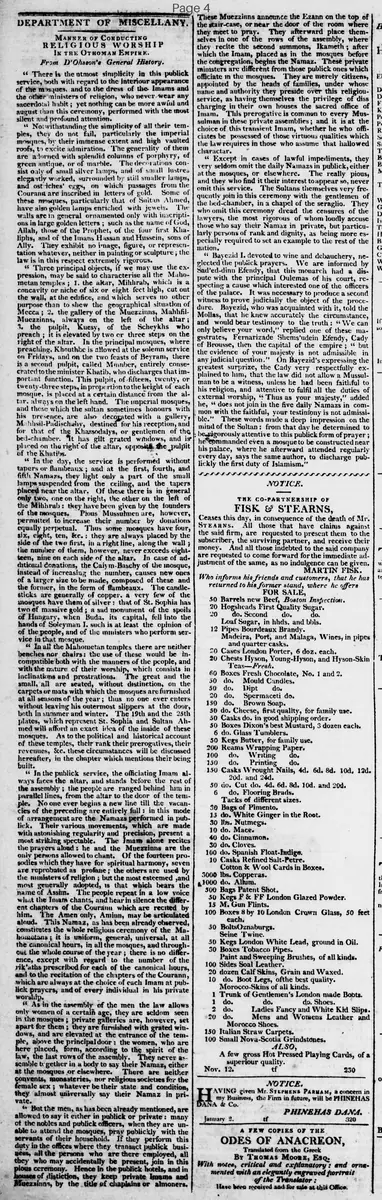
DEPARTMENT OF MISCELLANY.
Manner Of Conducting
RELIGIOUS WORSHIP
In the Ottoman Empire.
From D'Ohsson's General History.
"There is the utmost simplicity in this publick service, both with regard to the interiour appearance of the mosques, and to the dress of the Imams and the other ministers of religion, who never wear any sacerdotal habit; yet nothing can be more awful and august than this ceremony, performed with the most silent and profound attention.
"Notwithstanding the simplicity of all their temples, they do not fail, particularly the imperial mosques, by their immense extent and high vaulted roofs, to excite admiration. The generality of them are adorned with splendid columns of porphyry, of green antique, or of marble. The decorations consist only of small silver lamps, and of small lustres elegantly worked, surrounded by still smaller lamps, and ostriches' eggs, on which passages from the Couran are inscribed in letters of gold. Some of these mosques, particularly that of Sultan Ahmed, have also golden lamps enriched with jewels. The walls are in general ornamented only with inscriptions in large golden letters; such as the name of God, Allah, those of the Prophet, of the four first Khaliphs, and of the Imams Hassan and Hussein, sons of Ally. They exhibit no image, figure, or representation whatever, neither in painting or sculpture; the law is in this respect extremely rigorous.
"Three principal objects, if we may use the expression, may be said to characterise all the Mahometan temples; 1. the altar, Mihhrab, which is a concavity or niche of six or eight feet high, cut out the wall, at the edifice, and which serves no other purpose than to shew the geographical situation of Mecca; 2. the gallery of the Muezzins, Mahfil-Muezzins, always on the left of the altar; 3. the pulpit, Kuesy, of the Scheykhs who preach: it is elevated by two or three steps on the right of the altar. In the principal mosques, where preaching, Khouthbe is allowed at the solemn service on Fridays, and on the two feasts of Beyram, there is a second pulpit, called Minber, entirely consecrated to the minister Khatib, who discharges that important function. This pulpit, of fifteen, twenty, or twenty-three steps, in proportion to the height of each mosque, is placed at a certain distance from the altar, always on the left hand. The imperial mosques, and those which the sultan sometimes honours with his presence, are also decorated with a gallery, Mahfil-Padischah, destined for his reception, and for that of the Khassodalys, or gentlemen of the bed-chamber. It has gilt grated windows, and is placed on the right of the altar, opposite the pulpit of the Khatibs.
"In the day, the service is performed without tapers or flambeaux: and at the first, fourth, and fifth Namazs, they light only a part of the small lamps suspended from the ceiling, and the tapers placed near the altar. Of these there is in general only two, one on the right, the other on the left of the Mihhrab: they have been given by the founders of the mosques. Pious Mussulmen are, however, permitted to increase their number by donations equally perpetual. Thus some mosques have four, six, eight, ten, &c.: they are always placed by the side of the two first, in a right line, along the wall; the number of them, however, never exceeds eighteen, nine on each side of the altar. In case of additional donations, the Caiy m-Baschy of the mosque, instead of increasing the number, causes new ones of a larger size to be made, composed of these and the former, in the form of flambeaux. The candle-sticks are generally of copper, a very few of the mosques have them of silver: that of St. Sophia has two of massive gold; a sad monument of the spoils of Hungary, when Buda, its capital, fell into the hands of Soleyman I. such is at least the opinion of the people, and of the ministers who perform service in that mosque.
"In all the Mahometan temples there are neither benches nor chairs: the use of these would be incompatible both with the manners of the people, and with the nature of their worship, which consists in inclinations and prostrations. The great and the small, all are seated, without distinction, on the carpets or mats with which the mosques are furnished at all seasons of the year; thus no one ever enters without leaving his outermost slippers at the door, both in summer and winter. The 19th and the 25th plates, which represent St. Sophia and Sultan Ahmed will afford an exact idea of the inside of these mosques. As to the political and historical account of these temples, their rank their prerogatives, their revenues, &c. these circumstances will be discussed hereafter, in the chapter which mentions their being built.
"In the publick service, the officiating Imam always faces the altar, and stands before the rest of the assembly; the people are ranged behind him in parallel lines, from the altar to the door of the temple. No one ever begins a new line till the vacancies of the preceding are entirely full: in this mode of arrangement are the Namazs performed in publick. Their various movements, which are made with astonishing regularity and precision, present a most striking spectacle. The Imam alone recites the prayers aloud: he and the Muezzins are the only persons allowed to chant. Of the fourteen prosodies which they have for spiritual harmony, seven are reprobated as profane; the others are used by the ministers of religion; but the most esteemed, and most generally adopted, is that which bears the name of Assim. The people repeat in a low voice what the Imam chants, and hear in silence the different chapters of the Couran which are recited by him. The Amen only, Amin, may be articulated aloud. This Namaz, as has been already observed, constitutes the whole religious ceremony of the Mahometans; it is uniform, general, universal, at all the canonical hours, in all the mosques, and throughout the whole course of the year; there is no difference, except with regard to the number of the rik'ahs prescribed for each of the canonical hours, and to the recitation of the chapters of the Couran, which are always at the choice of each Imam at publick prayers, and of every individual in his private worship.
"As in the assembly of the men the law allows only women of a certain age, they are seldom seen in the mosques; private galleries are, however, set apart for them; they are furnished with grated windows, and are elevated at the entrance of the temple, above the principal door: the women, who are here placed, form, according to the spirit of the law, the last rows of the assembly. They never assemble together in a body to say their Namaz, either at the mosques or elsewhere. There are neither convents, monasteries, nor religious societies for the female sex; whatever be their state and condition, they almost universally say their Namaz in private.
"But the men, as has been already mentioned, are allowed to say it either in publick or private: many of the nobles and publick officers, when they are unable to attend the mosques, pray publickly with the servants of their household. If they perform this duty in the offices where they transact publick business, all the persons who are there employed, all they who may accidentally be present, join in this pious ceremony. Hence in the publick hotels, and in houses of distinction, they keep private Imams and Muezzins, by the title of chaplains or almoners.
These Muezzins announce the Ezan on the top of the stair-case, or near the door of the room where they meet to pray. They afterward place themselves in one of the rows of the assembly, where they recite the second summons, Ikameth: after which the Imam, placed as in the mosques before the congregation, begins the Namaz. These private ministers are different from those publick ones which officiate in the mosques. They are merely citizens, appointed by the heads of families, under whose name and authority they preside over this religious service, as having themselves the privilege of discharging in their own houses the sacred office of Imam. This prerogative is common to every Mussulman in these private assemblies; and it is at the choice of this transient Imam, whether he who officiates be possessed of those virtuous qualities which the law requires in those who assume that hallowed character.
"Except in cases of lawful impediments, they very seldom omit the daily Namazs in publick, either at the mosques, or elsewhere. The really pious, and they who find it their interest to appear so, never omit this service. The Sultans themselves very frequently join in this ceremony with the gentlemen of the bed-chamber, in a chapel of the seraglio. They who omit this ceremony dread the censures of the lawyers, the most rigorous of whom loudly accuse those who say their Namaz in private, but particularly persons of rank and dignity, as being more especially required to set an example to the rest of the nation.
"Bayezid I. devoted to wine and debauchery, neglected the publick prayers. We are informed by Sad'ed-din Efendy, that this monarch had a dispute with the principal Oulemas of his court, respecting a cause which interested one of the officers of the palace. It was necessary to produce a second witness to prove judicially the object of the procedure. Bayezid, who was acquainted with it, told the Mollas, that he knew accurately the circumstance, and would bear testimony to the truth: "We can only believe your word," replied one of these magistrates, Fenarizade Shems'udin Efendy, Cady of Brousse, then the capital of the empire; "but the evidence of your majesty is not admissible in any judicial question." On Bayezid's expressing the greatest surprize, the Cady very respectfully explained to him, that the law did not allow a Mussulman to be a witness, unless he had been faithful to his religion, and attentive to fulfil all the duties of external worship, ": Thus as your majesty," added he, "does not join in the five daily Namazs in common with the faithful, your testimony is not admissible." These words made a deep impression on the mind of the Sultan: from that day he determined to be rigorously attentive to this publick form of prayer; he commanded even a mosque to be constructed near his palace, where he afterward attended regularly every day, says the same author, to discharge publickly the first duty of Islamism."
Manner Of Conducting
RELIGIOUS WORSHIP
In the Ottoman Empire.
From D'Ohsson's General History.
"There is the utmost simplicity in this publick service, both with regard to the interiour appearance of the mosques, and to the dress of the Imams and the other ministers of religion, who never wear any sacerdotal habit; yet nothing can be more awful and august than this ceremony, performed with the most silent and profound attention.
"Notwithstanding the simplicity of all their temples, they do not fail, particularly the imperial mosques, by their immense extent and high vaulted roofs, to excite admiration. The generality of them are adorned with splendid columns of porphyry, of green antique, or of marble. The decorations consist only of small silver lamps, and of small lustres elegantly worked, surrounded by still smaller lamps, and ostriches' eggs, on which passages from the Couran are inscribed in letters of gold. Some of these mosques, particularly that of Sultan Ahmed, have also golden lamps enriched with jewels. The walls are in general ornamented only with inscriptions in large golden letters; such as the name of God, Allah, those of the Prophet, of the four first Khaliphs, and of the Imams Hassan and Hussein, sons of Ally. They exhibit no image, figure, or representation whatever, neither in painting or sculpture; the law is in this respect extremely rigorous.
"Three principal objects, if we may use the expression, may be said to characterise all the Mahometan temples; 1. the altar, Mihhrab, which is a concavity or niche of six or eight feet high, cut out the wall, at the edifice, and which serves no other purpose than to shew the geographical situation of Mecca; 2. the gallery of the Muezzins, Mahfil-Muezzins, always on the left of the altar; 3. the pulpit, Kuesy, of the Scheykhs who preach: it is elevated by two or three steps on the right of the altar. In the principal mosques, where preaching, Khouthbe is allowed at the solemn service on Fridays, and on the two feasts of Beyram, there is a second pulpit, called Minber, entirely consecrated to the minister Khatib, who discharges that important function. This pulpit, of fifteen, twenty, or twenty-three steps, in proportion to the height of each mosque, is placed at a certain distance from the altar, always on the left hand. The imperial mosques, and those which the sultan sometimes honours with his presence, are also decorated with a gallery, Mahfil-Padischah, destined for his reception, and for that of the Khassodalys, or gentlemen of the bed-chamber. It has gilt grated windows, and is placed on the right of the altar, opposite the pulpit of the Khatibs.
"In the day, the service is performed without tapers or flambeaux: and at the first, fourth, and fifth Namazs, they light only a part of the small lamps suspended from the ceiling, and the tapers placed near the altar. Of these there is in general only two, one on the right, the other on the left of the Mihhrab: they have been given by the founders of the mosques. Pious Mussulmen are, however, permitted to increase their number by donations equally perpetual. Thus some mosques have four, six, eight, ten, &c.: they are always placed by the side of the two first, in a right line, along the wall; the number of them, however, never exceeds eighteen, nine on each side of the altar. In case of additional donations, the Caiy m-Baschy of the mosque, instead of increasing the number, causes new ones of a larger size to be made, composed of these and the former, in the form of flambeaux. The candle-sticks are generally of copper, a very few of the mosques have them of silver: that of St. Sophia has two of massive gold; a sad monument of the spoils of Hungary, when Buda, its capital, fell into the hands of Soleyman I. such is at least the opinion of the people, and of the ministers who perform service in that mosque.
"In all the Mahometan temples there are neither benches nor chairs: the use of these would be incompatible both with the manners of the people, and with the nature of their worship, which consists in inclinations and prostrations. The great and the small, all are seated, without distinction, on the carpets or mats with which the mosques are furnished at all seasons of the year; thus no one ever enters without leaving his outermost slippers at the door, both in summer and winter. The 19th and the 25th plates, which represent St. Sophia and Sultan Ahmed will afford an exact idea of the inside of these mosques. As to the political and historical account of these temples, their rank their prerogatives, their revenues, &c. these circumstances will be discussed hereafter, in the chapter which mentions their being built.
"In the publick service, the officiating Imam always faces the altar, and stands before the rest of the assembly; the people are ranged behind him in parallel lines, from the altar to the door of the temple. No one ever begins a new line till the vacancies of the preceding are entirely full: in this mode of arrangement are the Namazs performed in publick. Their various movements, which are made with astonishing regularity and precision, present a most striking spectacle. The Imam alone recites the prayers aloud: he and the Muezzins are the only persons allowed to chant. Of the fourteen prosodies which they have for spiritual harmony, seven are reprobated as profane; the others are used by the ministers of religion; but the most esteemed, and most generally adopted, is that which bears the name of Assim. The people repeat in a low voice what the Imam chants, and hear in silence the different chapters of the Couran which are recited by him. The Amen only, Amin, may be articulated aloud. This Namaz, as has been already observed, constitutes the whole religious ceremony of the Mahometans; it is uniform, general, universal, at all the canonical hours, in all the mosques, and throughout the whole course of the year; there is no difference, except with regard to the number of the rik'ahs prescribed for each of the canonical hours, and to the recitation of the chapters of the Couran, which are always at the choice of each Imam at publick prayers, and of every individual in his private worship.
"As in the assembly of the men the law allows only women of a certain age, they are seldom seen in the mosques; private galleries are, however, set apart for them; they are furnished with grated windows, and are elevated at the entrance of the temple, above the principal door: the women, who are here placed, form, according to the spirit of the law, the last rows of the assembly. They never assemble together in a body to say their Namaz, either at the mosques or elsewhere. There are neither convents, monasteries, nor religious societies for the female sex; whatever be their state and condition, they almost universally say their Namaz in private.
"But the men, as has been already mentioned, are allowed to say it either in publick or private: many of the nobles and publick officers, when they are unable to attend the mosques, pray publickly with the servants of their household. If they perform this duty in the offices where they transact publick business, all the persons who are there employed, all they who may accidentally be present, join in this pious ceremony. Hence in the publick hotels, and in houses of distinction, they keep private Imams and Muezzins, by the title of chaplains or almoners.
These Muezzins announce the Ezan on the top of the stair-case, or near the door of the room where they meet to pray. They afterward place themselves in one of the rows of the assembly, where they recite the second summons, Ikameth: after which the Imam, placed as in the mosques before the congregation, begins the Namaz. These private ministers are different from those publick ones which officiate in the mosques. They are merely citizens, appointed by the heads of families, under whose name and authority they preside over this religious service, as having themselves the privilege of discharging in their own houses the sacred office of Imam. This prerogative is common to every Mussulman in these private assemblies; and it is at the choice of this transient Imam, whether he who officiates be possessed of those virtuous qualities which the law requires in those who assume that hallowed character.
"Except in cases of lawful impediments, they very seldom omit the daily Namazs in publick, either at the mosques, or elsewhere. The really pious, and they who find it their interest to appear so, never omit this service. The Sultans themselves very frequently join in this ceremony with the gentlemen of the bed-chamber, in a chapel of the seraglio. They who omit this ceremony dread the censures of the lawyers, the most rigorous of whom loudly accuse those who say their Namaz in private, but particularly persons of rank and dignity, as being more especially required to set an example to the rest of the nation.
"Bayezid I. devoted to wine and debauchery, neglected the publick prayers. We are informed by Sad'ed-din Efendy, that this monarch had a dispute with the principal Oulemas of his court, respecting a cause which interested one of the officers of the palace. It was necessary to produce a second witness to prove judicially the object of the procedure. Bayezid, who was acquainted with it, told the Mollas, that he knew accurately the circumstance, and would bear testimony to the truth: "We can only believe your word," replied one of these magistrates, Fenarizade Shems'udin Efendy, Cady of Brousse, then the capital of the empire; "but the evidence of your majesty is not admissible in any judicial question." On Bayezid's expressing the greatest surprize, the Cady very respectfully explained to him, that the law did not allow a Mussulman to be a witness, unless he had been faithful to his religion, and attentive to fulfil all the duties of external worship, ": Thus as your majesty," added he, "does not join in the five daily Namazs in common with the faithful, your testimony is not admissible." These words made a deep impression on the mind of the Sultan: from that day he determined to be rigorously attentive to this publick form of prayer; he commanded even a mosque to be constructed near his palace, where he afterward attended regularly every day, says the same author, to discharge publickly the first duty of Islamism."
What sub-type of article is it?
Religious Affairs
What keywords are associated?
Ottoman Mosques
Religious Worship
Namaz Prayers
Imams Muezzins
Bayezid I
St Sophia
What entities or persons were involved?
Bayezid I
Soleyman I
Sad'ed Din Efendy
Fenarizade Shems'udin Efendy
Where did it happen?
Ottoman Empire
Foreign News Details
Primary Location
Ottoman Empire
Key Persons
Bayezid I
Soleyman I
Sad'ed Din Efendy
Fenarizade Shems'udin Efendy
Event Details
Description of simplicity in Ottoman mosque services, architecture including mihrab, pulpits, and lighting; worship practices involving Namaz prayers led by Imams, with men in lines and women in separate galleries; private prayers allowed; historical anecdote of Bayezid I reformed by judicial rebuke to attend public prayers.