Thank you for visiting SNEWPapers!
Sign up free
The National Intelligencer And Washington Advertiser
Washington, District Of Columbia
What is this article about?
The Treaty of Peace between the First Consul of the French Republic and the King of the Two Sicilies was signed in Florence on March 28, 1801. It ends hostilities, revokes prior agreements, closes ports to Turkish and English vessels, cedes Porto Longone, Presidios of Tuscany, and Piombino to France, lifts sequestrations, provides reparations of 500,000 francs, allows return of exiles, restores art objects, and extends to allied republics.
Clipping
OCR Quality
Full Text
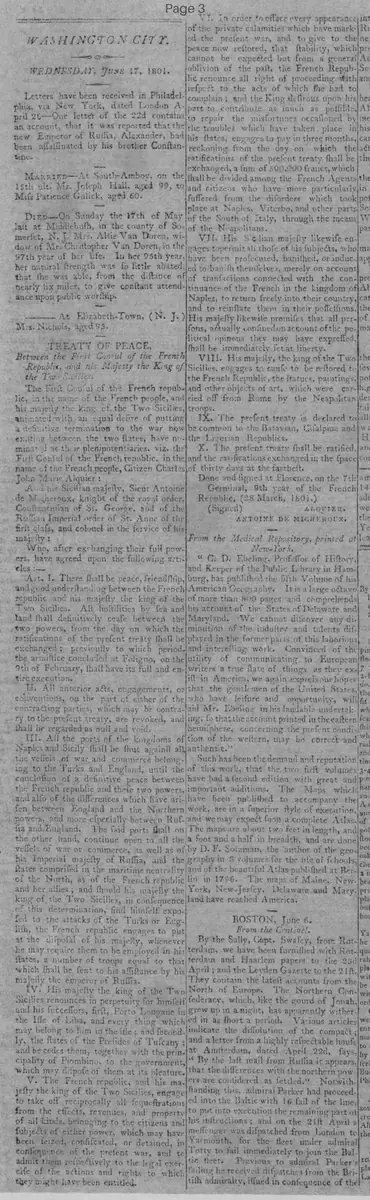
Between the First Consul of the French Republic, and his Majesty the King of the Two Sicilies.
The First Consul of the French republic, in the name of the French people, and his majesty the king of the Two Sicilies, animated with an equal desire of putting a definitive termination to the war now existing between the two states, have nominated as their plenipotentiaries, viz. the First Consul of the French republic, in the name of the French people, Citizen Charles John Marie Alquier:
And his Sicilian majesty, Sieur Antoine de Micheroux, knight of the royal order Constantinian of St. George, and of the Russian Imperial order of St. Anne of the first class, and colonel in the service of his majesty:
Who, after exchanging their full powers, have agreed upon the following articles:
Art. I. There shall be peace, friendship, and good understanding between the French republic and his majesty the king of the Two Sicilies. All hostilities by sea and land shall definitively cease between the two powers, from the day on which the ratifications of the present treaty shall be exchanged; previously to which period, the armistice concluded at Foligno, on the 9th of February, shall have its full and entire execution.
II. All anterior acts, engagements, or conventions, on the part of either of the contracting parties, which may be contrary to the present treaty, are revoked, and shall be regarded as null and void.
III. All the ports of the kingdoms of Naples and Sicily shall be shut against all the vessels of war and commerce belonging to the Turks and England, until the conclusion of a definitive peace between the French republic and these two powers, and also of the differences which have arisen between England and the Northern powers, and more especially between Russia and England. The said ports shall on the other hand, continue open to all the vessels of war or commerce, as well as of his Imperial majesty of Russia, and the states comprised in the maritime neutrality of the North, as of the French republic and her allies; and should his majesty the king of the Two Sicilies, in consequence of this determination, find himself exposed to the attacks of the Turks or English, the French republic engages to put at the disposal of his majesty, whenever he may require them to be employed in his states, a number of troops equal to that which shall be sent to his assistance by his majesty the emperor of Russia.
IV. His majesty the king of the Two Sicilies renounces in perpetuity for himself and his successors, first, Porto Longone in the Isle of Elba, and every thing which may belong to him in the isle; and secondly, the states of the Presidios of Tuscany: and he cedes them, together with the principality of Piombino, to the government, which may dispose of them at its pleasure.
V. The French republic, and his majesty the king of the Two Sicilies, engage to take off reciprocally all sequestrations from the effects, revenues, and property of all kinds, belonging to the citizens and subjects of either power, which may have been seized, confiscated, or detained, in consequence of the present war, and to admit them respectively to the legal exercise of the actions and rights to which they might have been entitled.
VI. In order to efface every appearance of the private calamities which have marked the present war, and to give to the peace now restored, that stability, which cannot be expected but from a general oblivion of the past, the French Republic renounce all right of proceeding with respect to the acts of which he had to complain; and the King desirous upon his part to contribute as much as possible, to repair the misfortunes occasioned by the troubles which have taken place in his states, engages to pay in three months, reckoning from the day on which the ratifications of the present treaty shall be exchanged, a sum of 500,000 francs, which shall be divided among the French Agents and citizens who have more particularly suffered from the disorders which took place at Naples, Viterbo, and other parts of the South of Italy, through the means of the Neapolitans.
VII. His Sicilian majesty likewise engages to permit all those of his subjects, who have been prosecuted, banished, or induced to banish themselves, merely on account of transactions connected with the continuance of the French in the kingdom of Naples, to return freely into their country, and to reinstate them in their possessions. His majesty likewise promises that all persons, actually confined on account of the political opinions they may have expressed, shall be immediately set at liberty.
VIII. His majesty, the king of the Two Sicilies, engages to cause to be restored to the French Republic, the statues, paintings, and other objects of art, which were carried off from Rome by the Neapolitan troops.
IX. The present treaty is declared to be common to the Batavian, Cisalpine and the Ligurian Republics.
X. The present treaty shall be ratified, and the ratifications exchanged in the space of thirty days at the furthest.
Done and signed at Florence, on the 7th Germinal, 9th year of the French Republic. (28 March, 1801.)
(Signed)
ALQUIER.
ANTOINE DE MICHEROUX.
What sub-type of article is it?
What keywords are associated?
What entities or persons were involved?
Where did it happen?
Foreign News Details
Primary Location
Florence
Event Date
28 March 1801
Key Persons
Outcome
peace and friendship established; hostilities cease upon ratification; ports closed to turks and english; cession of porto longone, presidios of tuscany, and piombino; lifting of sequestrations; 500,000 francs reparations to french sufferers; return of exiles and release of prisoners; restoration of art from rome; treaty extends to batavian, cisalpine, and ligurian republics.
Event Details
The treaty, signed by plenipotentiaries Alquier for France and Micheroux for the Two Sicilies, ends the war with provisions for peace, revocation of contrary agreements, port closures to enemies while open to allies and neutrals, French troop assistance if needed, territorial cessions, mutual restoration of seized properties, amnesty and reparations, release of political prisoners, art restitution, and ratification within 30 days.