Thank you for visiting SNEWPapers!
Sign up free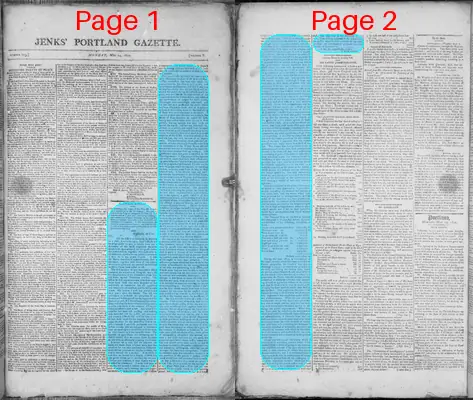
Jenks's Portland Gazette
Portland, Cumberland County, Maine
What is this article about?
Newspaper introduces and publishes a letter from U.S. Congressman J. Stratton (noted as Hon. Mr. Stanton of Virginia) dated Washington, April 22, 1802, summarizing key congressional measures including commerce protection against Barbary pirates, repeal of the Judiciary Act, repeal of internal taxes, and public debt provisions, while explaining his opposing votes and constitutional concerns.
Merged-components note: This is a continuation of the letter from Mr. Stanton on political measures, spanning pages 1 and 2; relabeled to letter_to_editor as it is a published letter with opinionated content.
Clippings
1 of 2
OCR Quality
Full Text
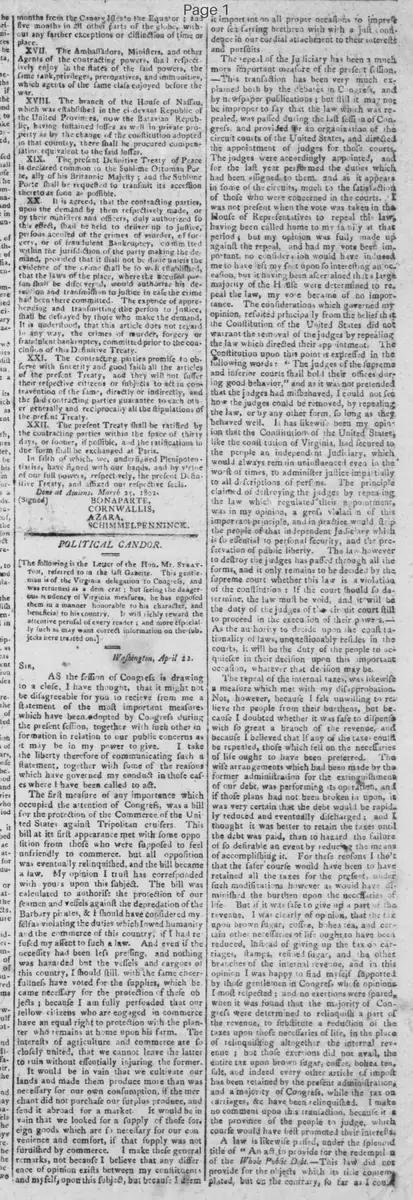
The following is the Letter of the Hon. Mr. Stanton, referred to in the last Gazette. This gentleman is of the Virginia delegation to Congress, and was returned as a democrat; but seeing the dangerous tendency of Virginia measures, he has opposed them in a manner honorable to his character, and beneficial to his country. It will richly reward the attentive perusal of every reader; and more especially such as may want correct information on the subjects here treated on.
Washington, April 22.
SIR,
AS the session of Congress is drawing to a close, I have thought, that it might not be disagreeable for you to receive from me a statement of the most important measures which have been adopted by Congress during the present session, together with such other information in relation to our public concerns as it may be in my power to give. I take the liberty therefore of communicating such a statement, together with some of the reasons which have governed my conduct in those cases where I have been called to act.
The first measure of any importance which occupied the attention of Congress, was a bill for the protection of the Commerce of the United States against Tripolitan cruisers. This bill at its first appearance met with some opposition from those who were supposed to feel unfriendly to commerce, but all opposition was eventually relinquished, and the bill became a law. My opinion I trust has corresponded with yours upon this subject. The bill was calculated to authorize the protection of our seamen and vessels against the depredation of the Barbary pirates, & I should have considered myself as violating the duties which I owed humanity and the commerce of this country, if I had refused my assent to such a law. And even if the necessity had been less pressing, and nothing was hazarded but the vessels and cargoes of this country, I should still, with the same cheerfulness have voted for the supplies, which became necessary for the protection of these objects; because I am fully persuaded that our fellow citizens who are engaged in commerce have an equal right to protection with the planter who remains at home upon his farm. The interests of agriculture and commerce are so closely united, that we cannot leave the latter to ruin without essentially injuring the former. It would be in vain that we cultivate our lands and made them produce more than was necessary for our own consumption, if the merchant did not purchase our surplus produce, and send it abroad for a market. It would be in vain that we looked for a supply of those foreign goods which are so necessary for our convenience and comfort, if that supply was not furnished by commerce. I make these general remarks, not because I believe that any difference of opinion exists between my constituents and myself, upon this subject, but because I deem it important on all proper occasions to impress our eastern brethren with a just confidence in our cordial attachment to their interests and pursuits.
The repeal of the Judiciary has been a much more important measure of the present session.—This transaction has been very much explained both by the debates in Congress, and by newspaper publications; but still it may not be improper to say that the law which was repealed, was passed during the last session of Congress, and provided an organization of the circuit courts of the United States, and directed the appointment of judges for those courts. The judges were accordingly appointed, and for the last year performed the duties which had been assigned to them, and as it appears in some of the circuits, much to the satisfaction of those who were concerned in the courts. I was not present when the vote was taken in the House of Representatives to repeal this law, having been called home to my family at that period; but my opinion was fully made up against the repeal, and had my vote been important, no consideration would have induced me to have left my seat upon so interesting an occasion, but it having been ascertained that a large majority of the House were determined to repeal the law, my vote became of no importance. The considerations which governed my opinion, resulted principally from the belief that the Constitution of the United States did not warrant the removal of the judges by repealing the law which directed their appointment. The Constitution upon this point is expressed in the following words: "The judges of the supreme and inferior courts shall hold their offices during good behavior," and as it was not pretended that the judges had misbehaved, I could not see how the judges could be removed, by repealing the law, or by any other form, so long as they behaved well. It has likewise been my opinion that the Constitution of the United States like the constitution of Virginia, had secured to the people an independent Judiciary, which would always remain uninfluenced even in the worst of times, to administer justice impartially to all descriptions of persons. The principle claimed of destroying the judges by repeating the law which regulated their appointment, was in my opinion, a gross violation of this important principle, and in practice would strip the people of that independent judiciary which is so essential to personal security, and the preservation of public liberty. The law however to destroy the judges has passed through all the forms, and it only remains to be decided by the supreme court whether this law is a violation of the constitution: If the court should so determine, the law must be void, and it will be the duty of the judges of the circuit court still to proceed in the execution of their powers.—As the authority to decide upon the constitutionality of laws, unquestionably resides in the courts, it will be the duty of the people to acquiesce in their decision upon this important occasion, whatever that decision may be.
The repeal of the internal taxes, was likewise a measure which met with my disapprobation. Not, however, because I felt unwilling to relieve the people from their burdens, but because I doubted whether it was safe to dispense with so great a branch of the revenue, and because I believed that if any of those taxes could be repealed, those which fell on the necessaries of life ought to have been preferred. The wise arrangements which had been made by the former administration for the extinguishment of our debt, was performing its operation, and if those plans had not been broken in upon, it was very certain that the debt would be rapidly reduced and eventually discharged; and I thought it was better to retain the taxes until the debt was paid, than to hazard the failure of so desirable an event by reducing the means of accomplishing it. For these reasons I thought that the safer course would have been to have retained all the taxes for the present, under such modifications however as would have diminished the burden upon the necessaries of life. But if it was safe to give up a part of the revenue, I was clearly of opinion, that the tax upon brown sugar, coffee, bohea tea, and certain other necessaries of life ought to have been reduced, instead of giving up the tax on carriages, stamps, refined sugar, and the other branches of the internal revenue, and in this opinion I was happy to find myself supported by those gentlemen in Congress whose opinions I most respected; and no exertions were spared, when it was found that the majority of Congress were determined to relinquish a part of the revenue, to substitute a reduction of the taxes upon those necessaries of life, in the place of relinquishing altogether the internal revenue; but those exertions did not avail, the entire tax upon brown sugar, coffee, bohea tea, salt, and indeed every other article of impost has been retained by the present administration, and a majority of Congress, while the tax on carriages, &c have been relinquished, I make no comment upon this transaction, because it is the province of the people to judge, which course would have best promoted their interests.
A law is likewise passed, under the splendid title of "An act to provide for the redemption of the Whole Public Debt.—This law did not provide for the objects which its title contemplated, but on the contrary, so far as I could judge by its provision—it provided for a continuation of the debt. Instead of compelling the treasury to discharge the debt due in Holland, which amounts to $3,000,000 dollars, authorizes the reloaning of as great a proportion of the same, upon a credit of six years, and at a higher rate of interest, including charges, than is now paid. This law has likewise authorized the administration to enter into contracts for the payment of any part of this foreign debt, an authority which it is apparent may be abused, to the great loss of the government, because contracts may be made under this law with speculators, who will receive this large sum at the treasury upon an agreement to place the same in Holland to our credit, and may altogether fail of executing the contract on their part, and our debt may still remain unpaid. Although I hope and trust that no such abuse of power will take place, yet I did not feel willing to give such extensive powers when I deem the same so unnecessary. This law likewise enables the administration to employ at considerable expense, a variety of agencies in relation to the foreign debt, some of which were in my judgment unnecessary, and all of them of a very doubtful character. Under such circumstances and impressions, I voted against the passage of this law, notwithstanding the fairness of its title. And although I should think it improper to impeach the motives of those who passed the law, or to say that the intention was to impose on the public by a title which agreed so badly with the law itself, yet it could not escape my notice, that such must be the effect upon those who had not the advantage of reading the law. A further reason likewise of a conclusive nature operated on my mind against the passage of the law in question, it was that by comparing this law with the former provisions for the redemption of the debt it appeared that the former provisions were really better than those of this law. The former laws had provided funds to meet every part of the debt, both principal and interest, as the same fell due, only authorizing a reloaning of parts of the same in cases where from unforeseen causes the revenue should be insufficient to meet the object, and they likewise provided that every surplus of revenue should be faithfully applied to buy in the debt, as it could be obtained on fair terms in the market; whilst the new law without varying essentially the former provisions, has only embarrassed them, by authorizing a reloaning of the Dutch debt at the discretion of the administration, and creating a variety of new and extensive agencies.
Since my residence in this place, I have availed myself of every opportunity to gain information respecting the situation and amount of the public debt, and the means which have been provided for its extinguishment, and the result of my enquiries has been placed completely under the control of the Government; and the means provided by the former Congresses for its final extinguishment, were in every respect ample, and if left to their operation, would have accomplished that object without embarrassment.
The National Debt on the first of January last amounted to 77,891,890 dollars, 29 cents, and consisted of the following description of stocks:
Six per cent and deferred stock $51,783.66
Three per cent deferred 19,079,705.63
Navy six per cent do. 711,700
Six per cent of 1796 do. 80,000
Five and a half per cent do. 1,847,500
Four and a half per cent do. 176,000
Eight per cent do. 648,200
Bank Loan at six per cent 1,590,000
Ditto at five per cent 1,150,000
Dutch Debt 9,915,000
Dollars 77,891,889.29
During the year 1801, in consequence of the ample revenue which had been provided by former congresses, the Treasury was able to discharge 2,279,371.33 cents of the principal of the debt, and during the current year, unless the present administration should avail itself of the law which I have mentioned, to reloan and perpetuate the Dutch debt, the treasury will be compelled to discharge a further sum amounting at least to 3,400,000 dollars of the principal, and so from year to year to continue discharging the same until the whole debt shall be extinguished. This prosperous situation of our finances is owing to the skill with which the treasury department was conducted under the former administrations. When the new administration came into power, they found a full treasury and an ample revenue, and they had nothing to do but to apply the public money to discharge the public engagements. Whatever my fears may be respecting the consequences which must result from the measures of the present administration, I sincerely hope that we shall continue to enjoy the same prosperity which attended us under the administration of our former presidents. In expressing this sentiment I cannot be suspected of insincerity, because I am embarked in common with others in the destinies of this country, and must suffer by our common misfortunes and be benefited by the general prosperity.
I hope you will excuse the liberty which I have taken of addressing you this letter. It has resulted from a desire of giving to my constituents a faithful account of the part which I have taken in these concerns, in which they are so deeply interested; and I have deemed it more important to do this, in consequence of having differed in opinion from all my colleagues upon every important measure which has been agitated during the present session. It would be indecorous in me to question the correctness of the motives which have governed their conduct, and conscious of the integrity of my own, I am willing to submit to the tribunal of the public, whether their conduct or my own, has been best calculated to promote the true interest of this country.
I am, Sir, respectfully, yours,
J. STRATTON.
What sub-type of article is it?
What themes does it cover?
What keywords are associated?
What entities or persons were involved?
Letter to Editor Details
Author
J. Stratton
Recipient
Sir
Main Argument
provides a detailed account of key congressional measures during the session, including protection of commerce, repeal of the judiciary act, repeal of internal taxes, and public debt management, explaining his votes in opposition to the majority and emphasizing constitutional principles and fiscal prudence.
Notable Details