Thank you for visiting SNEWPapers!
Sign up free
Editorial
March 19, 1919
New Ulm Review
New Ulm, Brown County, Minnesota
What is this article about?
This editorial defends the First and Tenth Amendments, highlighting free speech and press as essential rights protected from federal interference. It criticizes the Espionage Law as unconstitutional, compares it to the 1798 Sedition Act, and urges its repeal to ensure public opinion influences policy, including at the Paris Conference.
Clipping
OCR Quality
98%
Excellent
Full Text
Fundamental Rights.
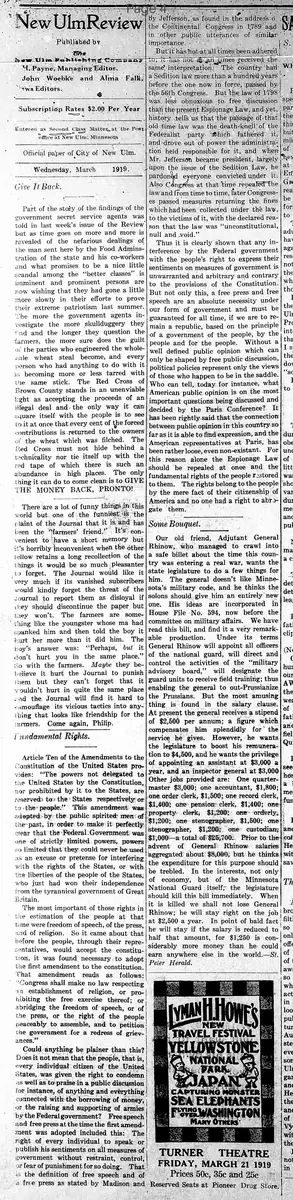
Article Ten of the Amendments to the Constitution of the United States provides: "The powers not delegated to the United States by the Constitution, nor prohibited by it to the States, are reserved to the States respectively or to the people." This amendment was adopted by the public spirited men of the past, in order to make it perfectly clear that the Federal Government was one of strictly limited powers, powers so limited that they could never be used as an excuse or pretense for interfering with the rights of the States, or with the liberties of the people of the States, who just had won their independence from the tyrannical government of Great Britain.
The most important of those rights in the estimation of the people at that time were freedom of speech, of the press, and of religion. So it came about that before the people, through their representatives, would accept the constitution, it was found necessary to adopt the first amendment to the constitution. That amendment reads as follows:
"Congress shall make no law respecting an establishment of religion, or prohibiting the free exercise thereof; or abridging the freedom of speech, or of the press, or the right of the people peaceably to assemble, and to petition the government for a redress of grievances."
Could anything be plainer than this? Does it not mean that the people, that is, every individual citizen of the United States, was given the right to condemn as well as to praise in a public discussion for instance, of anything and everything connected with the borrowing of money, or the raising and supporting of armies by the Federal government? Free speech and free press at the time the first amendment was adopted included this: The right of every individual to speak or publish his sentiments on all measures of government without restraint, control, or fear of punishment for so doing. That is the definition of free speech and of a free press as stated by Madison and by Jefferson, as found in the address of the Continental Congress in 1789 and in other public utterances of similar importance.
But it has not at all times been adhered to, it has not at all times received the same interpretation. The country had a Sedition law more than a hundred years before the one now in force, passed by the 56th Congress. But the law of 1798 was less obnoxious to free discussion than the present Espionage Law, and yet, history tells us that the passage of that old time law was the death-knell of the Federalist party which fathered it and drove out of power the administration held responsible for it, and when Mr. Jefferson became president, largely upon the issue of the Sedition Law, he pardoned everyone convicted under it. Also Congress at that time repealed the law and from time to time, later Congresses passed measures returning the fines which had been collected under the law, to the victims of it, with the declared reason that the law was "unconstitutional, null and void."
Thus it is clearly shown that any interference by the Federal government with the people's right to express their sentiments on measures of government is unwarranted and arbitrary and contrary to the provisions of the Constitution.
But not only this, a free press and free speech are an absolute necessity under our form of government and must be guaranteed for all time, if we are to remain a republic, based on the principle of a government of the people, by the people and for the people. Without a well defined public opinion which can only be shaped by free public discussion, political policies represent only the views of those who happen to be in the saddle.
Who can tell, today for instance, what American public opinion is on the most important questions being discussed and decided by the Paris Conference? It has been rightly said that the connection between public opinion in this country so far as it is able to find expression, and the American representatives at Paris, has been rather loose, even non-existent. For this reason alone the Espionage Law should be repealed at once and the fundamental rights of the people restored to them. The rights belong to the people by the mere fact of their citizenship of America and no one had a right to abrogate them.
Article Ten of the Amendments to the Constitution of the United States provides: "The powers not delegated to the United States by the Constitution, nor prohibited by it to the States, are reserved to the States respectively or to the people." This amendment was adopted by the public spirited men of the past, in order to make it perfectly clear that the Federal Government was one of strictly limited powers, powers so limited that they could never be used as an excuse or pretense for interfering with the rights of the States, or with the liberties of the people of the States, who just had won their independence from the tyrannical government of Great Britain.
The most important of those rights in the estimation of the people at that time were freedom of speech, of the press, and of religion. So it came about that before the people, through their representatives, would accept the constitution, it was found necessary to adopt the first amendment to the constitution. That amendment reads as follows:
"Congress shall make no law respecting an establishment of religion, or prohibiting the free exercise thereof; or abridging the freedom of speech, or of the press, or the right of the people peaceably to assemble, and to petition the government for a redress of grievances."
Could anything be plainer than this? Does it not mean that the people, that is, every individual citizen of the United States, was given the right to condemn as well as to praise in a public discussion for instance, of anything and everything connected with the borrowing of money, or the raising and supporting of armies by the Federal government? Free speech and free press at the time the first amendment was adopted included this: The right of every individual to speak or publish his sentiments on all measures of government without restraint, control, or fear of punishment for so doing. That is the definition of free speech and of a free press as stated by Madison and by Jefferson, as found in the address of the Continental Congress in 1789 and in other public utterances of similar importance.
But it has not at all times been adhered to, it has not at all times received the same interpretation. The country had a Sedition law more than a hundred years before the one now in force, passed by the 56th Congress. But the law of 1798 was less obnoxious to free discussion than the present Espionage Law, and yet, history tells us that the passage of that old time law was the death-knell of the Federalist party which fathered it and drove out of power the administration held responsible for it, and when Mr. Jefferson became president, largely upon the issue of the Sedition Law, he pardoned everyone convicted under it. Also Congress at that time repealed the law and from time to time, later Congresses passed measures returning the fines which had been collected under the law, to the victims of it, with the declared reason that the law was "unconstitutional, null and void."
Thus it is clearly shown that any interference by the Federal government with the people's right to express their sentiments on measures of government is unwarranted and arbitrary and contrary to the provisions of the Constitution.
But not only this, a free press and free speech are an absolute necessity under our form of government and must be guaranteed for all time, if we are to remain a republic, based on the principle of a government of the people, by the people and for the people. Without a well defined public opinion which can only be shaped by free public discussion, political policies represent only the views of those who happen to be in the saddle.
Who can tell, today for instance, what American public opinion is on the most important questions being discussed and decided by the Paris Conference? It has been rightly said that the connection between public opinion in this country so far as it is able to find expression, and the American representatives at Paris, has been rather loose, even non-existent. For this reason alone the Espionage Law should be repealed at once and the fundamental rights of the people restored to them. The rights belong to the people by the mere fact of their citizenship of America and no one had a right to abrogate them.
What sub-type of article is it?
Constitutional
Press Freedom
What keywords are associated?
First Amendment
Tenth Amendment
Free Speech
Free Press
Espionage Law
Sedition Act
Constitutional Rights
Public Opinion
What entities or persons were involved?
Madison
Jefferson
Federalist Party
Continental Congress
Paris Conference
Editorial Details
Primary Topic
Defense Of Free Speech And Press Against The Espionage Law
Stance / Tone
Strongly Supportive Of Constitutional Rights And Critical Of Federal Interference
Key Figures
Madison
Jefferson
Federalist Party
Continental Congress
Paris Conference
Key Arguments
Tenth Amendment Limits Federal Powers To Prevent Interference With State Rights And Individual Liberties.
First Amendment Guarantees Freedom Of Speech, Press, And Religion Without Congressional Abridgment.
Free Speech Includes The Right To Criticize Government Measures Without Fear Of Punishment.
Historical Sedition Act Of 1798 Was Repealed As Unconstitutional And Led To The Fall Of The Federalist Party.
Espionage Law Is More Restrictive Than The 1798 Act And Should Be Repealed Immediately.
Free Press And Speech Are Essential For Shaping Public Opinion And Maintaining A Republic.