Thank you for visiting SNEWPapers!
Sign up free
Alexandria Daily Advertiser
Alexandria, Virginia
What is this article about?
Letter from midshipman Henry Lyne Martin on USS Essex reports imminent peace with Tripoli after freeing Philadelphia's crew; court acquits Capt. Bainbridge; Gen. Eaton's expedition aided peace; squadron remains in Mediterranean amid rumors of war with Spain.
Clipping
OCR Quality
Full Text
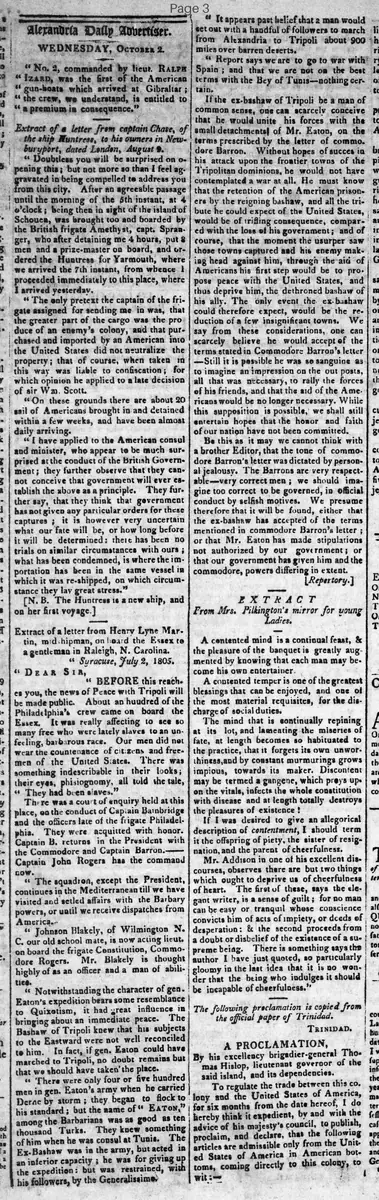
"Syracuse, July 2, 1805.
"DEAR SIR,
"BEFORE this reaches you, the news of Peace with Tripoli will be made public. About an hundred of the Philadelphia's crew came on board the Essex. It was really affecting to see so many free who were lately slaves to an unfeeling, barbarous race. Our men did not wear the countenance of citizens and freemen of the United States. There was something indescribable in their looks; their eyes, physiognomy, all told the tale, 'They had been slaves.'
There was a court of enquiry held at this place, on the conduct of Captain Bainbridge and the officers late of the frigate Philadelphia. They were acquitted with honor. Captain B. returns in the President with the Commodore and Captain Barron. Captain John Rogers has the command now.
"The squadron, except the President, continues in the Mediterranean till we have visited and settled affairs with the Barbary powers, or until we receive dispatches from America.
"Johnson Blakely, of Wilmington N. C. our old school mate, is now acting lieut. on board the frigate Constitution, Commodore Rogers. Mr. Blakely is thought highly of as an officer and a man of ability.
"Notwithstanding the character of gen. Eaton's expedition bears some resemblance to Quixotism, it had great influence in bringing about an immediate peace. The Bashaw of Tripoli knew that his subjects to the Eastward were not well reconciled to him. In fact, if gen. Eaton could have marched to Tripoli, no doubt remains but that we should have taken the place.
"There were only four or five hundred men in gen. Eaton's army when he carried his standard; but the name of "Eaton," Derne by storm; they began to flock to among the Barbarians was as good as ten thousand Turks. They knew something of him when he was consul at Tunis. The Ex-Bashaw was in the army, but acted in an inferior capacity: he was for giving up the expedition: but was restrained, with his followers, by the Generalissimo.
It appears past belief that a man would set out with a handful of followers to march from Alexandria to Tripoli about 900 miles over barren deserts.
"Report says we are to go to war with Spain; and that we are not on the best terms with the Bey of Tunis—nothing certain.
If the ex-bashaw of Tripoli be a man of common sense, one can scarcely conceive that he would unite his forces with the small detachments of Mr. Eaton, on the terms prescribed by the letter of commodore Barron. Without hopes of success in his attack upon the frontier towns of the Tripolitan dominions, he would not have contemplated a war at all. He must know that the retention of the American prisoners by the reigning bashaw, and all the tribute he could expect of the United States, would be of rising consequence, compared with the loss of his government; and of course, that the moment the usurper saw those towns captured and his enemy making head against him, through the aid of Americans his first step would be to propose peace with the United States, and thus deprive him, the dethroned bashaw of his ally. The only event the ex-bashaw could therefore expect, would be the reduction of a few insignificant towns. We say from these considerations, one can scarcely believe he would accept of the terms stated in Commodore Barron's letter—Still it is possible he was so sanguine as to imagine an impression on the out posts, all that was necessary, to rally the forces of his friends, and that the aid of the Americans would be no longer necessary. While this supposition is possible, we shall still entertain hopes that the honor and faith of our nation have not been committed.
Be this as it may we cannot think with a brother Editor, that the tone of commodore Barron's letter was dictated by personal jealousy. The Barrons are very respectable—very correct men; we should imagine too correct to be governed, in official conduct by selfish motives. We presume therefore that it will be found, either that the ex-bashaw has accepted of the terms mentioned in commodore Barron's letter: or that Mr. Eaton has made stipulations not authorized by our government; or that our government has given him and the commodore, powers differing in extent.
[Repertory.]
What sub-type of article is it?
What keywords are associated?
What entities or persons were involved?
Where did it happen?
Foreign News Details
Primary Location
Tripoli
Event Date
July 2, 1805
Key Persons
Outcome
peace with tripoli imminent; philadelphia crew freed; bainbridge and officers acquitted with honor; eaton's expedition influenced peace; squadron to settle affairs with barbary powers.
Event Details
Letter reports freeing of Philadelphia's crew after their capture; court of enquiry acquits Captain Bainbridge and officers; US squadron continues in Mediterranean; Gen. Eaton's march from Alexandria to Derne and beyond pressured Tripoli into peace; rumors of war with Spain and tensions with Tunis; discussion of Ex-Bashaw's potential alliance terms with Eaton under Commodore Barron.