Thank you for visiting SNEWPapers!
Sign up free
The Enquirer
Richmond, Henrico County, Virginia
What is this article about?
Biographical account of French General Moreau's life, from his birth in Morlaix, education, revolutionary involvement in Brittany, to his rapid military rise, key victories in 1794-1796 campaigns against Austrians, and masterful 1796 retreat from Bavaria, highlighting his filial piety.
Clipping
OCR Quality
Full Text
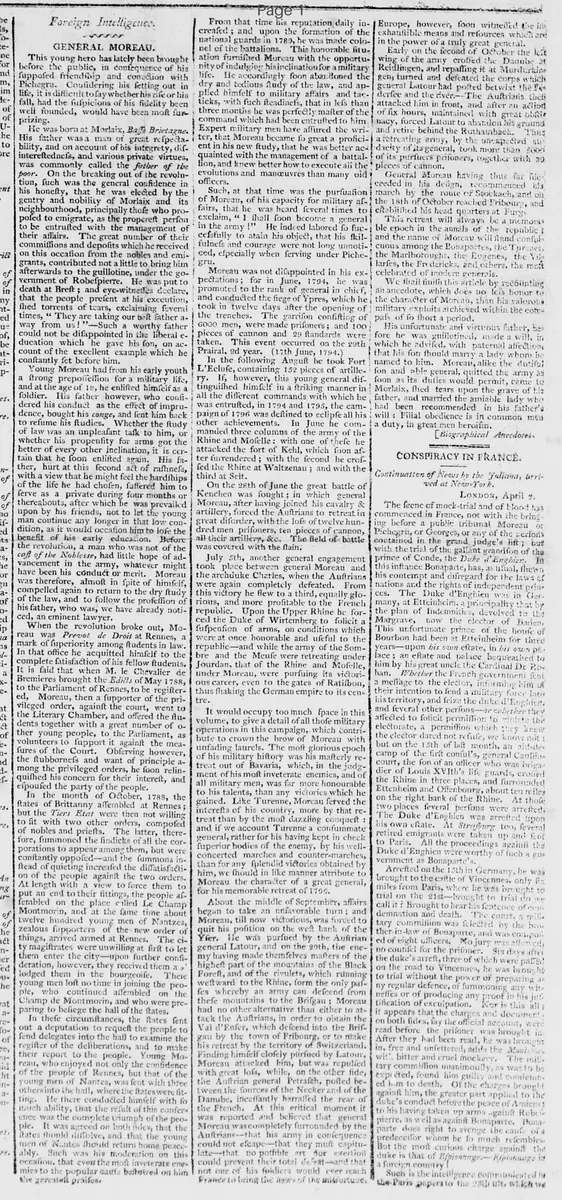
GENERAL MOREAU.
This young hero has lately been brought before the public, in consequence of his supposed friendship and connexion with Pichegru. Considering his setting out in life, it is difficult to say whether his rise or his fall, had the suspicions of his fidelity been well founded, would have been most surprising.
He was born at Morlaix, Basse Bretagne. His father was a man of great respectability, and on account of his integrity, disinterestedness, and various private virtues, was commonly called the father of the poor. On the breaking out of the revolution, such was the general confidence in his honesty, that he was elected by the gentry and nobility of Morlaix and its neighbourhood, principally those who proposed to emigrate, as the properest person to be entrusted with the management of their affairs. The great number of their commissions and deposits which he received on this occasion from the nobles and emigrants, contributed not a little to bring him afterwards to the guillotine, under the government of Robespierre. He was put to death at Brest; and eye-witnesses declare, that the people present at his execution, shed torrents of tears, exclaiming several times, "They are taking our good father away from us!"--Such a worthy father could not be disappointed in the liberal education which he gave his son, on account of the excellent example which he constantly set before him.
Young Moreau had from his early youth a strong prepossession for a military life, and at the age of 18, he enlisted himself as a soldier. His father however, who considered his conduct as the effect of imprudence, bought his conge, and sent him back to resume his studies. Whether the study of law was an unpleasant task to him, or whether his propensity for arms got the better of every other inclination, it is certain that he soon enlisted again. His father, hurt at this second act of rashness, with a view that he might feel the hardships of the life he had chosen, suffered him to serve as a private during four months or thereabouts, after which he was prevailed upon by his friends, not to let the young man continue any longer in that low condition, as it would occasion him to lose the benefit of his early education. Before the revolution, a man who was not of the cast of the Noblesse, had little hope of advancement in the army, whatever might have been his conduct or merit. Moreau was therefore, almost in spite of himself, compelled again to return to the dry study of the law, and to follow the profession of his father, who was, we have already noticed, an eminent lawyer.
When the revolution broke out, Moreau was Prevot de Droit at Rennes, a mark of superiority among students in law. In that office he acquitted himself to the complete satisfaction of his fellow students. It is said that when M. le Chevalier de Bremieres brought the Edicts of May 1788, to the Parliament of Rennes, to be registered, Moreau, then a supporter of the privileged order, against the court, went to the Literary Chamber, and offered the students together with a great number of other young people, to the Parliament, as volunteers to support it against the measures of the Court. Observing however, the stubbornness and want of principle among the privileged orders, he soon relinquished his concern for their interest, and espoused the party of the people.
In the month of October, 1789, the States of Brittany assembled at Rennes; but the Tiers Etat were then not willing to sit with two other orders, composed of nobles and priests. The latter, therefore, summoned the syndics of all the corporations to appear among them, but were constantly opposed--and the summons instead of quieting increased the dissatisfaction of the people against the two orders. At length with a view to force them to put an end to their sittings, the people assembled on the place called Le Champ Montmorin, and at the same time about twelve hundred young men of Nantes, zealous supporters of the new order of things, arrived armed at Rennes. The city magistrates were unwilling at first to let them enter the city--upon further consideration, however, they received them and lodged them in the bourgeoisie. These young men lost no time in joining the people, who continued assembled on the Champ de Montmorin, and who were preparing to besiege the hall of the states. In these circumstances, the states sent out a deputation to request the people to send delegates into the hall to examine the register of the deliberations, and to make their report to the people. Young Moreau, who enjoyed not only the confidence of the people of Rennes, but that of the young men of Nantes, was sent with three others into the hall, where the states were sitting. He there conducted himself with so much ability, that the result of this conference was the complete triumph of the people. It was agreed on both sides, that the States should dissolve, and that the young men of Nantes should return home peaceably. Such was his moderation on this occasion, that even the most inveterate enemies to the popular cause bestowed on him the greatest praises.
From that time his reputation daily increased; and upon the formation of the national guards in 1789, he was made colonel of the battalions. This honorable situation furnished Moreau with the opportunity of indulging his inclination for a military life. He accordingly soon abandoned the dry and tedious study of the law, and applied himself to military affairs and tactics, with such steadiness, that in less than three months he was perfectly master of the command which had been entrusted to him. Expert military men have assured the writer, that Moreau became so great a proficient in his new study, that he was better acquainted with the management of a battalion, and knew better how to execute all the evolutions and manoeuvres than many old officers.
Such, at that time was the persuasion of Moreau, of his capacity for military affairs, that he was heard several times to exclaim, "I shall soon become a general in the army!" He indeed labored so successfully to attain his object, that his skilfulness and courage were not long unnoticed, especially when serving under Pichegru.
Moreau was not disappointed in his expectations; for in June, 1794, he was promoted to the rank of general in chief, and conducted the siege of Ypres, which he took in twelve days after the opening of the trenches. The garrison consisting of 5000 men, were made prisoners: and 100 pieces of cannon and 29 standards were taken. This event occurred on the 29th Prairial, 2d year. (17th June, 1794.)
In the following August he took Fort L'Ecluse, containing 152 pieces of artillery. If, however, this young general distinguished himself in a striking manner in all the different commands with which he was entrusted, in 1794 and 1795, the campaign of 1796 was destined to eclipse all his other achievements. In June he commanded three columns of the army of the Rhine and Moselle: with one of these he attacked the fort of Kehl, which soon after surrendered; with the second he crossed the Rhine at Waltzenau; and with the third at Selt.
On the 28th of June the great battle of Kechen was fought; in which general Moreau, after having joined his cavalry & artillery, forced the Austrians to retreat in great disorder, with the loss of twelve hundred men prisoners, ten pieces of cannon, all their artillery, &c. The field of battle was covered with the slain.
July 5th, another general engagement took place between general Moreau and the archduke Charles, when the Austrians were again completely defeated. From this victory he flew to a third, equally glorious, and more profitable to the French republic. Upon the Upper Rhine he forced the Duke of Wirtemberg to solicit a suspension of arms, on conditions which were at once honorable and useful to the republic--and while the army of the Sombre and the Meuse were retreating under Jourdan, that of the Rhine and Moselle, under Moreau, were pursuing its victorious career, even to the gates of Ratisbon, thus shaking the German empire to its centre.
It would occupy too much space in this volume, to give a detail of all those military operations in this campaign, which contribute to crown the brow of Moreau with unfading laurels. The most glorious epoch of his military history was his masterly retreat out of Bavaria, which, in the judgment of his most inveterate enemies, and of all military men, was far more honourable to his talents, than any victories which he gained. Like Turenne, Moreau served the interests of his country, more by that retreat than by the most dazzling conquest: and if we account Turenne a consummate general, rather for his having kept in check superior bodies of the enemy, by his well-concerted marches and counter-marches, than for any splendid victories obtained by him, we should in like manner attribute to Moreau the character of a great general, for his memorable retreat of 1796.
About the middle of September, affairs began to take an unfavorable turn; and Moreau, till now victorious, was forced to quit his position on the west bank of the Isar. He was pursued by the Austrian general Latour, and on the 30th, the enemy having made themselves masters of the highest part of the mountains of the Black Forest, and of the rivulets, which running westward to the Rhine, form the only passes whereby an army can descend from these mountains to the Brisgau; Moreau had no other alternative than either to attack the Austrians, in order to obtain the Val d'Enfer, which descend into the Brisgau by the town of Fribourg, or to make his retreat by the territory of Switzerland. Finding himself closely pursued by Latour, Moreau attacked him, but was repulsed with great loss, while, on the other side, the Austrian general Petrasch, posted between the sources of the Neckar and of the Danube, incessantly harassed the rear of the French. At this critical moment it was reported and believed that general Moreau was completely surrounded by the Austrians--that his army in consequence could not escape--that they must capitulate--that no possible arts or exertions could prevent their total defeat--and that not one of his soldiers would ever reach France to bring the news of the misfortune.
Europe, however, soon witnessed the inexhaustible means and resources which are in the power of a truly great general.
Early on the second of October the left wing of the army crossed the Danube at Riedlingen, and repassing it at Murtzkirchen turned and defeated the corps which general Latour had posted betwixt the Fesdersee and the river.--The Austrians then attacked him in front, and after an action of six hours, maintained with great bravery, forced Latour to abandon his ground and retire behind the Rothtembach. Thus a retreating army, by the unexpected audacity of its general, took more than 5000 of its pursuers prisoners, together with 40 pieces of cannon.
General Moreau having thus far succeeded in his design, recommenced his march by the route of Stockach, and on the 15th of October reached Fribourg, and established his head quarters at Furstenberg.
This retreat will always be a memorable epoch in the annals of the republic! and the name of Moreau will stand conspicuous among the Bonapartes, the Turennes, the Marlboroughs, the Eugenes, the Villarses, the Fredericks, and others, the most celebrated of modern generals.
We shall finish this article by recounting an anecdote, which does no less honor to the character of Moreau, than his valorous military exploits achieved within the compass of so short a period.
His unfortunate and virtuous father, before he was guillotined, made a will, in which he advised, with paternal affection, that his son should marry a lady whom he named to him. Moreau, alike the dutiful son and able general, quitted the army as soon as its duties would permit, came to Morlaix, shed tears upon the grave of his father, and married the amiable lady who had been recommended in his father's will: Filial obedience is in common men a duty, in great men heroism.
What sub-type of article is it?
What keywords are associated?
What entities or persons were involved?
Where did it happen?
Foreign News Details
Primary Location
France
Event Date
1789 1796
Key Persons
Outcome
victories at ypres (5000 prisoners, 100 cannon), fort l'ecluse (152 artillery), kehl, battles at kechen (1200 prisoners, 10 cannon), july 5 engagement, suspension of arms with duke of wirtemberg; masterful retreat from bavaria capturing 5000 austrians and 40 cannon despite being pursued.
Event Details
Biographical narrative of General Moreau's early life in Brittany, shift from law to military during French Revolution, role in 1789 Brittany events, rapid rise to general in 1794, successes in Rhine and Moselle campaigns including sieges and battles against Austrians in 1796, and strategic retreat from Bavaria.