Thank you for visiting SNEWPapers!
Sign up free
Story
September 13, 1890
The Wichita Daily Eagle
Wichita, Sedgwick County, Kansas
What is this article about?
Biographical sketch of Col. Thomas P. Ochiltree, a witty Texan politician, military figure, and international personality, highlighting his career from youth in Texas Rangers through Civil War service, congressional representation, and European travels.
Clipping
OCR Quality
95%
Excellent
Full Text
A PICTURESQUE AMERICAN.
Interesting Glimpses at the Career of Col. Thomas P. Ochiltree.
Our American civilization has produced but two men of international reputation, of whom people very familiar with their names, being asked what these men have done to achieve greatness, would stammer, hesitate and finally fail to answer.
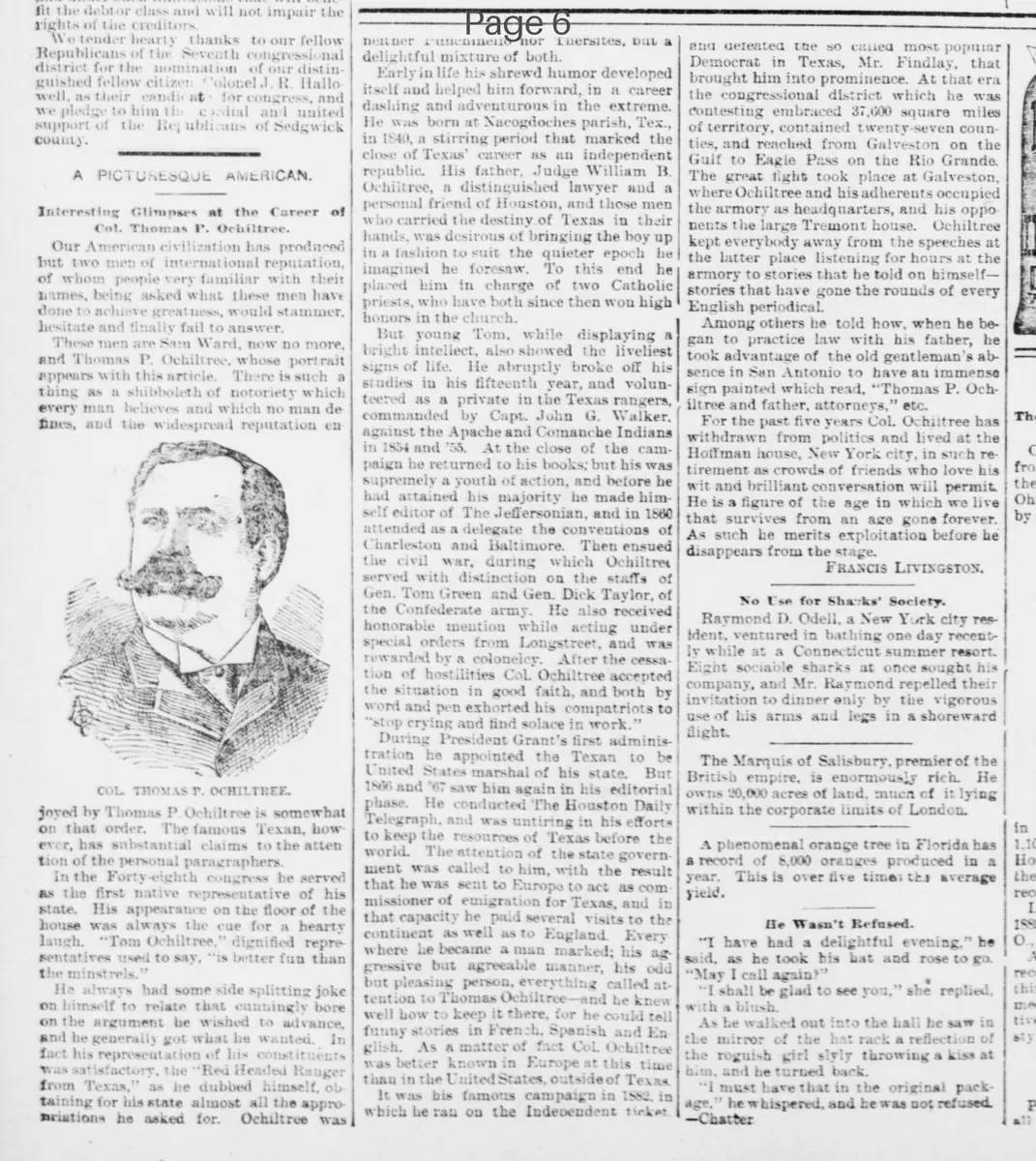
These men are Sam Ward, now no more, and Thomas P. Ochiltree, whose portrait appears with this article. There is such a thing as a shibboleth of notoriety which every man believes and which no man defines, and the widespread reputation enjoyed by Thomas P. Ochiltree is somewhat on that order. The famous Texan, however, has substantial claims to the attention of the personal paragraphers.
In the Forty-eighth congress he served as the first native representative of his state. His appearance on the floor of the house was always the cue for a hearty laugh. "Tom Ochiltree," dignified representatives used to say, "is better fun than the minstrels."
He always had some side-splitting joke on himself to relate that cunningly bore on the argument he wished to advance, and he generally got what he wanted. In fact his representation of his constituents was satisfactory, the "Red Headed Ranger from Texas," as he dubbed himself, obtaining for his state almost all the appropriations he asked for. Ochiltree was born at Nacogdoches parish, Tex., in 1840, a stirring period that marked the close of Texas' career as an independent republic. His father, Judge William B. Ochiltree, a distinguished lawyer and a personal friend of Houston, and those men who carried the destiny of Texas in their hands, was desirous of bringing the boy up in a fashion to suit the quieter epoch he imagined he foresaw. To this end he placed him in charge of two Catholic priests, who have both since then won high honors in the church.
But young Tom, while displaying a bright intellect, also showed the liveliest signs of life. He abruptly broke off his studies in his fifteenth year, and volunteered as a private in the Texas rangers, commanded by Capt. John G. Walker, against the Apache and Comanche Indians in 1854 and '55. At the close of the campaign he returned to his books; but his was supremely a youth of action, and before he had attained his majority he made himself editor of The Jeffersonian, and in 1860 attended as a delegate the conventions of Charleston and Baltimore. Then ensued the civil war, during which Ochiltree served with distinction on the staffs of Gen. Tom Green and Gen. Dick Taylor, of the Confederate army. He also received honorable mention while acting under special orders from Longstreet, and was rewarded by a colonelcy. After the cessation of hostilities Col. Ochiltree accepted the situation in good faith, and both by word and pen exhorted his compatriots to "stop crying and find solace in work."
During President Grant's first administration he appointed the Texan to be United States marshal of his state. But 1866 and '67 saw him again in his editorial phase. He conducted The Houston Daily Telegraph, and was untiring in his efforts to keep the resources of Texas before the world. The attention of the state government was called to him, with the result that he was sent to Europe to act as commissioner of emigration for Texas, and in that capacity he paid several visits to the continent as well as to England. Everywhere he became a man marked; his aggressive but agreeable manner, his odd but pleasing person, everything called attention to Thomas Ochiltree—and he knew well how to keep it there, for he could tell funny stories in French, Spanish and English. As a matter of fact Col. Ochiltree was better known in Europe at this time than in the United States, outside of Texas.
It was his famous campaign in 1870, in which he ran on the Independent ticket and defeated the so-called most popular Democrat in Texas, Mr. Findlay, that brought him into prominence. At that era the congressional district which he was contesting embraced 37,000 square miles of territory, contained twenty-seven counties, and reached from Galveston on the Gulf to Eagle Pass on the Rio Grande.
The great fight took place at Galveston, where Ochiltree and his adherents occupied the armory as headquarters, and his opponents the large Tremont house. Ochiltree kept everybody away from the speeches at the latter place listening for hours at the armory to stories that he told on himself—stories that have gone the rounds of every English periodical.
Among others he told how, when he began to practice law with his father, he took advantage of the old gentleman's absence in San Antonio to have an immense sign painted which read, "Thomas P. Ochiltree and father, attorneys," etc.
For the past five years Col. Ochiltree has withdrawn from politics and lived at the Hoffman house, New York city, in such retirement as crowds of friends who love his wit and brilliant conversation will permit. He is a figure of the age in which we live that survives from an age gone forever. As such he merits exploitation before he disappears from the stage.
Francis Livingston.
Interesting Glimpses at the Career of Col. Thomas P. Ochiltree.
Our American civilization has produced but two men of international reputation, of whom people very familiar with their names, being asked what these men have done to achieve greatness, would stammer, hesitate and finally fail to answer.
These men are Sam Ward, now no more, and Thomas P. Ochiltree, whose portrait appears with this article. There is such a thing as a shibboleth of notoriety which every man believes and which no man defines, and the widespread reputation enjoyed by Thomas P. Ochiltree is somewhat on that order. The famous Texan, however, has substantial claims to the attention of the personal paragraphers.
In the Forty-eighth congress he served as the first native representative of his state. His appearance on the floor of the house was always the cue for a hearty laugh. "Tom Ochiltree," dignified representatives used to say, "is better fun than the minstrels."
He always had some side-splitting joke on himself to relate that cunningly bore on the argument he wished to advance, and he generally got what he wanted. In fact his representation of his constituents was satisfactory, the "Red Headed Ranger from Texas," as he dubbed himself, obtaining for his state almost all the appropriations he asked for. Ochiltree was born at Nacogdoches parish, Tex., in 1840, a stirring period that marked the close of Texas' career as an independent republic. His father, Judge William B. Ochiltree, a distinguished lawyer and a personal friend of Houston, and those men who carried the destiny of Texas in their hands, was desirous of bringing the boy up in a fashion to suit the quieter epoch he imagined he foresaw. To this end he placed him in charge of two Catholic priests, who have both since then won high honors in the church.
But young Tom, while displaying a bright intellect, also showed the liveliest signs of life. He abruptly broke off his studies in his fifteenth year, and volunteered as a private in the Texas rangers, commanded by Capt. John G. Walker, against the Apache and Comanche Indians in 1854 and '55. At the close of the campaign he returned to his books; but his was supremely a youth of action, and before he had attained his majority he made himself editor of The Jeffersonian, and in 1860 attended as a delegate the conventions of Charleston and Baltimore. Then ensued the civil war, during which Ochiltree served with distinction on the staffs of Gen. Tom Green and Gen. Dick Taylor, of the Confederate army. He also received honorable mention while acting under special orders from Longstreet, and was rewarded by a colonelcy. After the cessation of hostilities Col. Ochiltree accepted the situation in good faith, and both by word and pen exhorted his compatriots to "stop crying and find solace in work."
During President Grant's first administration he appointed the Texan to be United States marshal of his state. But 1866 and '67 saw him again in his editorial phase. He conducted The Houston Daily Telegraph, and was untiring in his efforts to keep the resources of Texas before the world. The attention of the state government was called to him, with the result that he was sent to Europe to act as commissioner of emigration for Texas, and in that capacity he paid several visits to the continent as well as to England. Everywhere he became a man marked; his aggressive but agreeable manner, his odd but pleasing person, everything called attention to Thomas Ochiltree—and he knew well how to keep it there, for he could tell funny stories in French, Spanish and English. As a matter of fact Col. Ochiltree was better known in Europe at this time than in the United States, outside of Texas.
It was his famous campaign in 1870, in which he ran on the Independent ticket and defeated the so-called most popular Democrat in Texas, Mr. Findlay, that brought him into prominence. At that era the congressional district which he was contesting embraced 37,000 square miles of territory, contained twenty-seven counties, and reached from Galveston on the Gulf to Eagle Pass on the Rio Grande.
The great fight took place at Galveston, where Ochiltree and his adherents occupied the armory as headquarters, and his opponents the large Tremont house. Ochiltree kept everybody away from the speeches at the latter place listening for hours at the armory to stories that he told on himself—stories that have gone the rounds of every English periodical.
Among others he told how, when he began to practice law with his father, he took advantage of the old gentleman's absence in San Antonio to have an immense sign painted which read, "Thomas P. Ochiltree and father, attorneys," etc.
For the past five years Col. Ochiltree has withdrawn from politics and lived at the Hoffman house, New York city, in such retirement as crowds of friends who love his wit and brilliant conversation will permit. He is a figure of the age in which we live that survives from an age gone forever. As such he merits exploitation before he disappears from the stage.
Francis Livingston.
What sub-type of article is it?
Biography
What themes does it cover?
Triumph
Bravery Heroism
What keywords are associated?
Thomas Ochiltree
Texas Ranger
Confederate Colonel
Congressman
Texas Politics
Wit
Military Service
What entities or persons were involved?
Thomas P. Ochiltree
William B. Ochiltree
Sam Ward
Tom Green
Dick Taylor
Longstreet
Ulysses S. Grant
Findlay
Where did it happen?
Texas, New York City, Europe
Story Details
Key Persons
Thomas P. Ochiltree
William B. Ochiltree
Sam Ward
Tom Green
Dick Taylor
Longstreet
Ulysses S. Grant
Findlay
Location
Texas, New York City, Europe
Event Date
Born 1840
Story Details
Thomas P. Ochiltree, born in 1840 in Texas, served in Texas Rangers, edited newspapers, fought in Civil War as Confederate colonel, became U.S. Marshal, commissioner of emigration to Europe, and Congressman known for wit and securing appropriations for Texas.